
John Cox was a different kind of Republican, but still lost like one
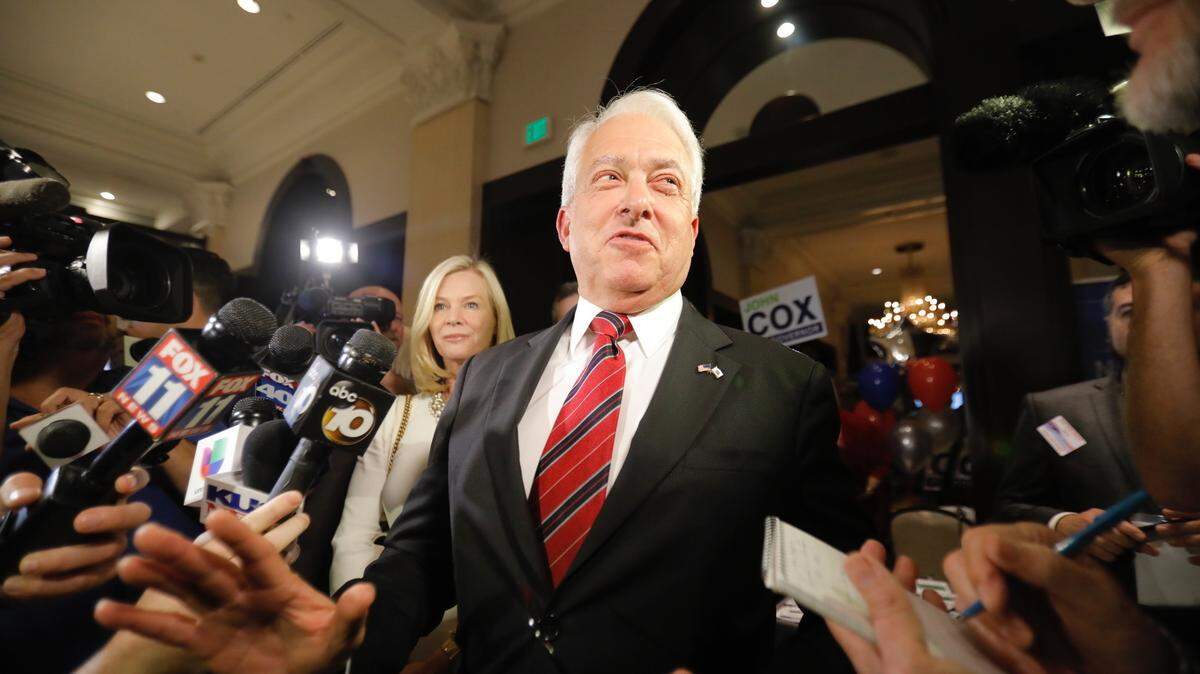
In the end, it wasn’t even close.
John Cox, the venture capitalist and housing developer from San Diego by way of Chicago, was the third Republican candidate to lose – bigly – the California governor’s race to a Democrat in as many elections.
Lt. Gov. Gavin Newsom sailed to victory Tuesday, defeating Cox by more than 1.3 million votes (and counting, since the final official tally won’t be available until next month).
By Wednesday morning, Newsom’s margin of victory looked strikingly similar to Jerry Brown’s curb-stomping defeat of Republican Neel Kashkari in 2014. Cox might have narrowed the gap somewhat, but let’s face it: Doing a little better than the last guy is a small consolation.
Cox deserved to do better. He really did.
Cox was willing to deviate from the standard GOP playbook. He visited precincts Republicans often ignored or feared to tread. And he was (and is) a genuinely public-spirited man who made empowering California’s middle and working classes the centerpiece of his campaign.
Also, he was just weird enough to be interesting.
Prior to his run for governor, Cox might have been best known for a quixotic presidential campaign in 2008. He also promoted a provocative (if sadly neglected) plan to expand the Legislature by thousands of seats to better represent the state’s diverse and varied populace. My personal favorite was his proposed 2016 ballot measure that would have required legislators to wear the logos of their top-10 donors – you know, just like NASCAR drivers. That one fizzled for want of enough signatures.

Alas, Cox had several factors working against him. Newsom outraised and outspent him by a factor of 3 to 1. Money isn’t everything in politics (just ask Beto O’Rourke), but you can’t fight an air war on TV and radio in a state as large as California without tens of millions of dollars. Cox may be rich, but he isn’t Donald Trump-rich.
Speaking of Trump, although the president’s endorsement in the spring likely helped Cox take second place in the June primary, it didn’t do him much good on Tuesday. California truly is the “state of resistance” – a distinction that helped sink Cox’s political aspirations.
But even if that hadn’t been the case – even if California were not ostentatiously and obnoxiously anti-Trump – Cox had to persuade voters that things are a lot worse than they seem. That’s a tough sell in the world’s fifth largest economy.
A great many Californians, it is fair to say, have enjoyed the benefits of life in the Golden State without too many of the burdens.
That’s certainly true if you live within, say, 35 miles of the coast. If you’re in tech or if you’re in certain areas of law or finance or banking or the insurance racket, you’re probably doing pretty well. The same is true if you have a job in the public sector.
For Californians who happen to live and work further inland, it’s a different story. If you’re a suburban renter or homeowner in San Bernardino or Fresno or Stockton, things aren’t quite so nice, are they? You might have noticed crime going up in your neighborhood. Your commute might be getting longer. Your wages may have gone up a little, but your utility and grocery bills have gone up more.
Not surprisingly, Cox performed very well with inland voters. He won almost all of California’s inland and rural counties. Unfortunately, there simply weren’t enough people there to get anywhere close to a majority.
As for Newsom – a politician constitutionally incapable of speaking in anything other than bromides and clichés – he has a mighty large task in front of him. Included among his “big, hairy audacious goals” are “guaranteed health care for all,” solving the homeless crisis with heavily subsidized low-income housing, a “master plan for aging with dignity,” and an “all-hands approach to ending child poverty.”
If you think the “one percent” are going to foot the bill for all of that, dream on. Everyone is going to pay for this progressive pipe dream.
Where does all this leave California Republicans? Nowhere enviable or good. The California GOP has tried and tried and tried and utterly failed to compete on a statewide level for close a decade now. Forty years in the wilderness is beginning to sound about right.
There may be another way, however. Steve Poizner ran for his old job as state insurance commissioner as an independent, but appears to have narrowly lost to Democratic rival Ricardo Lara. Poizner was a Republican not so very long ago. He seems to have realized, as a great many other Californians have, that the GOP in the Golden State is a lead balloon.
Could an independent wage a successful statewide campaign in California? Given Newsom’s grand ambitions – and a host of ever-present “known-unknowns” such as another recession or a natural disaster – we might get to test that proposition in 2022.
This story was originally published November 7, 2018 at 4:00 PM.