
California budget’s ‘inflation relief’ appears designed to inflate politicians’ polls
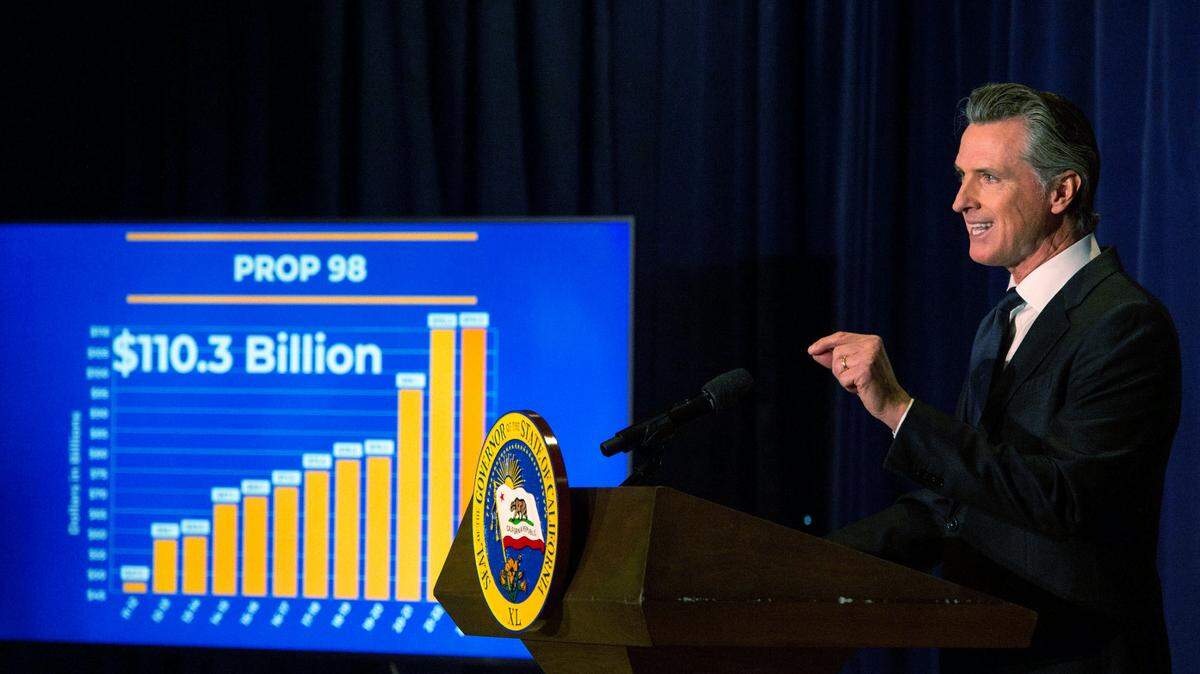
Now that Gov. Gavin Newsom and his fellow Democrats in the Legislature have enacted a state budget resolving their season-long stalemate over inflation relief, Californians struggling to afford gas, food and other prices can take comfort that help is on the way. Can’t they?
Well, yes, but it’s not in any hurry. Following three months of glacially paced deal-making, the result isn’t expected to reach most of the state’s taxpayers for another three months, Assembly Speaker Anthony Rendon estimated. Probably not coincidentally, that suggests voters will get the money about when they get their ballots.
And, yes, some of the eventual beneficiaries are no doubt struggling with the cost of living amid the worst price inflation in 40 years. But others are pulling down as much as half a million dollars a year and therefore probably aren’t struggling in any conventional sense of the word.
All of which makes this look less like urgent inflation relief than calculated vote-purchasing.
The nearly $10 billion agreement struck by Newsom, Rendon and state Senate President Pro Tem Toni Atkins, which broke a stalemate dating to March and blew a legislative deadline by two weeks, promises payments to taxpayers with yearly earnings up to $250,000 individually or $500,000 jointly. The one-time rebates are expected to range from $200 to $1,050 depending on income and the number of individuals in each household.
The best that can be said for the deal is that it’s not as indefensible as what the governor originally proposed. Newsom, a self-styled climate crusader, wanted to send $400 in gas money for each vehicle registered in California, up to two cars per person, regardless of income. Newsom thereby proposed to pay even the wealthiest Californians for burning fossil fuels. Worse, he spent the past three months sticking to this miserable idea to no discernible effect other than to delay the payments until campaign season.
Legislative leaders’ main concession to the governor was to double their already lofty income ceiling from $125,000 to $250,000 a year for individuals and from $250,000 to $500,000 for couples. The legislators’ original proposal was expected to send money to all but the richest 10%; the version the governor signed is expected to cover all but the richest 2.5%.
Newsom had the chutzpah to call this a “middle-class tax rebate.” But if people making half a million dollars a year and lying somewhere north of the 95th percentile of the income spectrum are not upper-class, who is? Then again, the governor wanted to send public money to people making even more.
Atkins and Rendon deserve some credit for insisting that the assistance be loosely correlated with need and tied to humans rather than cars. But to the extent that this unimaginative and wasteful spending spree looks good, it’s mainly by virtue of the contrast with a proposal that was even more dubious.
Much of this money is still going to Californians who are wealthy by every definition and, as a group, did disproportionately well during the pandemic. It would be far better spent on aid for people who genuinely need it, including the low-income non-tax-filers completely excluded from the rebates; assistance with homelessness and housing costs, the greatest strain on the state’s neediest; and infrastructure, which might actually help ease the inflationary pressures the payments are supposedly meant to alleviate.
The governor and legislators have all these billions to play with largely because of the gravity-defying prosperity of the wealthy in a state with the nation’s highest poverty rate. The least they could do is spend the windfall on mitigating California’s grotesque disparities instead of furthering them.
BEHIND THE STORY
MOREWhat are editorials, and who writes them?
Editorials represent the collective opinion of The Sacramento Bee Editorial Board.
They do not reflect the individual opinions of board members or the views of Bee reporters in the news section. Bee reporters do not participate in editorial board deliberations or weigh in on board decisions. The same rules apply to our sister publications, The Modesto Bee, Fresno Bee, Merced Sun-Star and San Luis Obispo Tribune.
In Sacramento, our board includes Bee Executive Editor Colleen McCain Nelson, McClatchy California Opinion Editor Marcos Breton, opinion writers Robin Epley, Tom Philp, LeBron Antonio Hill and op-ed editor Hannah Holzer.
In Fresno and Merced, the board includes Central Valley Executive Editor Don Blount, Senior Editor Christopher Kirkpatrick, Opinion Editor Juan Esparza Loera, and opinion writer Tad Weber.
In Modesto, the board includes Senior Editor Carlos Virgen and in San Luis Obispo, it includes Opinion Editor Stephanie Finucane.
We base our opinions on reporting by our colleagues in the news section, and our own reporting and interviews. Our members attend public meetings, call people and follow-up on story ideas from readers just as news reporters do. Unlike objective reporters, we share our judgments and state clearly what we think should happen based on our knowledge.
Read more by clicking the arrow in the upper right.
Tell us what you think
You may or may not agree with our perspective. We believe disagreement is healthy and necessary for a functioning democracy. If you would like to share your own views on events important to the Sacramento region, you may write a letter to the editor (150 words or less) using this form, or email an op-ed (650-750 words) to opinion@sacbee.com. Due to a high volume of submissions, we are not able to publish everything we receive.
Support The Sacramento Bee
These conversations are important for our community. Keep the conversation going by supporting The Sacramento Bee. Subscribe here.