
PG&E customers are hammered by insanely high rates. Is no one looking out for them? | Opinion
Another big rate increase will hit PG&E customers next year, making California — already the most expensive state in the Union — even less affordable.
So here’s the question: Will double-digit increases continue until utility bills of $300, $400, even $500 a month are the norm for average households? (That’s not counting water and sewer bills.)
That can’t happen. It will push more families into poverty and will make it even tougher for households to switch from natural gas to cleaner electric appliances, since that will mean even higher energy bills.
Yet the California Public Utilities Commission — which consists of five members appointed by the governor — continues to acquiesce to the utilities.
As recently as Nov. 16, the commission unanimously approved a 13% rate increase for PG&E gas and electric customers, which will add $32.50 to the average bill. Lower-income households that quality for the utility’s CARE program will pay around $21 more per month.
Non-CARE, electric-only customers will see their bill increase by an average of $22.20.
The PUC tried to placate an angry public by pointing out that PG&E’s original request for $15.4 billion in revenue was cut by $1.8 billion — which the PUC described as a “substantial” savings.
We doubt that ratepayers will consider that a “substantial” cut, not when they will be paying nearly $400 a year more for natural gas and electricity in 2024 and again in 2025, followed by a slight decrease in 2026.
What’s in it for ratepayers?
PG&E tried to sell the increase by focusing on the safety measures it would fund, particularly for undergrounding power lines in areas of high fire danger. PG&E wanted to bury 2,100 miles of line over the next few years, and eventually as many as 10,000 miles.
It’s hard to argue against protection that could avoid future disasters like the Camp Fire that destroyed the town of Paradise and killed 85 people, or the Dixie fire that burned almost 100,000 acres in Northern California, caused massive evacuations and injured six firefighters. PG&E was found responsible for both fires.
But undergrounding is expensive. According to estimates from California utilities, it can run anywhere from $1.85 million to $6.072 million per mile. Ratepayer advocates argued that there is another way to reliably reduce wildfire risk posed by power lines. Insulating them with fire-protective coating, referred to as hardening, is not only less expensive — it’s around $800,000 per mile — but could also be completed much more quickly.
They urged the PUC to support more hardening and far less undergrounding, yet commissioners ultimately sided mostly with PG&E and allowed the burial of 1,230 miles of lines. That was still a win for PG&E and its shareholders, since utilities earn a guaranteed rate of return on capital investments — at ratepayers’ expense.
Credit worries
In lobbying the PUC, PG&E didn’t just emphasize safety enhancements — it also raised the issue of its poor credit rating.
“As a result of low credit ratings, PG&E’s cost of borrowing is currently about 100 basis points (1%) higher than utility peers,” it noted in a PowerPoint presentation submitted to the PUC. “Due to PG&E’s lower credit rating, for each $5 billion of debt issued, customers will pay an additional approximately $1 billion in nominal interest over the life of the debt.”
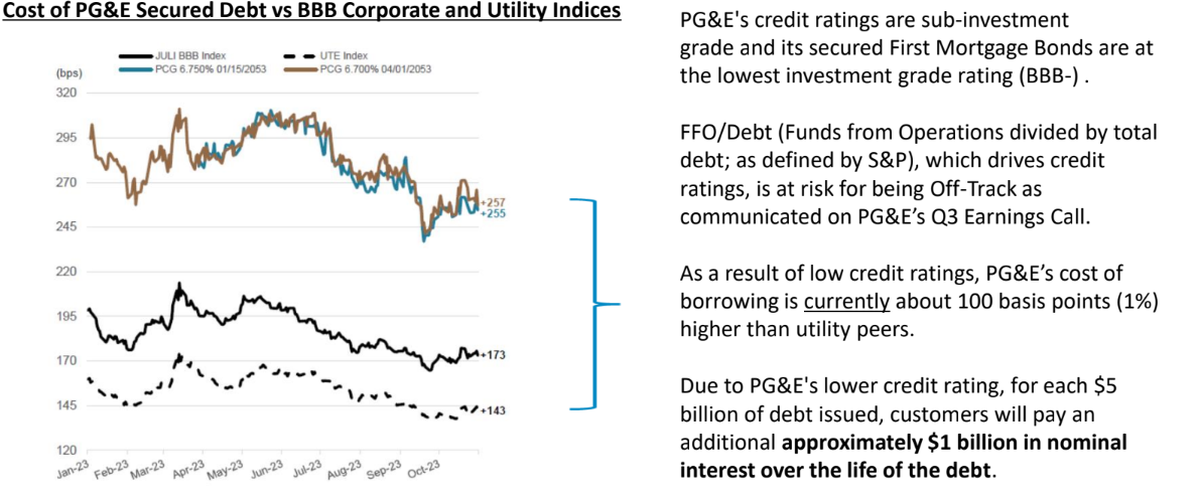
Ratepayers are not responsible for PG&E’s bad credit rating.
Sticking them with the bill for enormously costly projects that boost company revenue — thereby making PG&E more attractive to Wall Street — feels like yet another example of price gouging, especially when you consider the company’s track record of negligence and overspending.
Take a look at this 10-year audit of PG&E’s early undergrounding projects: The report, released in 2019, found that “PG&E did not perform any benchmarking studies from 2007 to present and PG&E did not provide any explanation as to why its costs were higher than nation-wide average undergrounding costs.”
In the latest rate case, a less ambitious undergrounding goal would have given PG&E an opportunity to prove that it can handle the project efficiently and cost-effectively, along with easing the burden on ratepayers.
‘It is not sustainable’
Looking ahead, the PUC must rein in PG&E.
Let the company find ways to cut costs — including eliminating bonuses for company executives and reducing shareholder dividends — instead of overburdening ratepayers.
TURN, The Utility Reform Network, suggests putting a cap on rate increases; tie them to the rise in the consumer price index, for example.
“It is not sustainable to have the sky be the limit,” TURN Executive Director Mark Toney said.
We appreciate the tough job the PUC faces. It must weigh the need to protect public safety and the environment against the oftentimes competing goal of keeping rates as affordable as possible.
But what’s happening now is indeed unsustainable. The average household bill for gas and electricity increased from $154.52 in 2016 to $241.03 in 2023, according to the San Francisco Chronicle.
Come January, it will jump again, to approximately $273 per month..
The California Public Utilities Commission must find a better balance between the reasonable demands of ratepayers and the outsized ambitions of an investor-owned utility beholden to its shareholders.
This story was originally published November 26, 2023 at 5:00 AM with the headline "PG&E customers are hammered by insanely high rates. Is no one looking out for them? | Opinion."