
Can Black people thrive in California? Education, prison disparities show legacy of racism
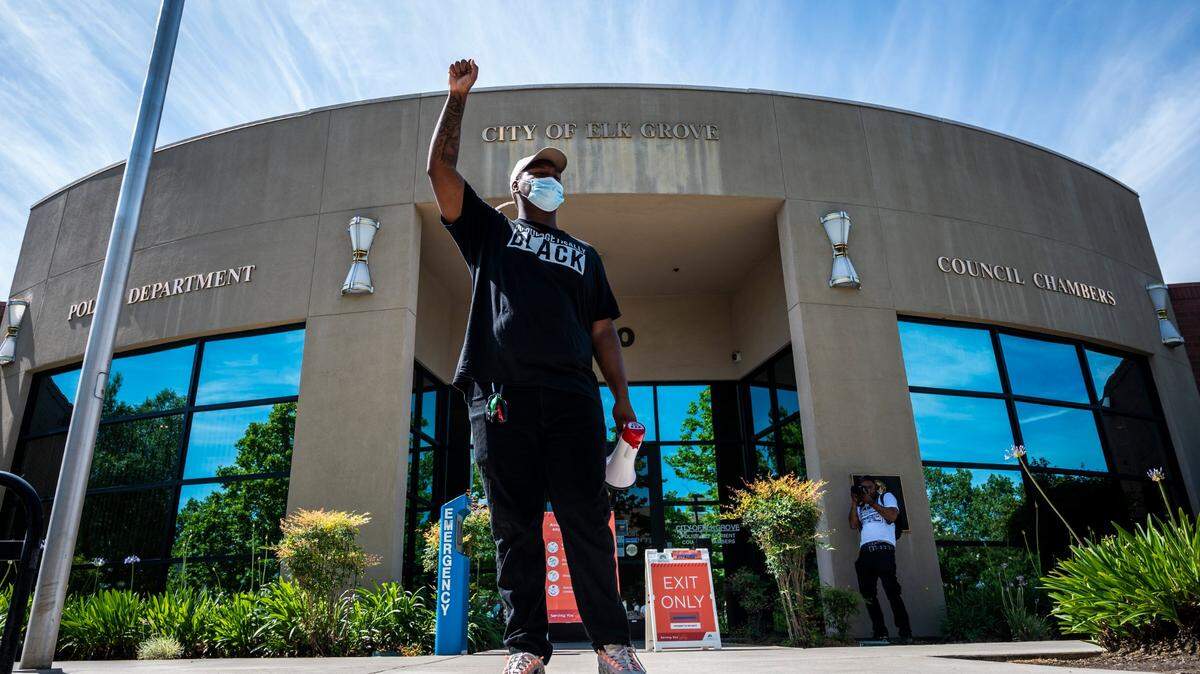
Is it legal for Black people to thrive in California? The immediate answer may rely more on hope than on the realities of anti-Black history and the enduring politics and policies that continue to harm Black people.
California was not a slave state, though possessing slaves was legal. Nor was it a member of the slave-holding Confederate States of America. Still, Confederate war veterans were welcome to the state, and communities honored the names of its generals on buildings and other public monuments. The legislature refused to ratify both the 14th amendment in 1868 (which guaranteed equal treatment) and the 1870 15th amendment (which extended voting rights to men without regard to race) — until 1959 and 1962, respectively.
As California became the Golden State after World War II, it simultaneously marginalized Black people. Established cities and new suburbs created ghettos or excluded Black people altogether through racist housing practices. One of the more notorious examples concerned the ocean front property of Willa and Charles Bruce and other Black residents in Manhattan Beach. The city council brazenly seized their property for a public park. What racist harassment by the local Klan could not achieve, eminent domain secured in 1924.
A far more common practice to keep residential communities white until the passage of federal fair housing legislation in 1968 was the denial of financial services for home ownership and the use of covenants that prohibited selling or transmitting property to Black people. The effects of these racist practices linger today in the persistent wealth gap and in the language of property deeds.
The state served as a proving ground for the Republican Party’s southern strategy. Applied by former California U.S. Senator Richard Nixon in his successful presidential bid in 1968, the southern strategy drew on racist stereotypes of Black people as unfit citizens.
In campaigns for higher office, Governors Ronald Reagan and Pete Wilson perfected dog-whistle politics. In the 1980s, Reagan deployed the figure of the “welfare queen” not just to stigmatize poor Black people but also to blame them for using the very social safety net that white people used. The backlash against affirmative action had become a signature wedge issue by the 1990s.
Against the background of a recession, Wilson used the coded language of “fairness” to justify white resentment as he advocated for a referendum to prohibit any consideration of race, gender and national origins in state hiring or admissions to post-secondary educational institutions. At a time when admissions to flagship campuses in the University of California became more competitive, this appeal to fairness made it easier to shift blame to the failure of the public education system, the flaws of Black communities and a winner-take-all mentality.
White and non-Black minority voters passed proposition 209 in 1996. Public opinion has not changed much since then. Even in the wake of the national reckoning on systemic racism in the spring and summer of 2020, voters refused to repeal Proposition 209 when given the opportunity on the fall ballot.
The harm caused by so-called race-neutral policies to the state’s Black communities over the past quarter-century is clear and can be best represented in two metrics: their participation in the UC system and the California prison system. Even as the share of the statewide Black population has declined to 6%, they remain under-represented in the UC system and over-represented in the prison system. Before the passage of Proposition 209, their share of undergraduate enrollments was 5% — 25 years later, it is 4%. The second metric is the inmate population in the California corrections system, arguably one of the largest in the world. As of 2018 data, nearly 30% of all inmates are Black.
These trends capture the meaning of structural racism in a state that is often imagined as a destination where anyone can thrive. One minimizes access to a proven elevator of social mobility while the other hollows out lives and whole communities.
Another measure of the state’s priorities is the growth of the prison system and the university. The state opened 21 new prisons between 1984 and 2005, but only one new UC campus at Merced in 2005.
Is it legal for Black people to thrive in California? Answering in the affirmative poses another set of questions. Are we overlooking the realities of anti-Black history, politics and policies in the state or are we actually working to create a California where Black people thrive?
This story was originally published June 13, 2021 at 6:00 AM.