
Stop forcing California students to learn algebra and other math they don’t need
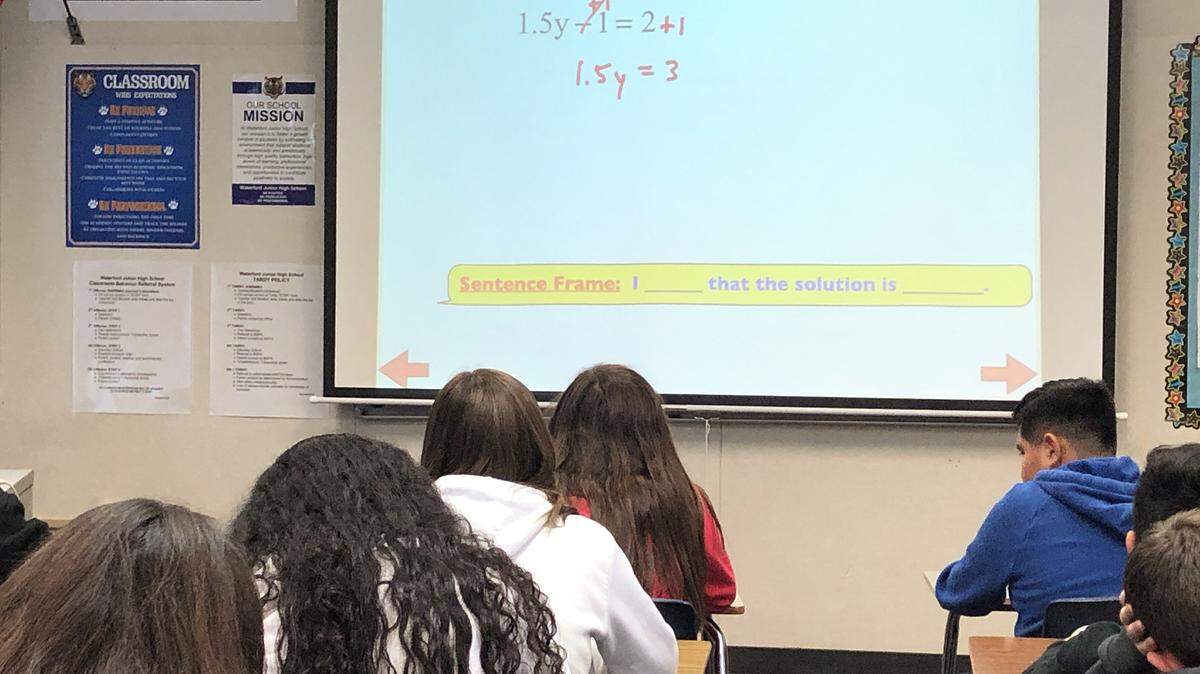
The California Department of Education controversially proposes that all students take the same math courses through 10th grade. Critics lament barring high-achieving students from progressing rapidly. However, the pace at which students advance is not the only consideration.
Algebra is a gatekeeper to high school graduation, even though different individuals need different mathematical skills. Instead, students should have the option to replace algebra, trigonometry and precalculus with more relevant courses.
What would some relevant courses be? Working with numerical data in spreadsheets is necessary in many jobs. Geometry is useful for carpenters, interior designers and other skilled workers. Self-employed workers, whether styling hair or consulting for corporations, need basic accounting skills. And self-sufficient adults should understand compound interest and its implications for mortgages and retirement.
Understanding statistics is indispensable for informed citizenship. News reports regularly begin “According to a recent study…,” and people should know what key questions to ask. If researchers announce that a vaccine reduces disease fatality by a certain percentage, could outliers in a particular age group skew results? If researchers report that the SAT does not predict college performance, does that finding arise from not sampling a broad swath of students? A course combining statistics, formal logic (a subject intertwined with mathematics) and civics would be invaluable preparation for evaluating arguments.
There’s certainly a role for classes emphasizing algebra and building toward calculus. That role is preparing students who want to study highly quantitative fields in college.
De-emphasizing algebra in other tracks doesn’t mean denying opportunities to attempt algebra-heavy tracks. After all, you don’t know what path you belong on until you’ve tried it. Everyone should attempt algebra, get a taste of calculating with symbols and gauge their comfort with such work before choosing a path. Some should persist in classes heavy on algebra, while others should focus on math skills more relevant to daily life.
There is, alas, a cost to steering students away from advanced algebra and toward spreadsheets, but it isn’t measured in dollars. Financial literacy courses are hardly more resource-intensive than precalculus. Rather, the cost is a forsaken ideal.
STEM (science, technology, engineering and math) is the educational buzzword of the moment. Many people believe more students should study math-intensive fields in college. However, evidence that we need more STEM graduates is mixed or worse.
Putting students on different tracks in high school means admitting that not everyone will — or should — do the same things. Academic tracking is common in Europe; surely individualistic Americans can likewise accept varied educational pathways suiting individuals’ particular strengths and interests.
Not pursuing advanced technical careers need not doom people to ignorance of society’s technological foundations. Students can and should learn basic concepts of cryptography, epidemiological models and other essentials of modern society. The underlying principles should be made transparent so that informed citizens can balance trust with caution.
The history of mathematics should likewise command attention. Geometry and arithmetic developed in tandem with agriculture and urban civilization, facilitating land allocation, architecture, taxation and commerce. The digital logic underlying computers started in philosophy. Applications of math are fundamental to human history and should be taught as such.
We must embrace broad and varied notions of mathematical literacy. Students should enjoy opportunities to sample different approaches to mathematics and choose paths suiting their goals. Whether they go on to develop the symbol manipulation skills needed for advanced science and engineering careers or focus on calculations in daily living, they should take classes appropriate to their needs and interests.
People don’t all follow the same path in life, and we need not follow identical paths in math either.