
New statue at Capitol Park replaces painful reminder for California Native Americans | Opinion
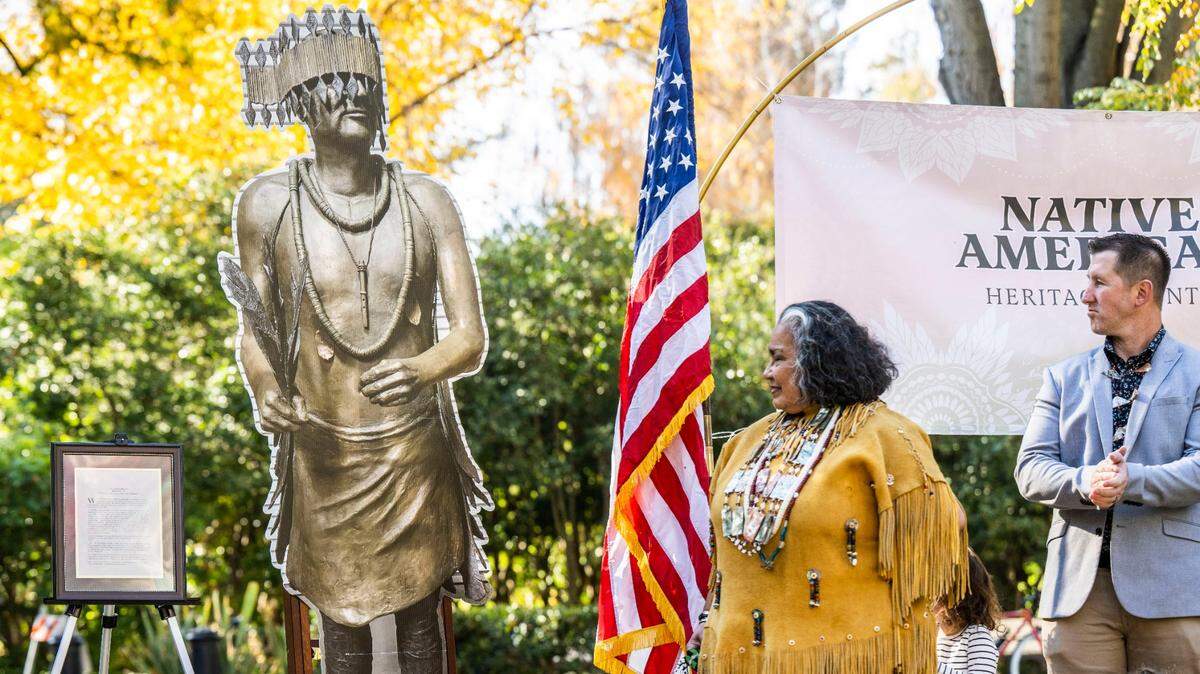
Today, Sacramento’s Capitol Park will add a new historic monument to those now honoring California’s fallen heroes, including veterans, firefighters and peace officers. The new monument will honor local Northern California tribes on whose lands the Capitol now resides. They were heroes who lost much but proved their courage and resiliency many times over.
The statue will rest where a painful reminder to California Native Americans once stood: a statue of Junipero Serra, the founder of the state’s Spanish mission system. Serra’s monument was toppled in July of 2020 during the civil rights protests of that year. California’s Native American population plummeted during and after Serra’s time from approximately 310,000 to 100,000, according to the National Park Service. Despite the wanton killing, enslavement and other brutal treatment, Native Americans survived.
A bronze replica of a skirt dancer modeled after a Native American who fought fiercely to protect his culture, tribal sovereignty and civil rights will face the Capitol in testament to the First People, guardians and stewards of the land for millennia. At long last, Native Americans will see visible acknowledgment of their rightful presence in the state that once set militias against them.
In November of 2018, I became the first California Native American elected to the Legislature since statehood, which dates back to Sept. 9, 1850. After my election, I walked into a building that held more reminders of what Native Americans had endured: a statue of Christopher Columbus, who proceeded Serra, and whose explorations unleashed death and disease on the Americas. That sculpture was also removed in 2020.
Still hanging is a portrait of Peter Burnett, California’s first governor, who declared in his 1851 State of the State address “that a war of extermination will continue to be waged between the races until the Indian race becomes extinct must be expected.” He then proceeded to secure legislative funding to finance that extermination. Historian Benjamin Madley called it genocide, and estimates that at least 6,460 California Indians wee killed in California between 1846 and 1873, and that the U.S. army killed at least another 1,600 native Californians.
Murals celebrating settlers and gold miners also adorn the Capitol and the legislature’s hearing rooms. That period of California history, like the mission period, almost succeeded in fulfilling Burnett’s demand for extermination.
California’s shameful treatment of the First People was rarely if ever discussed. Now, this past is acknowledged through bills I authored — such as the new park monument, or a just-approved legislative hearing room mural depicting Native American contributions. We also changed the name of a San Francisco law school that bore the name of Serranus Hastings, the state’s first Supreme Court justice who employed militias to kill Native Americans in the 1860s to take their land.
The trauma of genocide and atrocities is a bone-deep, soul-deep pain that cannot be erased, but does fuel resolve and strength.
Native Americans are acting to resolve issues affecting California’s Indian Country, such as the crisis of Missing and Murdered Indigenous People (MMIP). In May, during MMIP week, for the first time ever, Native Americans held a candlelight vigil with more than 800 people on the Capitol’s West Steps. The dome was lit red to commemorate these victims of violence.
In February, California tribes held their first Capitol Day of Action to lobby for measures like the Feather Alert, a resource available to law enforcement agencies investigating the suspicious or unexplainable disappearance of an indigenous woman or indigenous person. I was proud to carry the enabling legislation on their behalf. And we continue to seek the return of Native American remains and artifacts wrongfully held for almost 30 years by state institutions.
Five years after walking into the Capitol as a legislator, I see evidence that California is writing a new chapter of healing and trust with its First People. Our state’s tribal communities are expressing their concerns, and telling the story of their diversity, history and accomplishments.
As we commemorate Native American Heritage Month in November, let’s celebrate Native contributions and a stronger, more visible activism by California’s tribal communities.