Fifty years after Saigon fell, Vietnam prospers while the US is still at war | Opinion
By Hai-Ho TranSpecial to The Bee
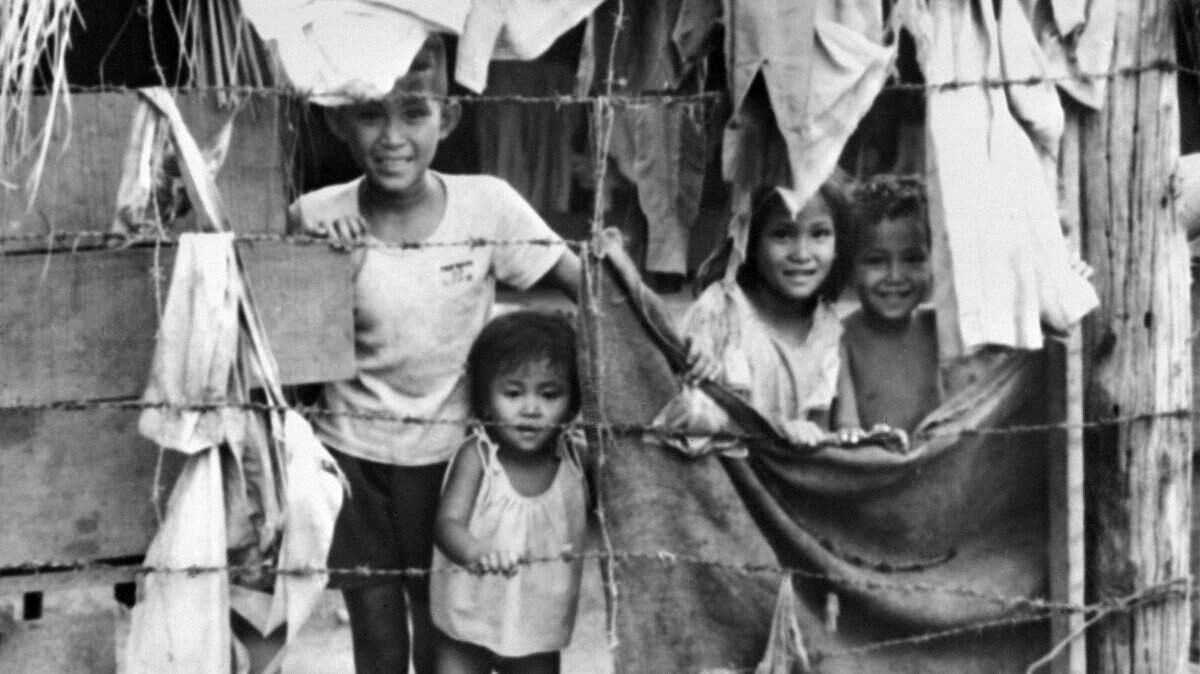
Kmer and Vietnamese refugee children stand behind barbed wires in April 1976 in Thailand. Refugees camps started in 1975 with those fleeing the Khmer Rouge, followed in 1979 by those fleeing starvation and the advancing Vietnamese army, followed by those affected by the 1984/85 Vietnamese offensive along the Thai border.
AFP
TNS
On the 50th anniversary of the end of the Vietnam War on April 30 — what people in Vietnam have long known as the American War — I find myself reflecting not just on history, but on the quiet, often unspoken stories that we carry with us.
It’s been five decades since the fall of Saigon, and yet the scars of that conflict remain deeply etched into the hearts and minds of Vietnamese people, both those who remained in the homeland and those scattered across the diaspora.
With my mother growing older, I recently felt an urgency to ask her about her experiences during the war — chapters of her life she had never spoken about. She hesitated, as if words could not contain the complexity of her memory. I couldn’t quite tell whether it was pain or shame that kept her quiet, but I understood.
In Vietnamese families, trauma often resides in silence, tucked in the margins of daily life.
My mother had once been a teacher, but she later worked as a radio operator, relaying battlefield updates in Vietnamese and translating them for American and South Vietnamese forces. Her job placed her at the heart of the conflict, yet she bore it silently, never once casting herself as a witness to history. Many from that generation, on all sides of the war, have carried their grief and trauma quietly, as if to shield the next generation from its weight.
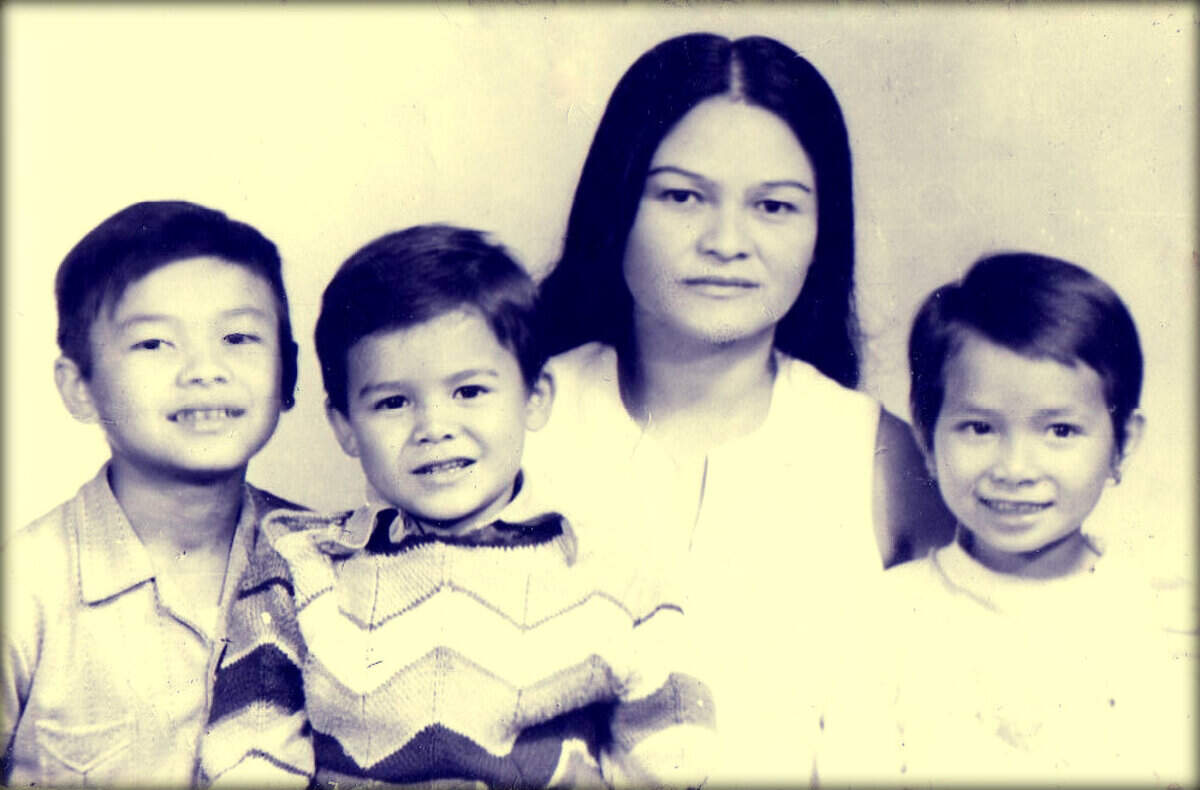
Hai-Ho Tran, left, with his family in Vietnam in 1979 Hai-Ho Tran
Vietnam, torn apart
The war didn’t just divide Vietnam, it tore it apart.
First came the physical split, along the 17th parallel established by the Geneva Accords in 1954. Then came an emotional schism that remains to this day. That demarcation line has long since disappeared from maps, but its legacy lives on in the hearts of Vietnamese people. The divide between those who supported the North and those loyal to the South is still painfully real, particularly among overseas communities.
Strangely and unexpectedly, I’ve been spared the burden of that division, as members of my family fought on both sides. It allowed me to hold empathy above ideology. The war was not a contest between good and evil, but a human tragedy rooted in complexity.
After the Geneva Accords were signed, the artificial line separating North and South became a fault line for millions. My father was a captain in the South Vietnamese Army. My uncle was among the approximately 90,000 Vietnamese who moved from South to North (mostly Viet Minh fighters, political cadres and communist sympathizers who had battled the French during the First Indochina War). Their relocation was part of a political bargain, a temporary arrangement until nationwide elections could be held in 1956 — elections that, as history shows, never came to pass.
This part of the story is often overlooked both in Western accounts and even within Vietnam itself: Many of those 90,000 who had gone North later returned to the South, often in secret, to form the nucleus of the Viet Cong, or the National Liberation Front. These returnees were seasoned, ideologically driven and intimately familiar with the terrain and people of the South. Their role was pivotal in the early stages of the insurgency against the South Vietnamese government and the growing U.S. military presence.
At the same time, around 800,000 to 1 million people — mostly Catholics and anti-communists — fled in the opposite direction, from North to South, fearing political and religious persecution. Though far fewer moved North, their influence on the war’s trajectory was outsized and enduring.
Trauma followed bloodshed
My uncle, who studied agriculture at Hanoi University, eventually became a senior figure in the postwar Ministry of Agriculture in the unified Vietnam. Fluent in English, French and Russian, he was a scholar and a patriot. When my younger siblings wrote to him in English from abroad, he’d reply to their letters with English grammar corrections — each sentence a small lesson.
He traveled the world to learn agricultural techniques and brought them home to improve Vietnam’s crop yields and farming methods. I like to think that part of Vietnam’s agricultural success today is because of people like him. But he was also honest about his disillusionment. The corruption he witnessed — deep, systemic and corrosive — darkened his idealism.
After Saigon fell
The North suffered catastrophic losses, with over a million soldiers dead. But among the South Vietnamese, especially those who fled the country, the wounds were psychological, emotional and enduring. Many of us left on boats, risking pirates and drowning in search of freedom, only to carry the weight of exile and memory for the rest of our lives. Even today, an offhand political comment or disagreement can reawaken those buried wounds, proof that time alone can never fully heal them.
They say war doesn’t end when the shooting stops. I know that to be true. I was just six years old, living in Lang Hanh, a small town about 30 minutes south of Đà Lạt, when the Northern forces drew close. I remember the chaos. I remember chasing a soccer ball into the street on what might have been April 28, only to be struck by a couple fleeing on a motorbike. They didn’t stop. In war, the rules of compassion disappear. Someone pressed raw tobacco onto the wound on my eyebrow to stop the bleeding.
Just a mile from our home, a South Vietnamese and U.S. military post stood on a hill. As the war drew to its close, I heard the dull, rhythmic booms of weapons being destroyed — rendered useless rather than left for the enemy. But the memory that never leaves me is of a childhood friend who died after stepping on an unexploded ordnance. I remember them carrying his lifeless body home, torn open by a war that had supposedly ended.
Those moments shaped me — not just as a refugee, but as someone committed to opposing war in all its forms.
Lasting divisions
When I left Vietnam in 1985, after 10 years under a communist regime, I could never have imagined that the country would one day emerge as one of Asia’s fastest-growing economies. And yet, even amid this progress, I believe Vietnam could be so much more. A nation cannot reach its full potential until talent and integrity — not connections or bribery — determine who rises to leadership.
Still, I remain hopeful. A younger, often foreign-educated generation is stepping forward. As living standards improve, people will begin to think beyond survival and demand a society that honors fairness, free speech and open expression.
With time and distance, I’ve come to view the Vietnam War not just as a tragedy for my homeland, but as a cautionary tale about power, division and empire. Colonial empires of the past — namely Britain and France — used troops to enforce control. The American empire, more subtle in some ways, learned to sow division: to pit communities, ideologies and ethnic groups against one another. These divisions often linger long after the wars are over.
America, still at war
When I came to America, I believed in its promise of justice, liberty and human rights. I believed this was a nation that stood up for the voiceless. But over time, I have watched that belief unravel. Since Vietnam, the United States has remained at war, in one form or another, from Afghanistan to Iraq, Libya, Syria, Yemen and beyond. The instruments of warfare have changed, but the appetite for conflict endures.
Now, with heartbreak and disbelief, I watch the U.S. support what much of the world sees as a genocide unfolding in Gaza. I fled a war fueled by foreign powers, only to become a citizen of one that continues to wage war under the guise of diplomacy, security and self-interest. My disillusionment is not only personal, it is deeply moral.
This is not the America I believed in. But maybe it never was.
On the anniversary of April 30, I find myself thinking of the stories my mother never told, the memories I wish I didn’t carry and the ideals I once thought I understood. I honor lives lost on both sides of that war, and the millions more lost in the wars that followed. And I hope, perhaps naïvely, that by remembering honestly, speaking out and refusing to turn away in the face of injustice, we might finally begin to end the cycle of violence.
Wars don’t end when the bombs stop falling. They end when we choose not to repeat them.
Hai-Ho Tran, a former engineer turned financial guardian, grew up in Santa Cruz and now resides in Fremont, where he helps clients secure their financial futures.
This story was originally published April 30, 2025 at 6:00 AM.