
A message to Trump protesters in California: Put down the Mexican flags | Opinion
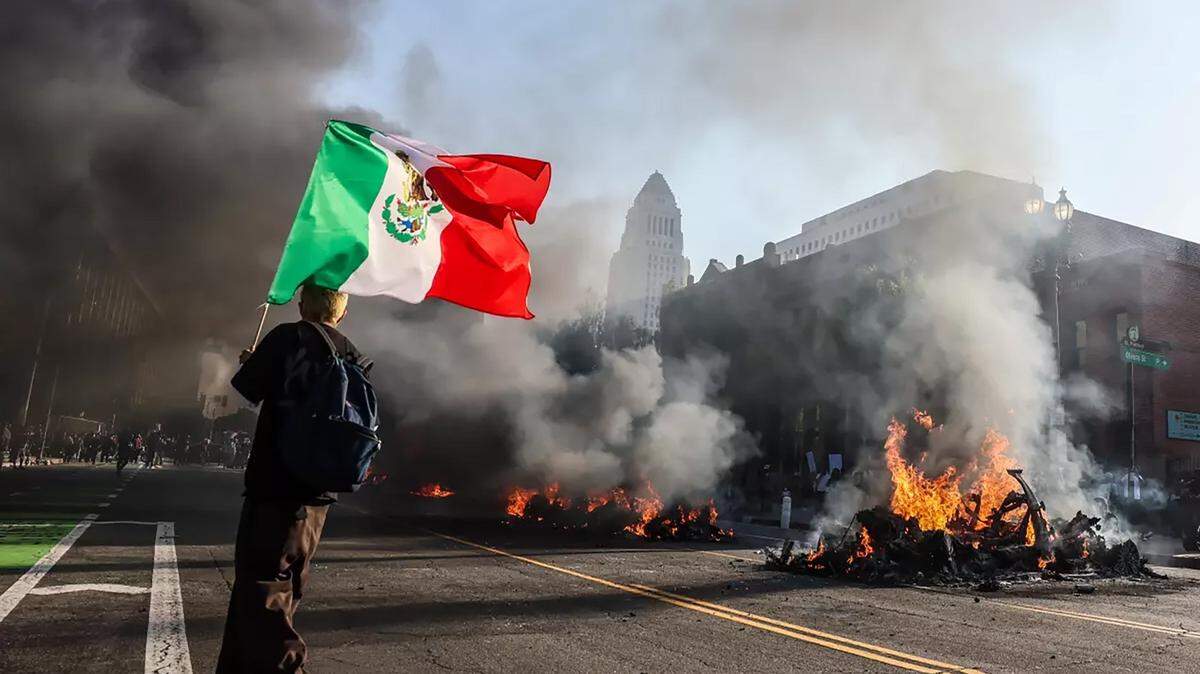
As thousands of demonstrators take to the streets of Los Angeles protesting immigration enforcement operations, images of Mexican flags waving alongside burning cars and clashes with federal agents are once again dominating news coverage.
While the passion and commitment of these protesters are undeniable, they are making a critical strategic error that could undermine their cause and harm the very communities they seek to protect. They are ignoring an important lesson from history on how prominently displaying this flag can backfire with the broader public.
More than 30 years ago, Californians were facing intense economic insecurity as the state was crawling out of a recession amid a dramatic influx of immigrants, trends eerily similar to today. It led to a public backlash against immigration led by then-Gov. Pete Wilson.
The political centerpiece of the movement in 1994 was Proposition 187. The measure called for denying public services to undocumented immigrants.
Latino students and activists organized massive protests across the state. Like today’s demonstrations, these protests featured prominent displays of Mexican flags. One demonstration at Los Angeles City Hall drew an estimated 70,000 protesters, one of the largest protests in city history.
But it only served to inflame a distressed public. Proposition 187 passed decisively with 59% of the vote. Post-election analysis revealed that the Mexican flag imagery had become a powerful weapon in the hands of the measure’s supporters.
Harold Ezell, the former Immigration and Naturalization Service Director who helped author Prop. 187, later declared that the “biggest mistake the opposition made was waving those green and white flags with the snake on it. They should have been waving the American flag.”
Technically, opponents of the measure eventually would win. Courts ruled that Prop. 187 was unconstitutional. But the political damage for supporters of immigrants would extend far beyond that single election.
Prop. 187’s passage, aided by the visual narrative of foreign flags at protests, helped transform California politics for a generation—but not necessarily in the way protesters intended. While an entirely new generation of Latino political activism was stirred by the heated passion of that campaign, so too was an anti-immigrant fervor that consumed California politics for a generation.
Rather than just building sympathy for immigrants and a show of ethnic solidarity when the community was under attack, the imagery reinforced opponents’ framing of immigration as a question of national loyalty rather than human and constitutional rights.
Today, protesters in Los Angeles risk repeating this strategic blunder.
The Mexican flag being waved amid destruction, violent interaction with law enforcement, and burning vehicles allows opponents to shift the narrative away from legitimate concerns about immigration enforcement tactics and toward questions of patriotism, lawlessness, and national identity.
It transforms what should be a debate about American constitutional rights and due process into a conversation about foreign loyalty and cultural assimilation. It highlights division and, at least optically, prioritizes foreign loyalty over American loyalty.
This messaging problem is particularly acute given how Latino political attitudes have evolved since 1994.
Research shows that today’s Latino voters, especially younger generations, are increasingly assimilated and respond differently to ethnic appeals than their predecessors. Millennial and Generation Z Latinos are more motivated by intersectional movements that promote equality for all Americans rather than country-of-origin symbolism.
For these assimilated voters, substantive policy discussions prove more influential than ethnic appeals tied to ancestral homelands. Pew Research Center shows that more than half of all Hispanics view themselves as “typical Americans.” That number grows to 80 percent in younger Latinos.
The Mexican flag imagery also alienates more than just Latinos. It also turns off potential allies who should be natural coalition partners. The 1994 protests should have included not just Latinos but also far more whites, Asian Americans, and African Americans who opposed Prop. 187 on civil rights grounds.
In the end, Prop. 187 lost only among Latinos but was supported by white, Black, and Asian voters due, at least in some part, to the ethnic polarization Latino activists were imparting to rally their communities. Similarly, today’s immigration enforcement concerns affect diverse communities across Los Angeles.
But when protests are visually dominated by Mexican flags, these broader coalitions understandably feel excluded from what should be an American civil rights movement. Perhaps most damaging, the flag imagery provides opponents with exactly the ammunition they need to dismiss legitimate grievances.
This is how immigration activists lose the message to Donald Trump.
Using the flag of a foreign nation undermines the moral high ground of this position. Moreover, it cedes the American flag to the rising extremism we’re witnessing on the American right.
Latinos are Americans concerned about American issues like economic opportunity, public safety, and constitutional rights.
Treating them as a monolithic bloc defined by ancestral nationality not only misreads their political priorities but also reinforces stereotypes that opponents can exploit.
Put away the Mexican flags.
Embrace American symbols and American values. Frame the debate in terms of constitutional rights and due process rather than ethnic identity. The stakes are too high, and the lessons of history too clear, to repeat the strategic errors that helped doom the fight against Prop. 187. American protesters fighting for American rights should carry American flags.