
Civil liberty threats under Trump echo Japanese American internment | Opinion
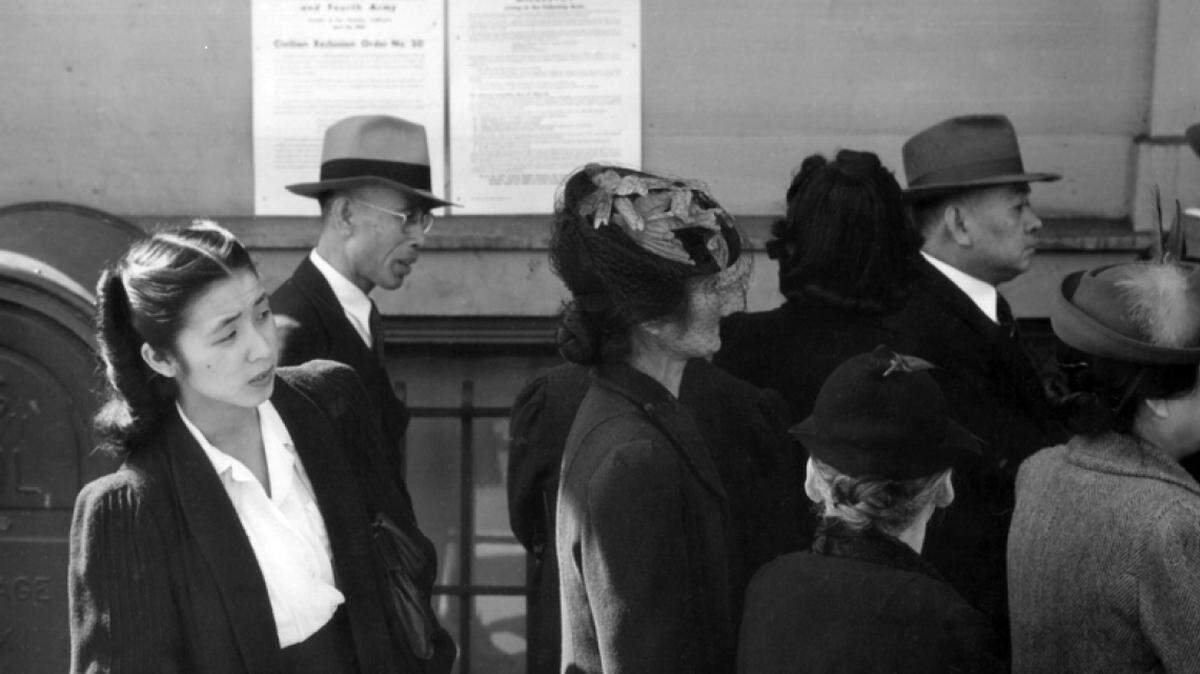
In mid-August, I went to the National Archives with a colleague from UC Berkeley, along with several researchers, to research Japanese American incarceration. The timing of our trip proved more eventful than anticipated: In the middle of our research, our phones buzzed with notifications announcing that President Donald Trump would send the National Guard to D.C.
Midway through our trip, one of our researchers, a woman of color, was interrogated by a federal agent about her citizenship status while waiting for the bus to the Archives.
The ongoing presence of U.S. Immigration and Customs Enforcement and the National Guard has shaken residents, as neighbors are abducted and businesses grind to a halt after losing their employees. As a historian, I have spent a decade researching U.S. civil rights history, having written extensively on chapters such as the incarceration of Japanese Americans in 1942.
As I spent that week in D.C. reviewing government records, I reflected on the parallels between the past and present. Today, the same failures to protect the rights of Japanese Americans and safeguard American civil liberties, such as the acceptance of racial profiling as government policy, are happening again under the Trump Administration.
One of the major factors why the incarceration was an injustice was that the mass detention of 120,000 Japanese Americans, many of whom were U.S. citizens, was based purely on the grounds of their race.
When Supreme Court Justice Robert Jackson dissented in Korematsu vs. U.S., the 1944 case that infamously upheld the incarceration as a legitimate policy, he argued that his fellow justices created “a loaded weapon” for further discrimination.
Today, we are seeing this “loaded weapon” of racial discrimination reused as a tool for the current deportation scheme. As Justice Sonia Sotomayor stated in her dissent in: “The Fourth Amendment protects every individual’s constitutional right to be ‘free from arbitrary interference by law officers.’ After today, that may no longer be true for those who happen to look a certain way, speak a certain way and appear to work a certain type of legitimate job that pays very little.”
The ruling in Noem v. Vasquez Perdomo, which legal experts have criticized as permitting racial profiling by ICE agents, erodes the rights of all Americans regardless of citizenship status. Already, there are several documented cases of U.S. citizens who have been racially profiled and rounded up by ICE.
The misuse of laws by the Trump administration, notably the Alien Enemies Act of 1798, has — as several judges have already ruled — created a constitutional crisis. The criteria of invasion described by the Adams Administration, which drafted the law to arrest French citizens in the event of a war with Napoleonic France, explicitly details invasion by “any foreign nation or government.”
When President Franklin Roosevelt invoked the Alien Enemies Act in 1941, it granted the Federal Bureau of Investigation the power to arrest enemy aliens. While federal agents detained some Germans and Italian nationals, the large number of Japanese nationals arrested was cited by politicians as evidence of disloyalty among the community.
Japanese immigrants — ineligible for citizenship because of the laws at the time — and their native-born children were portrayed as enemies by West Coast politicians despite no evidence of disloyalty. As such, historians have argued that the Alien Enemies Act paved the road to Executive Order 9066.
Immigration does not constitute an invasion. Labelling it as one not only distracts from the failures of Congress to implement just immigration reform, but also returns us to the racist rhetoric used by xenophobes of the past to describe immigrants of color, such as Chinese, Japanese and Mexican Americans. The final decisions of federal judges over the use of the act by this administration will have lasting consequences on immigration policy.
As Los Angeles Times columnist Gustavo Arellano rightfully pointed out last week, the Trump administration is hosting “a cruelty Olympics” through its use of inhumane tactics. “The difference now,” Arellano soberingly tells us, “is that cruelty seems like an absolute mandate. So forgive those of us who aren’t throwing roses at ICE when they march into our neighborhoods and haul off our loved ones.”
The ongoing deployment of troops to American cities, often under the guise of supporting ICE operations, threatens to politicize the military. When the National Guard was mobilized by the president, such as during the LA Riots in 1992, it was done with the consent of the governor when state law enforcement could not restore peace.
Today, the deployment of National Guard troops to cities like D.C., Portland and Chicago is done to attack Democratic political leaders. Already, a federal judge ruled Trump’s deployment of National Guard troops to Los Angeles unconstitutional for violating the Posse Comitatus Act. And while Trump cancelled deploying troops to San Francisco, the Bay Area is still a target of ICE raids.
The Supreme Court’s ruling on the deployments — which are slated to appear this term — will determine the future of the United States. Immigration, while already a divisive issue in American politics, has become a cudgel against the rights of American citizens and a justification for Trump’s abuse of power.
When I lived in D.C. on and off from 2017 to 2021, the city was a bustling metropolis with many vibrant communities. Seeing the occupation of the Capitol City by federal agents and soldiers has done more to antagonize its inhabitants than to protect them. What starts in D.C. may happen elsewhere.
Jonathan van Harmelen, Ph.D, is a historian currently teaching US history at Oberlin College. He writes about California history and is a columnist for the Japanese American National Museum’s blog Discover Nikkei.