
How Davis helped redefine how American cities think about cycling | Opinion
The small university town of Davis helped redefine how American cities think about cycling. When city crews painted the nation’s first modern bike lane on Third Street in 1967, they created more than a new road feature — they offered a model for safer, more livable streets that would spread across California and into national design manuals.
But cycling was common in Davis long before the 1960s: Newspaper archives from the 1940s reference bicycle licensing, and many UC Davis faculty routinely biked to campus.
And when UC Davis became an independent university in 1959, its second chancellor, Emil Mrak — an enthusiastic cyclist — made cycling a key theme in campus planning. The 1963 Long Range Development Plan called for wide bike paths, undercrossings, car-free academic zones and sufficient bike parking. Mrak urged incoming students to bring bicycles, which helped embed cycling into campus life.
By the early 1960s, rising car traffic made Davis streets increasingly dangerous for cyclists. So after returning from a trip to the Netherlands in 1964, Davis residents Frank and Eve Child wrote a letter to the Davis Enterprise urging the adoption of Dutch-style bike lanes. Their call to action led to the Citizens’ Bicycle Study Group, which gathered more than 2,000 petition signatures by 1966.
That year, pro–bike lane candidates swept the city council election. The new council instructed staff to stripe bike lanes on major roads and worked with contacts in the state legislature to revise the California Vehicle Code so that bike lanes could be legally approved. In 1967, the first U.S. bike lanes opened on Third Street and Sycamore Drive. The same year, UC Davis closed its campus core to cars, choosing bikes as the default mode of travel.
Cycling on campus surged through the late 1960s. In 1971, students opened the Bike Barn, a repair shop that quickly became a hub for cyclists on campus. But as bicycle traffic intensified between class periods, city intersections became overwhelmed.
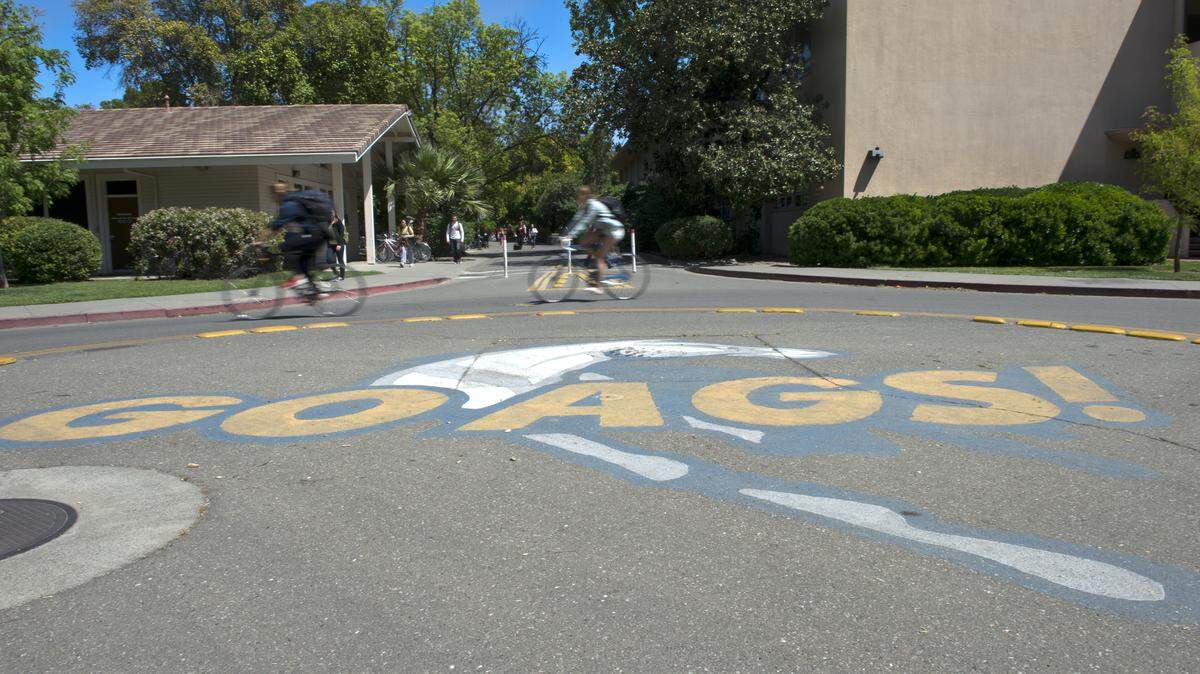
In 1972, the campus tested a roundabout — drawn with chalk and lined with a fire hose — at Hutchison Drive and California Avenue. Confusing at first, it soon reduced traffic chaos and evolved into a defining feature of UC Davis cycling. Today, the campus has more than 20 roundabouts.
Few individuals shaped Davis cycling more than David Takemoto-Weerts. After arriving in 1971, he joined the Bike Barn and later served three decades as UC Davis’ Bicycle Coordinator. He oversaw the replacement of the unpopular concrete “bike pods” with the more functional “lightning bolt” racks, testing prototypes directly with students. He also managed the recovery and auction of hundreds of abandoned bikes each year, keeping campus circulation efficient.
Takemoto-Weerts witnessed the evolution of Davis’ roundabouts and said he now worries about the challenges posed by fast, quiet e-bikes and scooters. He believes the city needs renewed focus on education, enforcement and infrastructure maintenance. Cracked pavement and fading paint, he warns, threaten the safety gains Davis once pioneered.
According to UC Davis Environmental Science and Policy Professor Susan Handy, lasting bicycle culture depends on three elements: personal attitudes, social norms and infrastructure. Davis is unusual because its culture emerged from the bottom up — people were already biking before infrastructure existed. In larger cities, she notes, top-down policies are required.
Handy emphasizes that people must feel biking is safe and enjoyable. Cultural events, like Bogotá’s weekly Ciclovía, which opens major roads to cyclists, can help shift public perception. But ultimately, protected and connected infrastructure is essential. Without it, she argues, no city can expect widespread cycling.
Handy challenges the idea that transportation success should be measured primarily by moving cars efficiently. The true goal should be to improve safety and livability for everyone. She highlights the benefits of “road diets,” which reduce four-lane roads to three while adding bike lanes. Davis applied this approach on Fifth Street, calming traffic and improving safety without significantly slowing cars.
Despite its status as the nation’s bike capital, Handy agrees that Davis has lost momentum. Local advocacy has weakened, and much of the infrastructure needs repair.
Still, Davis remains a blueprint for cities worldwide. Its history demonstrates that when policy, culture and design align, biking becomes not just possible, but natural.
Weiyun Zhou is a fourth-year undergraduate student at UC Davis majoring in economics.