
Number of California inmates serving time on 'three-strikes' falls to 15-year low
The number of felons serving time in prison under California's "three-strikes" law fell to a 15-year low in 2015, one in a series of results from the state's recently relaxed sentencing laws.
About 6,900 three-strikes felons were in California prisons late last year, down from 8,900 in late 2012, a 23 percent decline, state figures show. California has not seen fewer three-strikers since at least 2001.
The trend marks one piece of a broader decline in California's state prison population. Gov. Jerry Brown's prison realignment plan, in concert with revised sentencing laws and court decisions, have reduced the overall number of felons in California from about 170,000 a decade ago to about 127,000 today. California prisons are designed to hold about 85,000 inmates.
Since 1994, California's three-strikes law has mandated lengthy sentences for repeat felons. In its original form, a person with a prior conviction for a serious felony would receive a prison sentence of twice the term otherwise provided upon conviction of a second felony. A third felony conviction would net a sentence of at least 25 years to life.
Voters amended the law in 2012 to require that the three-strikes sentencing rules only be applied when the third offense is a serious or violent felony. Proposition 36 also allowed existing third-strike inmates to petition the court for a reduction of their terms if they would have been eligible for a lesser sentence under the new law.
Proponents of the law, which passed with 70 percent of the vote, argued it was unfair to sentence someone to a possible life term if the third strike involved a drug or property crime. At the time, the state was under a federal court order to drastically reduce its prison population. In 2014, voters passed another crime measure, Proposition 47, which reclassified several nonviolent crimes, including personal possession of many illegal drugs, from felonies to misdemeanors.
The decline in the three-strikes population largely reflects a decrease in the number of inmates serving time for a non-violent third felony offense. The number of three-strikes prisoners doing time for drug offenses, for example, declined by 60 percent from 2012 to 2015. The number in prison for property crimes declined by about 40 percent.
A racial disparity persists among those sentenced under the three-strikes law. African Americans continue to make up a disproportionate share of three-strikers.
The largest declines in three-strikers occurred among prisoners from Southern California and parts of the Central Valley. The number of three-strikes prisoners from San Bernardino, Tulare, Stanislaus and Kern counties fell by about 40 percent from 2012 to 2015.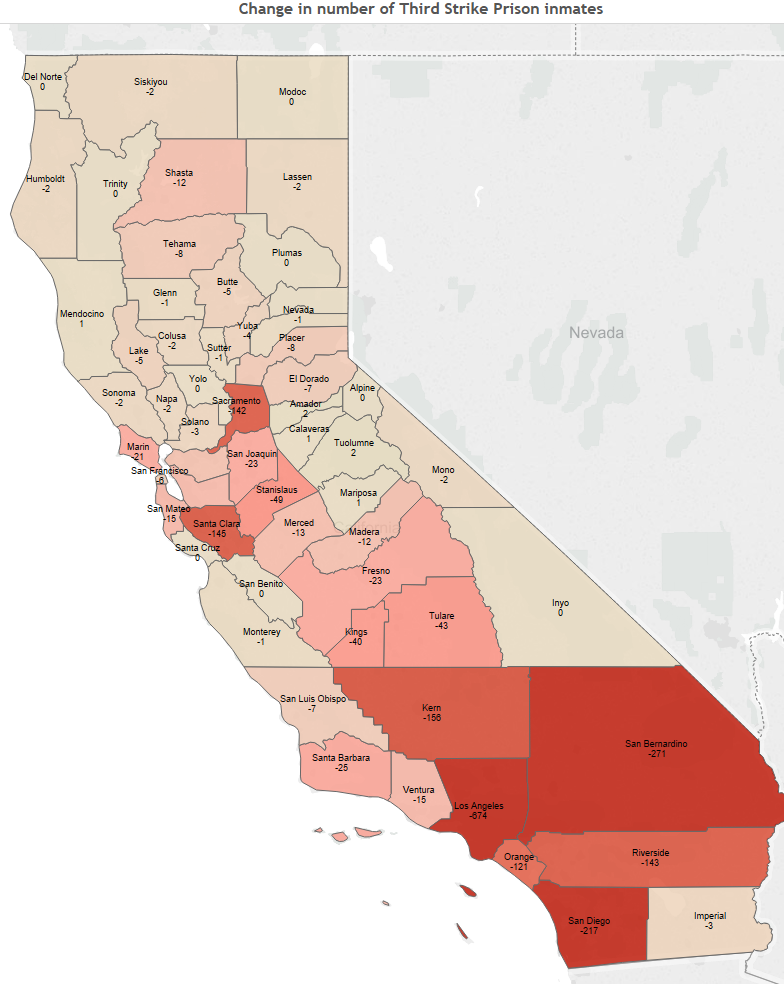
Source: California Department of Corrections and Rehabilitation
This story was originally published April 21, 2016 at 9:24 AM with the headline "Number of California inmates serving time on 'three-strikes' falls to 15-year low ."