
With no fall football at any level, it’s up to us to make spring games a reality
This week was supposed to be the start of football camp at various levels, to embrace optimism and to celebrate cohesion and collisions.
But practice sites on the regional front are silent, stalled and then undone by the coronavirus pandemic that has altered or hammered down on education, activities and businesses, not to mention the mounting mental toll.
Youth sports seasons have been canceled, clusters of children at play even outdoors deemed unsafe with the gripping concern an infected kid could go home and infect a grandparent. High school football seasons across the state and West Coast have been pushed to the winter and spring months; if it is not considered safe enough to engage in on-campus classroom instruction, then how it be safe to have sports competition?
Junior college programs had the same concerns and results. Division II and III football programs are also on the shelf, dominoes all going down in quick order. On Friday morning, the Big Sky Conference that includes Sacramento State and UC Davis postponed football league games until the spring.
There remains a glimmer of hope that Big Sky programs might be able squeeze in a nonconference schedule of up to three games this fall, health permitting. Cling to hope, right? With both hands cradling the ball and barreling in at the goal line.
Those making decisions to postpone seasons explored all options and waded through a mountain of data on what looks and feels wise or wrong. These football season pushbacks ensure nothing but they buy time and ramp up hope all over again. Not just for a successful season but to even have one.
The first kickoff will be a victory in and of itself. We championed the idea that tiny high schools in the small towns dotted throughout the mountain communities in the northern part of California would be able to cobble together some fall football games due to low COVID-19 numbers.
But the state Department of Health’s revised youth guidelines has, for now, put a halt on “tournaments, events or competitions.”
“We’re all bummed about this news,” Fall River High football coach Todd Sloat said. “Unless one of the schools goes rogue, we will be watching high school football in another state.”
It’ll be too risky to go rogue. People will lose jobs and reputations will be tarnished.
Instead, high school and college teams will explore the idea of fall practice sessions to keep sharp and to ward off the mental grind.
What’s left on the football fall menu?
The only football programs encouraged by a fall schedule in Northern California reside in the Pac-12 in Berkeley and Palo Alto, San Jose State in the Western Athletic Conference and in Santa Clara for the NFL’s 49ers. But things can change by the day if not the hour with this virus.
Positive COVID-19 tests will happen. There will be stop-and-starts. There will be debates about if competition in the Pac-12 and NFL is driven by finances and if it’s all worth it. It’s worth pushing forward until someone of authority puts a halt to it.
Some fans and followers of this sport will continue to argue against science, expressing on social media and doubting the insight and decisions of county health officials, educators, administrators, campus presidents, coaches and commissioners. In other words, the people burdened with responsibility.
Some will continue to argue that trying to salvage a season at any level is commendable, and that those who decided to side with safety are cowards. Others will suggest that it’s better to postpone seasons, to be safe and sure.
Trust concerns and what we can do
Trust has also become an issue on this topic. College football players (and those in the NFL) have opted out of this season, fearful of the virus spreading to their families. Athletes from all sports within the Pac-12 and Big 10 have gone public with demands in dealing with the pandemic, including the desire to have extended health insurance and to split revenue.
We should all cringe at the reports out of Colorado State where players and staffers suggest coaches have mandated that no one report virus symptoms and could be faced with reduced playing time if they do so. The Big Sky didn’t have any programs pull the football plug entirely, like Connecticut did in announcing no football this fall or next spring.
So now it’s up to all of us to continue to do our part — again. Mask up, social distance, wash your hands until they redden, then wash again. If we want football to return in the spring, or to take place at Cal, Stanford and with the 49ers this fall, these are minimum efforts.
But the thing about high school and college students is they like to mingle. They are social creatures, fueled by a sense of invincibility and the joys of chatter. COVID-19 numbers have spiked, scientists say, in part to gatherings — a home cookout, parties or the beach. There will be more gatherings.
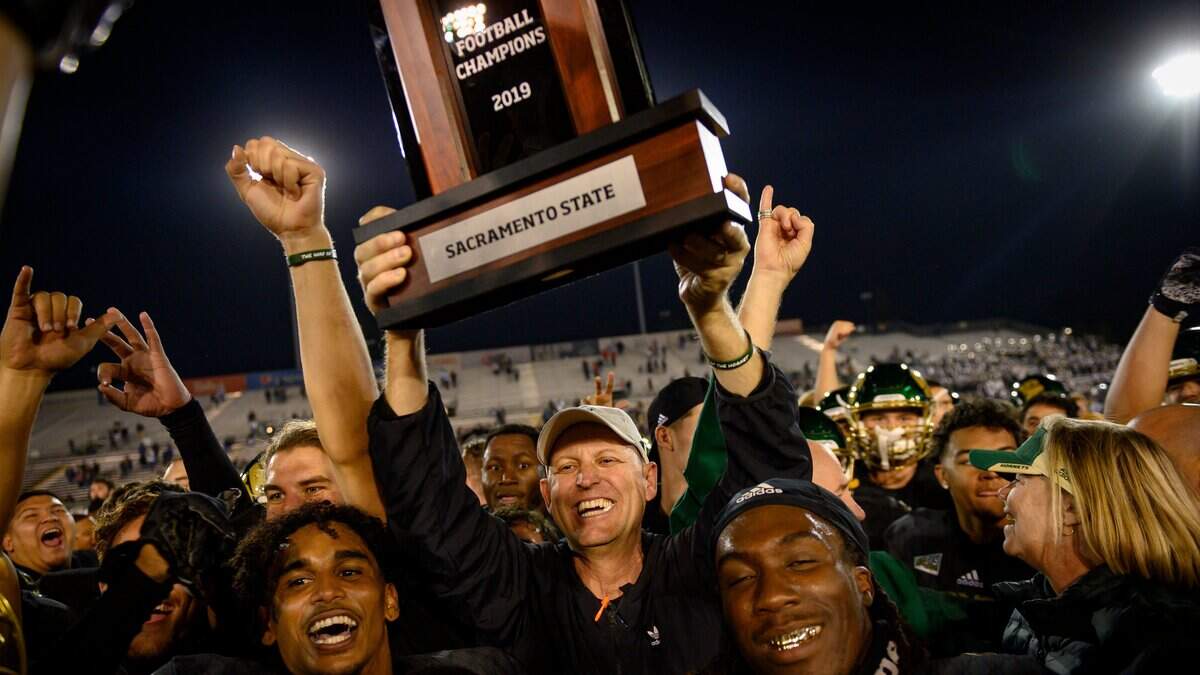
You can bet that UC Davis coach Dan Hawkins reminds his crew to social distance outside their immediate circle. So does Sac State coach Troy Taylor.
”We talk about staying in our own bubble, to interact with guys in your own group because you can get in trouble and have issues when you get outside the bubble,” Taylor said. “We remind our players, ‘Hey, this is bigger than you. Not keeping your team healthy and society healthy is the focus. No parties. No gatherings. Quarantine yourself. Be safe, wear masks.”
Why football grips us
What is about football that has such a hold on us?
Hawkins of UCD calls football, “the ultimate team game, the best game.” He grew up in the small town of Bieber in Lassen County in the 1970s, where buddies packed into pickup trucks with gun racks to seize the day and night. He was a hard-charging fullback at UCD, big on big-picture thinking.
Taylor is a Sacramento-area product, a quarterback leader at Cordova High and Cal. Football lessons resonate, in any season and any pandemic. How football programs navigate the unknown will be telling.
Taylor on the allure and importance of football, “It’s the most American sport there is. It epitomizes what we are about as a country — competition, working together as a team. People love that. There’s nothing like it, the complexities of the game, the fans and population and everything tied to it, connected to it. It’s something really important.”
He added, “This is all frustrating. Certainly, everyone wants to play, but we want to be safe. If spring is the better option, we’re up for that. If we can get a two or three nonconference games in this fall, we’d love it. Either way, we’ll make it work. This is not the end of the world. At some point, we’ll all play again.”