
Rise and grind: Davis native Nyjah Huston’s skateboarding journey to the Olympics rolls on
Fast, furious, and exhilarating — “Thrasher Magazine” subculture to the mainstream — the United States’ most popular urban sport finally made its Olympic debut this year in Tokyo.
Davis native Nyjah Huston had more than a front-row seat, with a slot in the first street competition in Olympic history. Huston is the highest-paid skateboarder in the world. With a whopping 4.9 million Instagram followers, he tops notable athletes like Michael Phelps (3.4 million), Shaun White (1.6 million) and Gabby Douglas (1.5 million).
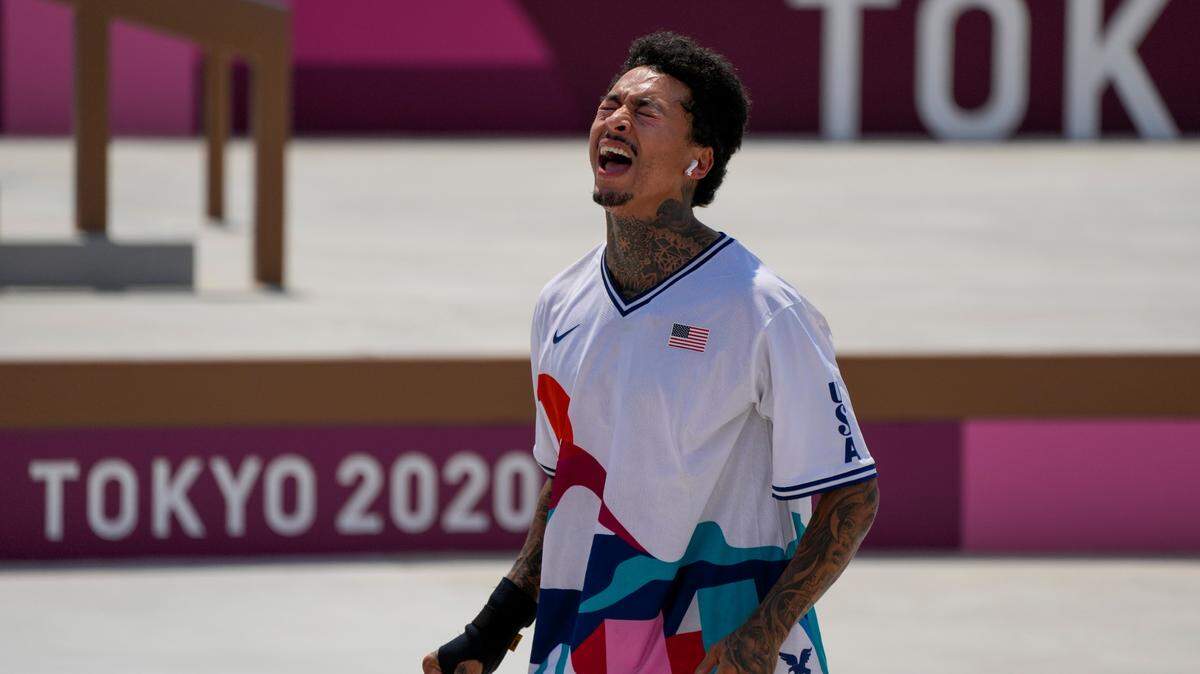
He’s regarded as one of the greats, with links to legends like Tony Hawk. That’s why spectators and judges alike were shocked at Huston’s Olympic performance this year. Predicted to get skateboarding’s historic first gold, the 26-year-old took seventh place in street, a discipline he’s dominated for more than a decade.
In the first week of Olympic competition, Nyjah fell four times in a row, undone by a move he dubbed the “Caballero kickflip backside lipslide with a fakie 360 flip.” It’s a mouthful and just as difficult to execute — Nyjah attempted to do a full 360 turn, flip his board underneath his feet, and maintain momentum, all while grinding down the street course’s handrail.
Each attempt ended with his back against the concrete.
Huston gave his fans an apology after the event:
“I’m sorry,” he said. “I know I definitely let some people down, and I have no problem admitting that.”
“But I’m human, you know,” he continued. “We’re skateboarders. We’re not going to go out there and win every single time with the stuff we’re doing out there. It’s way too technical for that.”
That Huston was even able to experience Olympic disappointment was the result of years of lobbying for the sport’s inclusion.
“It was a long and winding road, that mainly consisted of waiting until the IOC (International Olympic Committee) understood enough about skateboarding to make sure that the culture that created it would be fairly represented in the Olympic movement,” USA Skateboarding CEO Josh Friedberg said in an interview with USA Today.
“The IOC and Tokyo 2020 have recognized the inherent value of bringing a culture-based sport with global youth appeal into their mix,” he continued, “And it’s one of the most physically challenging of all sports – skateboarders at the Olympic-level are undeniably elite athletes.”
This year’s Olympics split the sport into two disciplines: park and street, both bisected by gender.
Park competitors skate on a course in the shape of a bowl or inverted dome. The spherical cap seamlessly transitions from a flat plane to arched walls. Park skaters build momentum from the top of the slope, dipping in its middle and launching themselves up to its opposing end at dizzying speeds. Judges score skaters’ stunning tricks in mid-air.
‘Street’ is exactly what it sounds like — the course mimics a street environment. Skaters grind handrails, curbs, benches, walls, and slopes. Each skater has 45 seconds to impress judges for an individual score. Judges determine the difficulty, quality, and composition of street skaters’ moves to determine victors.
Skaters like Huston have never subscribed to the mainstream idea of competition. It’s about growth, something clear as the Olympic skaters around him gave him hugs and shook off their own falls.
No one knows growth better than Huston, a man who made his professional skateboarding debut as a child.
Huston was born Nov. 30, 1994, on K Street in Davis. Like his siblings, he was born in a living room on a vinyl shower curtain-covered floor.
“I caught the babies with my bare hands, cleaned mother and child, and clamped and severed the umbilical cord, and proceeded with typical midwife treatment,” father and professional skateboarder Adeyemi Huston told The New York Times.
With his father’s prompting, Huston started skating at the age of 6, competing in amateur competitions alongside his siblings across California. At age 7, he signed his first skateboard deal with Element Skateboards. Three years later, he won the acclaimed Tampa Am in Florida.
At age 11, he went pro. With dreadlocks down to his feet (his famous young look), he premiered at the X Games, scoring a New York Times profile and gaining a reputation as a preteen prodigy.
In the span of 15 years, between X Games and the Olympics, Huston would win 17 gold medals, 7 silvers, and 2 bronzes.
But growth isn’t a linear process. Just like Huston’s fall from the Olympic podium, disappointment was commonplace — most evident in his tumultuous home life.
Huston’s father demanded excellence from his five children. As Nyjah’s success grew, Adeyemi turned his attention to the child he believed was most talented, Nyjah. Before his son’s fame, the family stayed afloat selling homegrown marijuana.
The Times reports that Huston’s sister, Isha Huston, recalls getting high off pot brownies at age 8.
Adeyemi moved the family to Puerto Rico with his son’s returns, further isolating them from potential help.
In numerous interviews, mother Kelle Huston describes making the difficult decision to run away back to California with four of her children, leaving then-13-year-old Nyjah behind. While Nyjah and Adeyemi were on a skateboarding trip, his mother and siblings made their escape.
Her testimony in divorce court was graphic:
“The physical abuse included grabbing, squeezing, kicking and pushing. The boys felt intimidated by their father.”
Adeyemi’s response was simple:
“I will not waste the court’s time trying to dignify these accusations.”
In his NBC Olympic biopic, Huston recounts feeling like his father’s “chosen one,” the child with the most talent and the one responsible for keeping his family together.
He felt like he had “no choice but to stay,” he said.
Huston wouldn’t reunite with his mother and siblings until two years later in California at age 15. Getting through the period was “the thing he was most proud of,” he recalled.
Huston broke from his first company, and his father’s reach, signing with a new label the next year.
Huston is a new man. Just like skateboarding’s Olympic debut, he’s steadily building his identity.
There are a few misdemeanors under his belt, some reminders of the past, but he’s making an effort to change in a changing sport.
In January, Huston broke from Element Skateboards. In June, he founded a new company, “Disorder.”
The new Nyjah doesn’t have dreadlocks — he’s covered from ankle to chin in tattoos. He skateboards with a cap on and AirPods in. He’s got a grace when he skates, a class that looks effortless.
“I’m proud of myself to be able to get through those times and still even want to skate,” said Huston in his biopic, “I still have so much passion and love for it to get to where I’m at now.”