
Sac State joins Mid-American Conference in FBS entry. How will it be funded?
A new era for Sacramento State football became official on Monday.
The two men at the forefront of the move to the highest level of NCAA Division I college athletics told their giddy and dancing gridiron student-athletes the historic news on Monday morning.
Hours later, Sac State President Luke Wood and Athletic Director Mark Orr shared excitement and optimism during a Zoom conference call about the school’s acceptance into the Mid-American Conference as a football-only member. The 5-year agreement means Sac State will join the MAC beginning with the fall 2026 season.
The move does not come cheap and it comes with logistical challenges. The MAC is heavy on teams from Ohio and Michigan, but the move to the FBS offered too much upside to ignore, Wood and Orr stressed.
Sac State is the first California program in nearly 60 years to move from the Football Championship Subdivision to the Football Bowl Subdivision , known in past decades as Division I-AA and I-A, respectively. Fresno State and San Diego State moved up to the FBS classification in 1969.
The MAC has television contracts to air games with ESPN and CBS Sports Network. FCS programs do not have that sort of television reach or revenue impact. And TV revenue has greatly helped fund FBS programs.
Sac State has been an FCS member since 1993 and spent the last 29 years in the Big Sky Conference. Sac State won conference crowns in 2019, 2021 and 2022 under former coach Troy Taylor in the program’s greatest run of success since starting football in 1954.
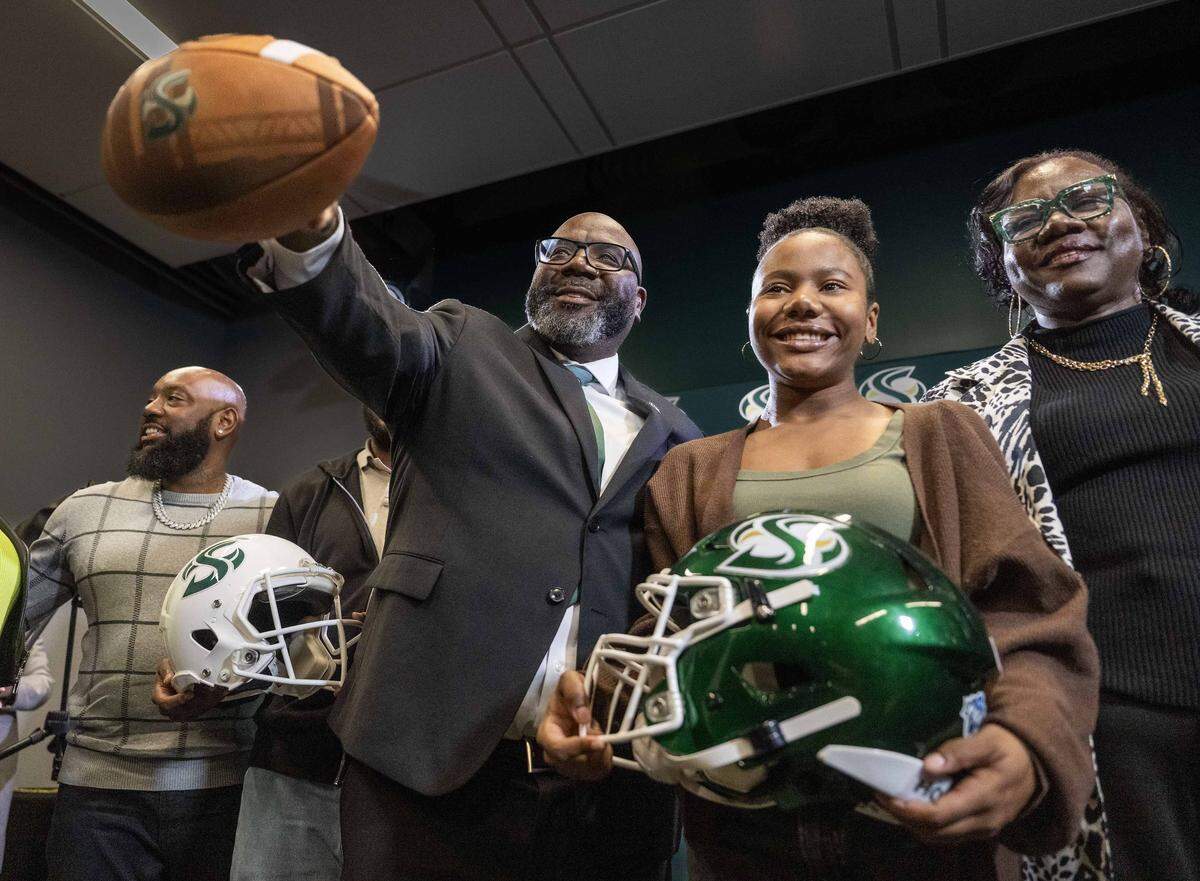
Alonzo Carter, hired in December to lead the program, was spotted in Instagram posts among ecstatic Hornets football players on campus when Orr and Wood told them the FBS move was official.
The price tag to join the MAC exceeds $20 million, including an $18 million entrance fee to the conference and a $5 million reclassification fee to the NCAA.
Why the MAC? Was there mutual interest?
The logistics for Sac State competing in a conference true to its Mid-American name are significant.
None of the road games will be easily accessible by car. By becoming the MAC’s 13th football program, Sac State replaced Northern Illinois University, which joined the Mountain West Conference. The other 12 MAC programs are Western Michigan, Ohio University, Toledo, Miami of Ohio, Central Michigan, Akron, Buffalo, Kent State, Ball State, Eastern Michigan, Bowling Green and Massachusetts.
Wood and Orr said the appeal for MAC presidents was extending the conference’s reach into California, the nation’s most populous state. Before the agreement, the state capital was the only top-20 television market in the country without an FBS football program. Because the MAC already has signed deals with ESPN and CBS Sports, Sac State will not immediately receive additional television revenue.
In an effort to ease the transition, Sac State agreed to cover travel costs for opposing teams. That will total between $150,000 and $200,000 per game for the four MAC teams scheduled to play at Hornet Stadium in 2026, Orr said. Sac State’s 2026 schedule has not been finalized as Orr fills out the remaining four games to complete a 12-game slate.
Sac State will pay $6 million of the $18 million entrance fee in 2026. The remainder will be paid over five years, Orr and Wood said.
Sac State’s effort to join the FBS was denied in a waiver request to the NCAA last summer. For months, Wood and Orr were peppered on social media with questions about whether the FBS pursuit was all talk and no substance. Sac State had interest in the revamped Pac-12 and Mountain West — any FBS conference, really — but a conference has to offer an invitiation.
“I’m grateful to all the people who supported us and to all the people who doubted us,” Wood said. “This makes the victory that much sweeter. It goes to show that we’ll continue to defy odds. ... The MAC wanted us. We were a big appeal to them.”
Orr said, as a Sacramento native, he has heard for decades that the region has “amazing athletes who feel like they couldn’t stay home to play football (on scholarship) because we were FCS. Now we can tell those student-athletes that they can play at the highest level of Division I football right here.”
How will Sac State fund the transition?
Wood said the “transition is about more than athletics.”
In an email to Sac State students, Wood wrote that the FBS move “is an economic development strategy that aligns directly with our commitment to national brand recognition and regional impact. According to the Intercollegiate Athletic Economic Impact Study, moving to FBS is projected to triple Sacramento State’s annual athletics economic impact. The five-year agreement with the MAC delivers extraordinary value.”
In the email, Wood said the study projects the university’s athletic economic impact will increase to $975 million, national broadcast valuation will grow to $675 million and game-day economic revenue will rise to $46 million.
Sac State’s other sports will enter the California-based Big West Conference this fall.
Wood said student fees, tuition dollars and state funds will not be used for conference entry fees.
Wood and Orr said students will continue to be admitted to football games for free and should be applauded for agreeing to past student-fee increases to support athletics. Funding for the FBS transition will come from football-generated revenue, ticket sales and corporate sponsorships, they said.
Orr said that since news leaked over the weekend that Sac State had been accepted into the MAC, he has heard from donors and alumni who want to support the football program. In short, the Hornets are open for business with local companies interested in partnerships.
“We’re now in the FBS for the long haul,” Orr said. “It’s not easy to get there. We now have big-time football right here in our town. I have no doubt people will come out and support it.”
‘Dogged determination’
MAC games are often featured on ESPN during the week, compared to the traditional Saturday games. Wood and Orr said they invite the chance to compete in a Tuesday or Wednesday night game on ESPN.
Wood said he sized up this journey and acceptance to the MAC as “a case study of dogged determination.”
Orr agreed.
“It’s Sacramento versus everybody. Sacramento has always been the underdog. I like it. Our city has always been that way,” he said. “I look at examples. No one thought this city would keep the Kings or get Golden 1 Center built, and it happened. There were doubts about going to the FBS, but Sacramento came through again.”
Wood said in the email to students the move elevates the university’s profile and creates opportunities “that extend far beyond the playing field.”
“This announcement represents a transformational moment for Sacramento State Athletics and positions our university for unprecedented growth and visibility while strengthening our ties to the Sacramento region and beyond,” Wood said in the email. “Our Hornets will compete on the national stage, bringing enhanced exposure to our university, our students, and our community.”
This story was originally published February 16, 2026 at 3:04 PM.