
The prep football season is too long. One longtime coach has ideas to shrink the schedule
One of the draws to high school football is that it starts well before the college and NFL campaigns.
It’s a charge for those involved to have the gridiron stage to themselves for a stretch, but do the prep seasons start too soon? Yes. Who remembers when the high schools kicked off after Labor Day? That’s ancient history, about the time when water was prohibited in practice in an effort to toughen the lads up.
Friday’s opening-night kickoffs around the Sacramento region featured games pushed back an hour to 8 p.m. starts to better avoid the heat. This didn’t help the freshman teams that kicked off Thursday at 5 p.m., at the peak heat hour of some 103 degrees and on broiling-hot turf fields that feel like the surface of the sun. It also didn’t help the junior varsity guys who slugged through 100-degree heat on Friday.
Too much heat is a constant health risk and concern. What to do?
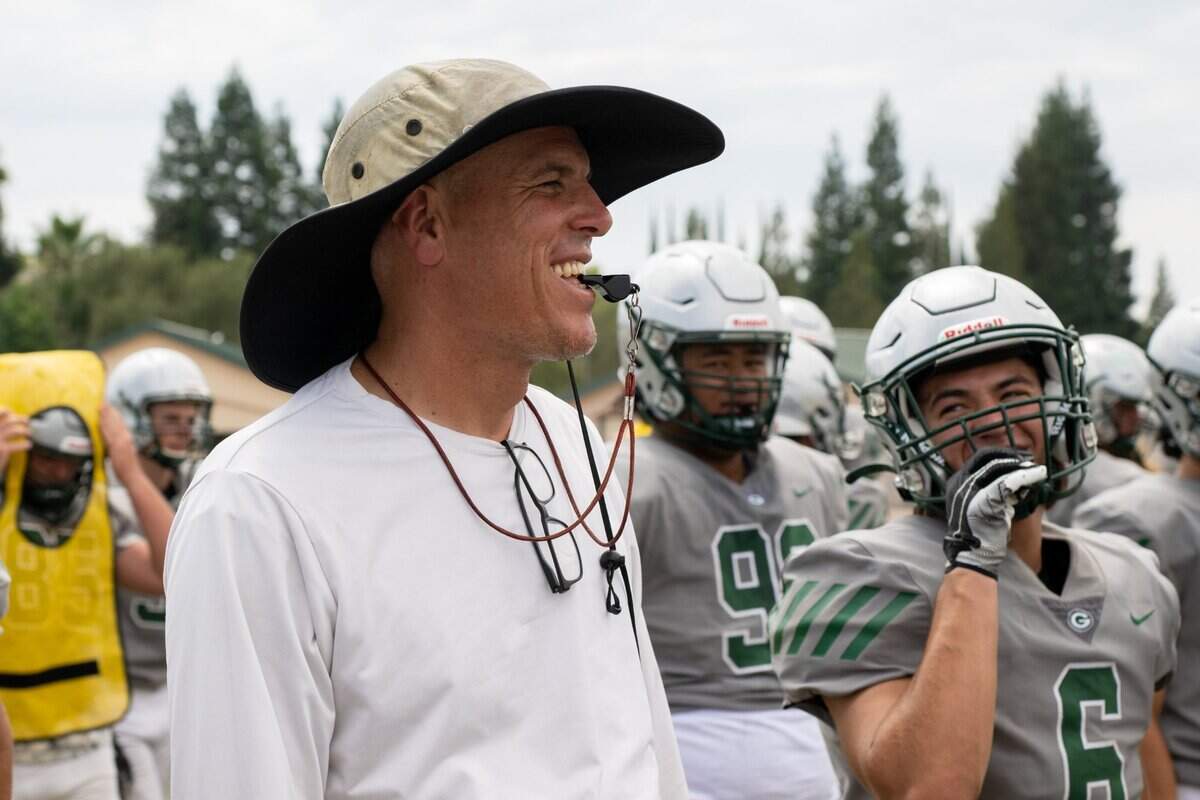
“I’m not that get-off-my-lawn guy, but if you look at the calendar of the actual season, summer ends Sept. 22 and fall begins, so we’ll have played half the regular season in the summer,” Granite Bay coach Joe Cattolico said. “And it’s hot. We’ve always played in hot weather, I get that. But there’s more hot weather than there used to be. How can we make this more of a fall sport again and not half of it in the summer? The idea isn’t to diminish football, but let’s make football better.
The veteran coach added, “I think if we push the season back a couple of weeks we can get more kids playing and more guys coaching. Some older coaches say they can’t coach anymore: ‘I can’t be out there half the season in 100-degree weather.’”
Any more vacation time for families/coaches?
It used to be high school teams didn’t hand out helmets until August. Now that happens by the third week of July, and this is after all of June with passing leagues and weightlifting sessions. Bay Area teams start a week or two later than our local ones do. Some won’t kick off until after Labor Day, so not everyone is on the same page.
Are the early seasonal starts going to spook some away? It’s already happening.
“There’s a commitment and dedication that comes with football, and we’re telling families and junior football programs to cut into vacations,” Cattolico said. “We had a parent of a freshman student last year who was deciding between football and another sport because he has to cut his summer short. If we push the season back, we can have our first games of the season on the Friday of Labor Day weekend, just like every other level of football.”
Programs within the Sacramento City Unified School District don’t start classes until Sept. 1, the day before the third game of the schedule for programs such as Burbank, Johnson, Kennedy, McClatchy and Rosemont. For some of those programs, roster numbers won’t rise until school starts because some of those students cannot get to practice, either due to transportation or a need to be an older-brother babysitter at home.
And home crowds before school starts are thin to bleak. No energy. No campus buildup. This isn’t an issue for other districts, where school started Aug. 12.
“I know the athletic directors in our district always talk about this,” McClatchy AD Rob Feickert said of having the season start so soon. “We got out of school on June 16 and football practice starts July 25, not including summer conditioning, so where’s the time off? I feel horrible for the off-campus coaches, and we have a ton of them, who don’t get a summer vacation.”
Ideas on how to make it a fall sport again
The schedule needs tweaking. It can be done. It’s been discussed within the offices of governing body CIF Sac-Joaquin Section.
One suggestion is to trim a week off the regular season without losing any game contact. This can be accomplished by making the regular season 10 weeks. As it stands now, prep teams have 11 weeks to play 10 games, thus allowing for an off-week bye.
Another possibility is trimming the amount of playoff teams and/or making the section playoffs three weeks instead of four, allowing for a later start date to the season. But that proposal hurts a program like McClatchy. The Lions last season basked in the joy of reaching the playoffs for the first time in 25 years. A postseason bid meant something to them.
“If you reduce the number of playoff teams, that means we would have been out as a lower seed, and we’d still be waiting for next year,” Feickert said. “I don’t think there’s a right answer.”
At Folsom, where the top-ranked Bulldogs annually compete for section and state honors, football is a year-round grind.
“High school football at the highest levels are overwhelming and jam-packed,” Folsom coach Paul Doherty said. “Where we struggle a little is getting kids some time off.”
As for shortening the playoff field or shortening the playoff schedule, Doherty isn’t sold.
“I’m definitely a fan of extra teams in the playoffs,” he said. “When I coached at Sac High, we took over a program with all those losing seasons. They gave me 50 bucks and a football and said run a program. I loved the challenge. We were a low seed and played at Del Oro in 2011. Lost by 50. We stayed at the Howard Johnson hotel in Rocklin the night before and treated it like a Super Bowl, and some of those players got into coaching because of those experiences. If we trim the playoffs down, we lose that.”
When did the seasons start so early?
The seasons start earlier because they last longer. When California introduced a state playoff format in 2006, becoming the last state in the country to do so, this extended the season. Then it got more full with the introduction of NorCal and SoCal regional finals to see which teams advanced to the state finals. That can be a 16-week grind, 17 if you consider full-contact scrimmages on the eve of the season.
“I see where coaches are coming from,” Cattolico said in not trimming the season. “One answer to that is to add more divisions. Instead of six 12-team divisions, let’s have nine 8-team divisions, and you still have 72 teams go to the playoffs.”
This model has worked splendidly for years in Southern California. What won’t work is trimming the regular season from 10 games to, say, six or seven. Schools depend on the gate receipts of games to fund athletic programs, and 10-game schedules have been the norm forever.
“It’s obviously doable, and it really would be nice to push it back two weeks,” Cattolico said, stressing player safety. “We would’ve started practice (on Aug. 9), which would be better. We’d still have miserable, hot-weather practices like this week, but we wouldn’t be playing ball games for most of the season in 100-degree heat.”
To create change, more coaches need to discuss the topic among themselves, with administrators, with CIF staffers who are always open to ideas.
Said Will DeBoard, assistant commissioner of the section, “We’ve had 15 weeks of a season, four weeks of postseason, 11 weeks of regular season, but we have talked about shrinking things a little bit. But no one wants to shrink the playoffs, or very few do. There’s also nothing wrong with playing just nine regular-season games and not 10, and some have done that.”
This story was originally published August 24, 2022 at 5:00 AM.