
49ers roster analysis: Receiver talk will rule offseason. Will they keep Sanders?
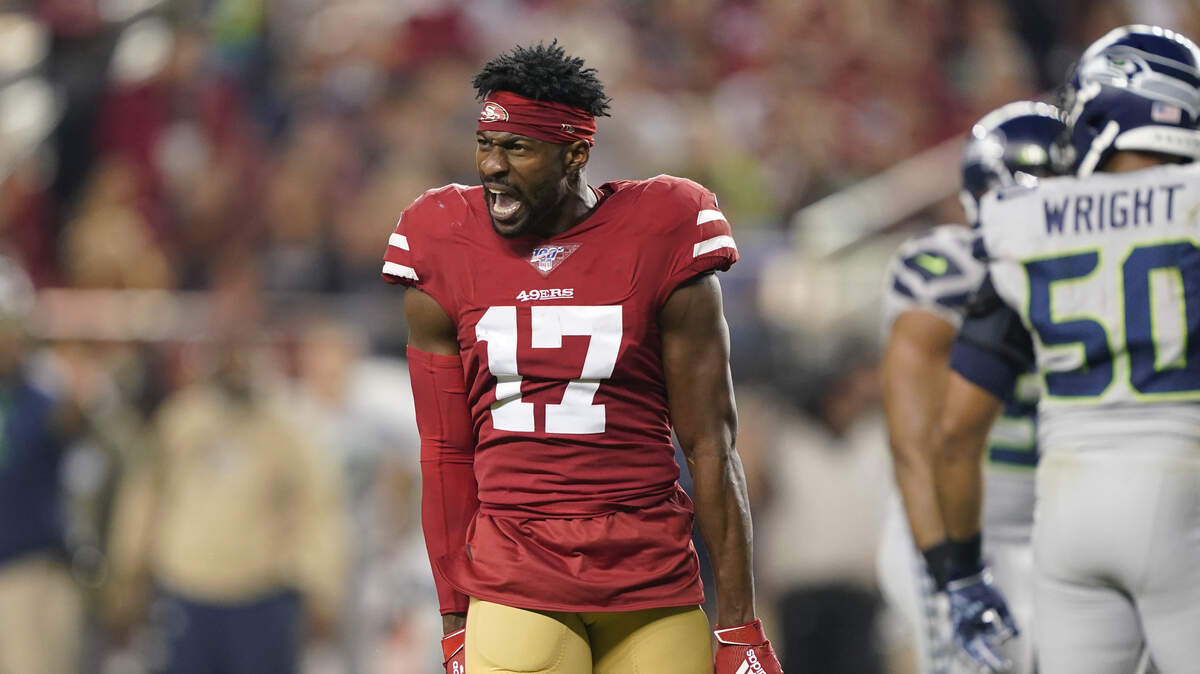
This is the last of a nine-part series breaking down each position on the 49ers roster before the start of free agency begins March 18. Here, we’ll take a look at wide receivers.
Kyle Shanahan takes particular interest in receivers. It’s his former college position, after all, and it’s the position he works most closely with the scouting department when it comes to evaluating the draft and free agency.
So it’s not entirely surprising the 49ers have added five receivers in the three drafts since Shanahan became the 49ers head coach in 2017.
Yet of the team’s top four reception leaders at receiver in 2019, only one of those players (Deebo Samuel) was a draft pick. The others — Emmanuel Sanders, Kendrick Bourne and Marquise Goodwin — were added via trade or free agency.
Part of that is because two of the team’s wideout draftees didn’t play last season because of injuries. Trent Taylor broke his foot before the preseason opener that required surgery, and then had four more surgeries due to various complications, including an infection, throughout the year.
Rookie third-round pick Jalen Hurd sustained a fracture in his back during joint practices with the Denver Broncos in August and missed his entire first NFL season. Finally, Dante Pettis, a second-round pick in 2018, couldn’t battle his way out of Shanahan’s doghouse in training camp and the early portion of the season, which led to trading the Denver Broncos third- and fourth-round draft picks to get Sanders (and a fifth-round choice).
Shanahan initially took a less-traditional route when it comes to evaluating receivers. He focuses far more on movement skills than physical measurements. The ability to separate from man-to-man coverage was the top trait he looks for in college prospects, which he admits is increasingly difficult because of the zone-heavy schemes defenses play.
But that’s appeared to change recently. He prioritized physicality in last year’s draft, landing two of toughest receivers in last year’s class in Samuel and Hurd. Sanders, who isn’t big at 5-11 and 180 pounds, is also known for his fearlessness, which rubbed off on his teammates.
The receiver spot is up in the air heading into 2020. Let’s take a look at where things stand.
What happened in 2019
Jimmy Garoppolo’s passer rating jumped from 90.8 during the first six games of the season to 108.1 over the final 10 games, coinciding with Sanders’ arrival. It was clear Sanders had a big impact on the passing game, which made the 49ers look good for their gamble by trading third- and fourth-round picks to give themselves a shot at winning the Super Bowl.
He quickly became the new alpha of the group, allowing Samuel to evolve into a strong No. 2 with Bourne serving as the reliable third option. The trade wasn’t good for Pettis or Goodwin, who saw their playing time drop precipitously (Goodwin landed on injured reserve in December).
Sanders made a handful of game-changing plays, including a 75-yard touchdown against the Saints in a game in which he also threw a touchdown pass. He converted a third-and-16 in a last-minute victory over the Rams that set up a winning field goal in December. Though Sanders’ most memorable of the year came when he was overthrown for by Garoppolo late in the Super Bowl on the same play as that third-and-16.
Sanders benefited from joining the 49ers after working with Broncos coordinator Rich Scangarello, who previously served as Shanahan’s quarterbacks coach. The bones of the offense were basically the same, making it a relatively easy transition, which was key in Sanders scoring touchdowns during his first two games.
Samuel’s development came quickly. He proved lethal with the ball in his hands. He was fifth among all receivers in yards after the catch (484) and tied the league lead with 18 broken tackles, according to Pro Football Focus. His 802 receiving yards in 15 games were the most by a 49ers rookie since Jerry Rice in 1985. His 53 rushing yards against the Chiefs were the most by any receiver in Super Bowl history.
Bourne had just 30 catches, but nearly all of them were important. He scored five touchdowns and 23 of his receptions went for first downs, including 12 third-down conversions.
It was mostly a lost year for Pettis, who will have to improve his strength, toughness and reliability to regain a prominent role in the offense after showing flashes of promise during his rookie season in 2018.
He finished with just 11 catches on 24 targets and was the team’s only receiver with a catch rate of less than 50 percent. The last straw might have been when Pettis stopped running his route on an incompletion toward the middle of the field late in the overtime loss to the Seahawks in November. He played just nine more snaps over the remaining regular season games and found himself inactive for the Super Bowl.
Richie James Jr. spent the year as the No. 5 option and punt returner. He averaged 8.0 yards per return. But more importantly, he didn’t fumble during the regular season, though he did muff a punt during the Super Bowl.
Changes looming
Sanders is the team’s top free agent on offense. With some $17-$19 million in projected cap space, it’s hard to see him coming back while the 49ers re-signed free agent Arik Armstead and still have to consider Jimmie Ward. The team also will look to give new contracts to George Kittle and DeForest Buckner. Sanders would likely have to return on a significant discount, which appears unlikely given other contenders (ahem, Patriots) might be willing to offer the market rate.
Bourne is a restricted free agent. The 49ers would love to bring him back, but it’s unclear if they’ll have the cap space to replace him if he receives an offer from another club that San Francisco can’t afford to match.
Goodwin also appears unlikely to return, though Shanahan said otherwise at the scouting combine last month. The 49ers could save some $3.6 million by releasing him this offseason. Goodwin had just 12 catches in nine games in 2019.
How pressing is the need?
It’s one of the most pressing needs on the roster is Sanders leaves — and even more so if Bourne ends up elsewhere.
The 49ers would love to have Pettis rebound from his down year but that’s not something they should expect. The same is true for Taylor and Hurd following their injuries.
Samuel has shown promise as a versatile weapon that Shanahan figured out how to use throughout the season. But San Francisco will need more than Samuel and Kittle for the passing game to be productive enough to get back to the Super Bowl.
Draft prospects and free agents to consider
The 49ers appear primed to add at least one more receiver in the draft. They’ve drafted a wideout each year since 2002, including two last year in Samuel and Hurd. This year’s class is considered one of the best in a generation, leaving plenty of options available when San Francisco picks at No. 31, or should they trade back into Day 2.
TCU’s Jalen Reagor has similar explosiveness to Goodwin and the tenacity of Samuel. Brandon Aiyuk (Arizona State) might be the closest draft prospect to Sanders. Denzel Mims (Baylor) is rocketing up draft boards after following up his strong week at the Senior Bowl with an explosive performance at the combine. He looks like he would be a natural replacement for Bourne given his size and route running.
Laviska Shenault Jr. (Colorado) is often compared to Samuel given his work with the ball in his hands, but he sustained an inflamed pubic bone injury while running a 4.58-second 40-yard dash in Indianapolis.
The 49ers might not have much money to spend in free agency. But some names to keep an eye on include Taylor Gabriel, who played with Shanahan in Cleveland and Atlanta, after he was released this offseason by the Bears. Gabriel would be a natural replacement for Goodwin. Same for Randall Cobb who spent last season in Dallas.