
Why the 49ers kept Arik Armstead and traded Deforest Buckner for a draft pick
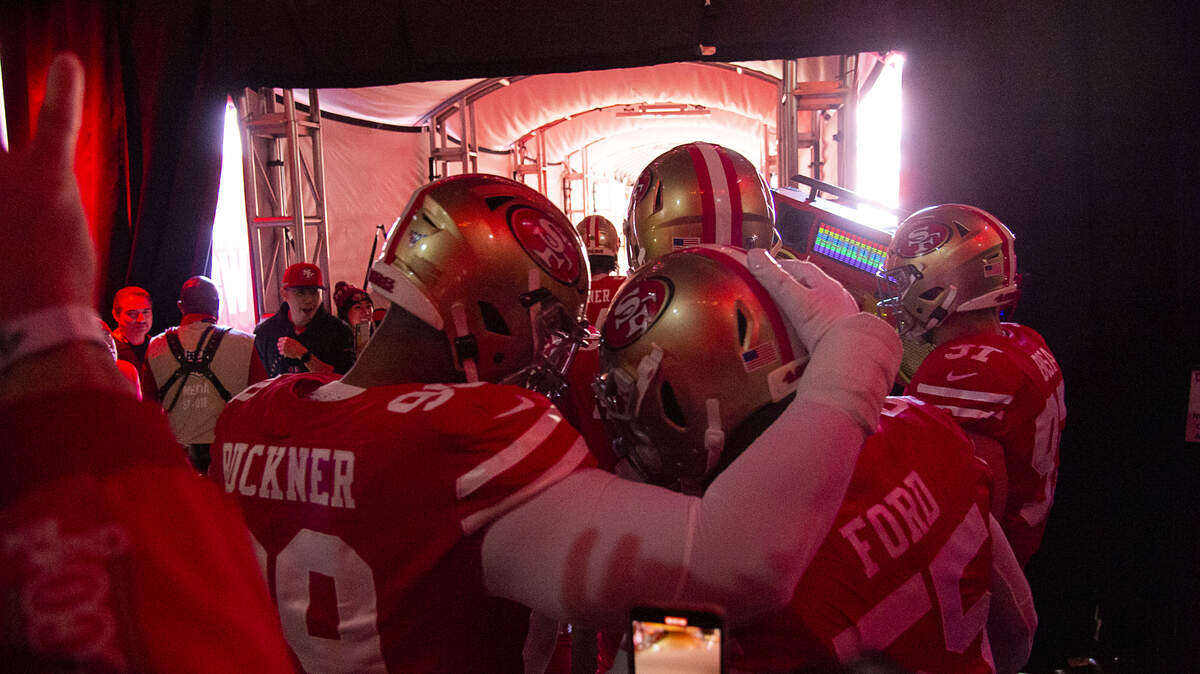
Only the Buffalo Bills spent more money on their defensive line in 2019 than the San Francisco 49ers.
It’s seemed likely the 49ers would take over the top spot in 2020. “Seemed” is the operative word here, until Monday afternoon.
That’s because the team Monday morning agreed to terms with looming free agent Arik Armstead on a five-year, $85 million contract, matching the deal given to pass rusher Dee Ford last offseason.
But that was just the first shoe to drop.
Moments after the 49ers formally announced Armstead’s extension, news broke the team had traded star defensive tackle DeForest Buckner to the Indianapolis Colts in a stunning move for the No. 13 pick in next month’s NFL Draft.
Buckner trade a win for both teams
The out-of-nowhere trade appears to be a win for both sides. The Colts get one of the league’s most productive and dependable defensive tackles. He’s missed just one game in his four seasons and recorded 19.5 sacks combined over the last two, not including his 2.5 sacks in three recent playoff games. He was the 49ers’ Bill Walsh Award winner for 2019, voted on by coaches for professional excellence.
Buckner was a team captain and the leader of the defensive line room. Joe Staley once said Buckner’s work ethic and competitiveness reminded him of only one teammate, Frank Gore, which is the highest praise Staley could give.
So why make the trade?
San Francisco would have had a hard time paying Buckner and Armstead nearly $40 million per season. Particularly with George Kittle needing a new contract and other significant deals already on the books. The 49ers don’t have the benefit of a quarterback playing on a rookie contract. Jimmy Garoppolo is slated to count for $26.6 million in 2020.
The 49ers felt Armstead, who led the team with 10 sacks last season (Bucker had 7.5), was worth keeping at $17 million per year while getting a premium draft pick in the Buckner deal. The move gives them a chance at landing another star with pick No. 13 in a draft loaded at receiver, while opening up the necessary space to give Kittle a record-setting contract for tight ends, which is surely to come at some point this offseason.
The details of Armstead’s contract have not been disclosed, but the team likely back loaded the contract to give cap flexibility heading into the new league year that begins Wednesday.
49ers making financial moves
The team had roughly $17 million in space heading into the week. The details of Armstead’s deal have not yet been made public, but the team should have more flexibility to spend on other players with Buckner’s money off the books. Buckner was scheduled to make about $12.4 million on his fifth-year option.
That flexibility could be used to keep other free agents, like receiver Emmanuel Sanders, safety Jimmie Ward and/or restricted free agents Kendrick Bourne and Matt Breida. They simply didn’t have the cap space to keep both Armstead and Buckner and continue adding talent to the rest of the roster.
The other key issue is San Francisco’s lack of draft capital.
Thanks to trading for Ford and Sanders over the last 12 months, the team didn’t have any selections in the second, third and fourth rounds next month. Getting the 13th pick significantly alters the 49ers’ draft war chest, potentially allowing them to move down from their original pick at 31 to acquire more midround selections, which the 49ers have turned into a slew of starters in recent drafts (Kittle, Deebo Samuel and Fred Warner come to mind).
Trading Buckner breaks up one of the NFL’s most imposing defensive lines. San Francisco was the only team to have four players with at least 6.5 sacks last season. Armstead led the way, rookie Nick Bosa had 9.0 sacks during his rookie-of-the-year campaign and Ford added 6.5 sacks while playing just 22 percent of the snaps. Ford missed five games with knee and hamstring injuries.
The trade also means 2020 is shaping up to be a big year for Ford.
Paying Armstead, who plays both defensive end and defensive tackle, gives the 49ers some long-term stability in case the team decides to move away from Ford next season (Buckner played only defensive tackle).
According to Overthecap.com, Ford’s contract has no more remaining guaranteed money. The club could release Ford in 2021 and save $12.8 million in cap dollars with a modest $4.8 million dead cap hit which would shrink each year after.
Why wouldn’t the team be sold on Ford long term?
Like Armstead, Ford had one ultra-productive NFL season before getting cashed out. And he played just 22 percent of the defensive snaps last season. His knee issue, by the way, hampered him from training camp on and he hinted at needing offseason surgery to repair tendinitis. Club officials said since the season ended Ford would not have a procedure.
The risk of letting Buckner go
With any big contract, risk is involved. Armstead’s 10 sacks last season, not including his two in the playoffs, dwarfed the nine sacks he had the previous four seasons combined. He hasn’t missed a start in the last two years, but sat out 18 games during 2016 and 2017 to have surgery for shoulder and hand injuries.
And there’s certainly risk in moving on from Buckner, a star in his prime who’s as durable as any player in the league. The risk is missing on a first-round pick and not matching the immense production Buckner gave the franchise over the past four seasons.
San Francisco doesn’t have a perfect record in Round 1 of the draft since Kyle Shanahan and John Lynch took over. Solomon Thomas has not been a productive player since he was taken with the No. 3 pick in 2017. And Reuben Foster was released before he could finish his second season. Nick Bosa and Mike McGlinchey have been home runs. The 49ers need to hit their pick with similar success this year to call the Buckner trade a win.
The 49ers love Armstead’s approach. He’s evolved into the type of steady, reliable presence the team wants to build with. It’s no small thing that Armstead has been fine with whatever role given to him, including nose tackle, while remaining productive.
Though it’s fair to wonder how much of Armstead’s production could be attributed to playing alongside Buckner. And how will the 49ers replace Buckner? It could mean more snaps for Thomas and nose tackle D.J. Jones, who are both serviceable, but not elite like Buckner, who was named a second-team All-Pro in 2019 by the Associated Press.
Clearly, San Francisco will have a new look in 2020, relying more heavily on Bosa, Armstead and Ford to be the faces of the defensive line, putting a ton of pressure on Shanahan and Lynch to fill the void and use the No. 13 pick to land another elite player.
This story was originally published March 16, 2020 at 3:14 PM.