Why 49ers would be wise to sit out free agent frenzy
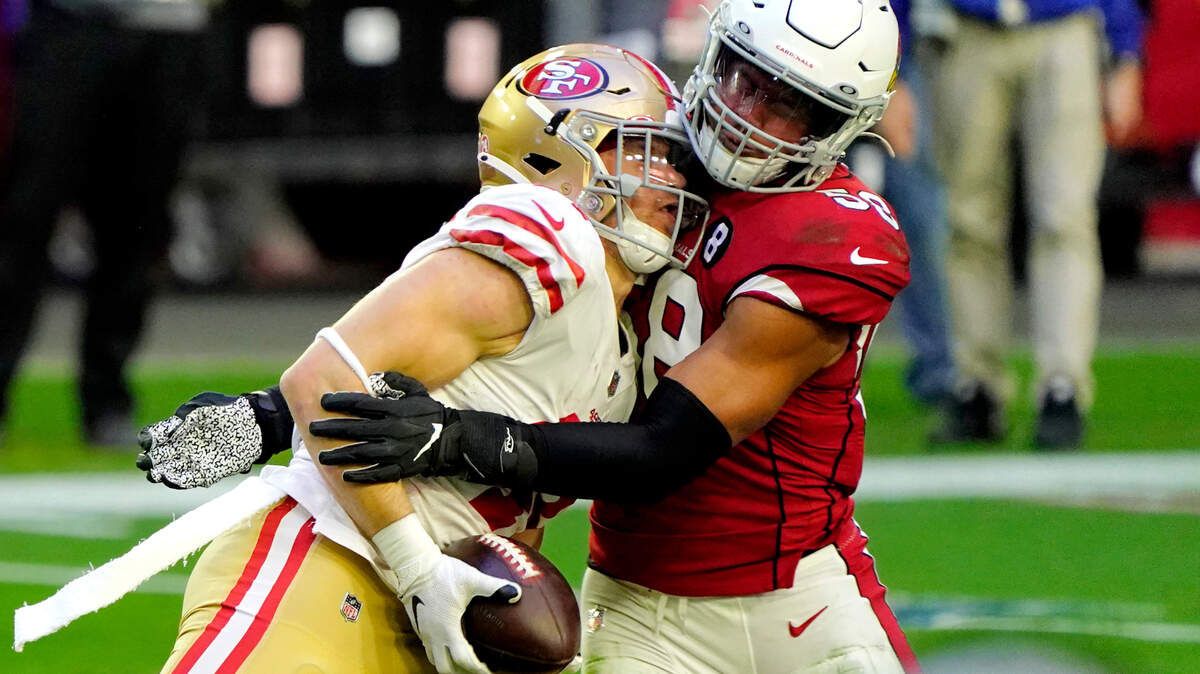
What do Pierre Garçon, Malcolm Smith, Weston Richburg, Jerick McKinnon, Kwon Alexander, Dee Ford and Arik Armstead have in common?
They all received lucrative contracts from the 49ers since 2017. And, in hindsight, there should be varying degrees of regret from coach Kyle Shanahan and general manager John Lynch with the way those contracts have worked out (so far, in Armstead’s case, as he has four years remaining).
Which paints a cautionary tale many NFL decision-makers have become familiar with: Overpaying the wrong players, especially in free agency, can be a damaging way to build a roster.
That’s a trend Shanahan and Lynch should pay careful attention to this week when the new league year begins and the free agency dollars start flowing. The league’s “legal tampering period” began Monday, when free agents begin negotiating with new teams. Those deals can’t become official until the new league year starts Wednesday.
Not all those contracts were all-out failures. Garçon had value as a veteran presence that helped the 49ers transition to Shanahan’s system after working in it previously with Washington. But he was released after appearing in 16 games combined over two seasons. Richburg was a quality center when healthy, but he’s had three surgeries since he last played in December 2019 and likely won’t get to the fourth season of his five-year, $47.5 million contract he signed in 2018.
It’s a similar story with Ford, who arrived via tag-and-trade from Kansas City in 2019, leaving the 49ers a complicated decision this spring after they paid him a star-level contract worth $85 million over five seasons. Those were the same terms for the contract Armstead inked a year ago before recording 3.5 sacks is a disappointing campaign in which he played mostly out of position while Nick Bosa and Ford dealt with injuries.
McKinnon, of course, missed the first two seasons after signing a four-year, $30 million deal in 2018, after tearing his ACL and later having complications that required additional surgery. Smith’s five-year, $26.5 million pact was head-scratching when he signed in 2017 and never became an important contributor after tearing a pectoral muscle during his first training camp.
On the other hand, there have been some good contracts the 49ers gave out in free agency.
Richard Sherman was an integral part of the defensive turnaround in 2019 when he was voted a second-team All-Pro and anchored one of the NFL’s best passing defenses. Fullback Kyle Juszczyk’s record-setting contract for fullbacks proved helpful over the last four seasons thanks to his smarts and versatility. Juszczyk cashed in again over the weekend, reportedly landing a five-year, $27 million contract with $10 million guarantees.
Jimmie Ward has been a constant at free safety after dealing with injuries and yearly position changes earlier in his career. Defensive end Kerry Hyder led the team in sacks last season while making just $1.5 million. His cap hit was roughly 10 percent of Ford’s.
Alexander’s deal falls somewhere in between. He made $14.625 million in 2019, the fifth-most among all linebackers, before getting traded in 2020 to shed his salary. He was a good player in tandem with Fred Warner, but there wasn’t much dropoff when the 49ers transitioned to 2019 fifth-round draft pick Dre Greenlaw.
However, Alexander has been credited by many of his teammates for helping change the culture in the locker room, and Warner has said Alexander helped bring out a different side to his personality that led to his All-Pro ascent.
A recent study from Overthecap.com’s Jason Fitzgerald used data to prove there’s a correlation between the worst teams over the last four seasons and free agent spending habits. A majority of the best teams, record-wise, used restraint in free-agent spending, while many of the worst teams have been the most prominent free agent spenders.
Which all means there’s an interesting decision to make regarding star left tackle Trent Williams, who is expected to land a contract in the $20 million per year range either with San Francisco or someone else.
Williams is about as sure a bet as there is in terms of picking a player to pay. He’s made the Pro Bowl eight times in 10 seasons, was Pro Football Focus’ top-rated tackle in the NFL in 2020 after sitting out in 2019 and plays one of the most important positions. Also in the case for bringing back Williams, contending teams like the Packers (David Bakhtiari) and Ravens (Ronnie Staley) have given out massive contracts to tackles with an understanding of how scarce elite tackles are.
But Williams will also be 33 by the time next season starts and the 49ers could potentially find a cheaper option in free agency or the draft. Going either route could give the team more flexibility to find other players at areas of need like pass rusher, cornerback and center.
Williams this week hinted at likely coming back to San Francisco. Yet given the team’s history with big money contracts, including the one given to quarterback Jimmy Garoppolo, it’s fair to ask if it’s wise to make such a significant investment.
The 49ers would hope Williams falls into the category with Sherman, Juszczyk and Ward and not Ford, Armstead and Richburg.
49ers big money contracts signed since 2017:
2017:
Brian Hoyer: 2 years, $12 million
Pierre Garçon: 5 years, $47.5 million
Kyle Juszczyk: 4 years, $21 million
Malcolm Smith: 5 years, $26.5 million
Marquise Goodwin: 2 years, $6 million
2018:
Richard Sherman: 3 years, $27.5 million
Weston Richburg: 5 years, $47.5 million
Jerick McKinnon: 4 years, $30 million
Jonathan Cooper: 1 year, $4.95 million
2019:
Kwon Alexander: 4 years, $54 million
Tevin Coleman: 2 years, $10 million
Dee Ford: 5 years, $85 million (came via trade for second-round pick)
2020:
Arik Armstead: 5 years, $85 million
Jimmie Ward: 3 years, $28.5 million
This story was originally published March 15, 2021 at 8:16 AM.