
Art review: ‘Seduction: Japan’s Floating World and The Printer’s Eye’ at Asian Art Museum
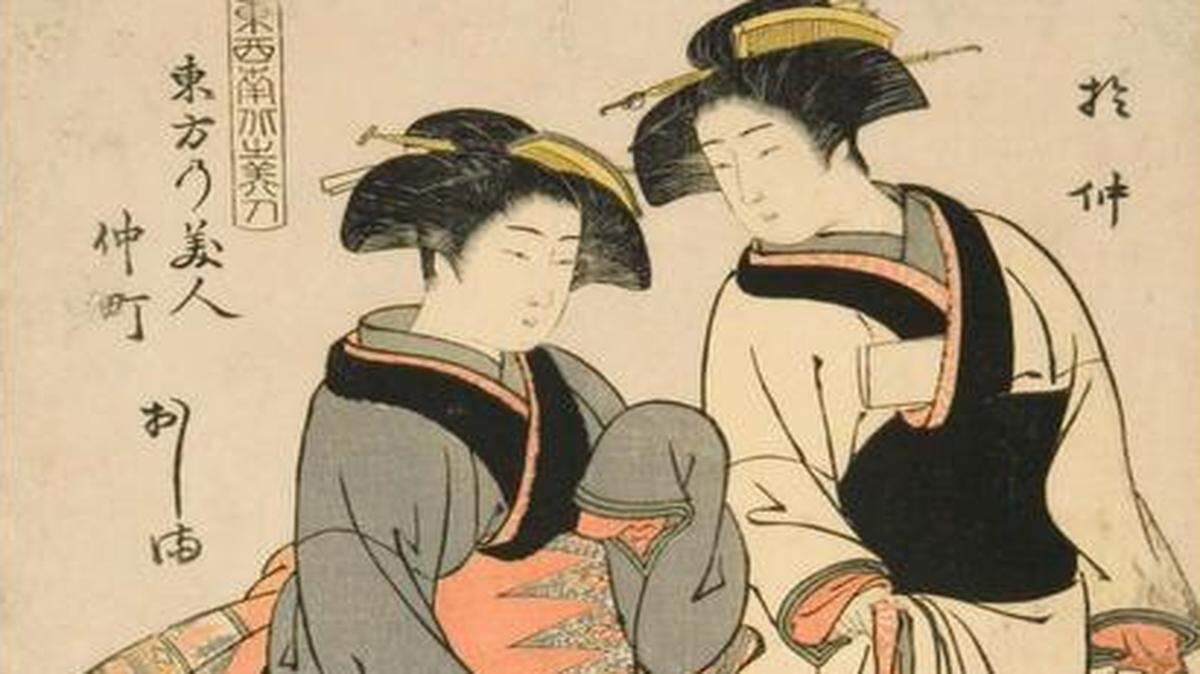
During Japan’s Edo Period (1615-1868) the term “floating world” (ukiyo) embodied a realm of wit, stylishness and extravagance with overtones of naughtiness and hedonism. “Seduction: Japan’s Floating World” at San Francisco’s Asian Art Museum takes viewers to the enticing entertainment districts of Edo (present-day Tokyo).
More than 60 artworks from the acclaimed John C. Weber Collection give viewers a taste of the famed pleasure district, the Yoshiwara, a red-light district where prostitutes displayed their charms in lattice-like structures. The centerpiece of the exhibition is an almost-58-foot, richly detailed hand scroll painting of life in the district, a walled and moated compound of about 20 acres established in 1617.
The scroll, which is read from right to left, unfolds on scene after scene of tea houses, shops and more than 100 brothels. Here prostitutes strolled the main street or lounged in soft bedding in the shape of kimonos. In one scene, cooks prepare exotic delights to tempt the appetites of patrons of the brothels.
Ironically, the term ukiyo referred to the suffering of the physical world brought on by desire. It was inverted during the Edo period to signify a “floating world,” a realm of boundless indulgence. Though Samurai were forbidden to enter the Yoshiwara, they visited in great numbers disguised under straw hats, joining rich merchants in partaking of the delights in the Yoshiwara.
There they found music, food and drink, but prostitutes were the main attraction. By the end of the 18th century more than 4,000 prostitutes worked in the pleasure area. The most expensive were elite courtesans who were rigorously trained in music, calligraphy, poetry and other refined arts. They were accessible only by strict protocols requiring huge payments and tips at introductory meetings.
Called “castle-wreckers,” these exclusive courtesans could make anywhere between the modern equivalent of $4,000 to $13,000 at a meeting. At the opposite end of the spectrum were moat-side prostitutes whose services were quick and inexpensive. Both were victims of an exploitative society where young country girls were bought at the ages of 7 or 8 and brought to the quarter. As apprentices to older courtesans, they learned how to manipulate clients with verbal tricks, faux love letters, and sham tears.
In addition to the scroll, the show includes exquisite paintings and prints of courtesans by Katsukawa Shunsho, Kitagawa Utamaro and Utagawa Kuniyoshi, who were among the most talented artists of the time. One of the most striking is Shunsho’s image of a courtesan with an androgynous young man, reflecting the period’s love of gender reversals. Other works include images of Kabuki actors dressed as women. As in Shakespeare’s day, women’s roles were played by men and in a later section of the show, a video presents renowned Kabuki actor Bando Tomasaburo V performing the role of Wisteria Maiden.
Accompanying the prints and paintings are objects from the period, including a celadon porcelain serving bowl. A selection of kimonos and men’s jackets demonstrate the beauty and intricacy of Japanese textiles. In addition to a kimono-shaped bed cover with an elegant phoenix design, there are many gowns meant for various times of the year. Some of the most gorgeous are summer kimonos in light fabrics and colors with designs taken from nature.
Accompanying “Seduction” is “The Printer’s Eye: Ukiyo-e From the Grabhorn Collection.” Edwin Grabhorn was a printer of fine books who had a discerning eye for prints.
The exhibition showcases 88 superb prints acquired by the Asian museum in 2005. On view are woodblock prints by Suzuki Haronobu, Utamaro, Okumura Masanobu and many others. A highlight of the show is an informative video that shows the stages of a woodblock print.
Seduction: Japan’s Floating World and The Printer’s Eye
Where: Asian Art Museum, 200 Larkin St., San Francisco
When: Through May 10. 10 a.m.-5 p.m. Tuesday-Sunday, 10 a.m.-9 p.m. Thursday
Cost: $10-$15, free admission first Sunday of every month and free for children under 12, San Francisco Unified School District students and members
Information: (415) 581-3500, www.asianart.org
This story was originally published March 19, 2015 at 9:00 AM with the headline "Art review: ‘Seduction: Japan’s Floating World and The Printer’s Eye’ at Asian Art Museum."