
A trip to the Bay Area’s ‘Great Eight’ independent bookstores
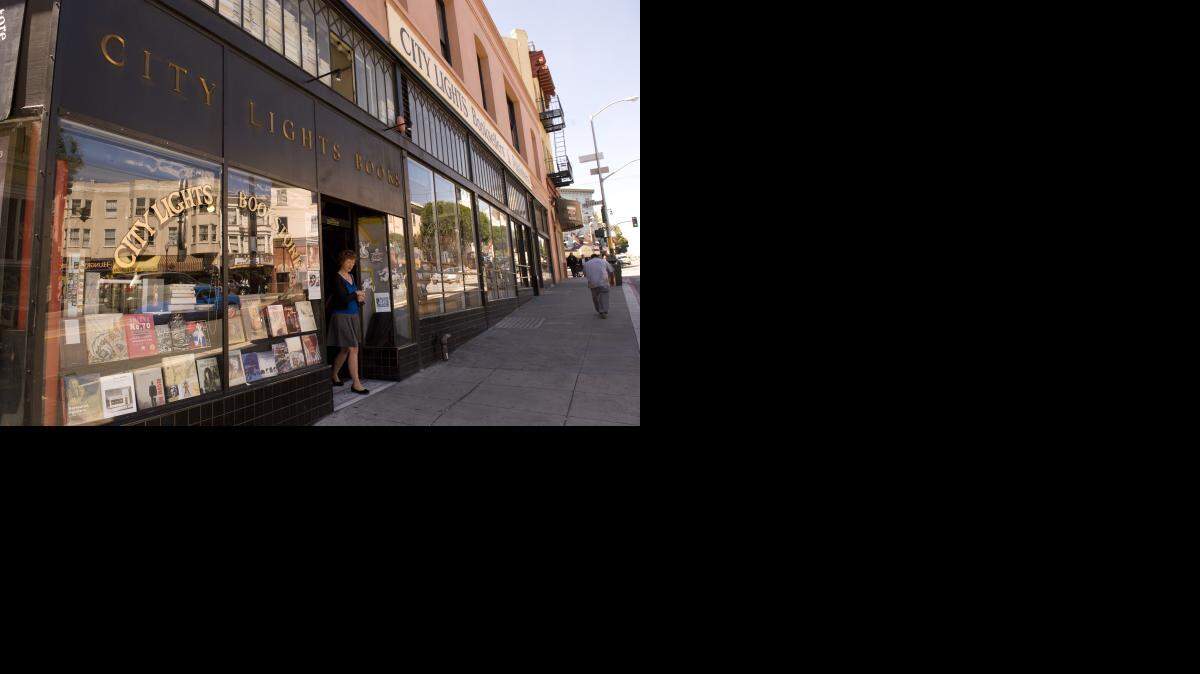
Up on the second floor of City Lights Books, way up high, beyond the corridor with the poster-sized Ferlinghetti poem (“Pity the nation that knows/No other language but its own/And no other culture but its own”), beyond a graffitied plea (“Free The Press … from its corporate owners”), beyond even the framed photos of Allen Ginsberg palling around with Bob Dylan, sat a creaky blue rocking chair by a wire-mesh window looking down on the teeming North Beach neighborhood.
Curiously, no one dared to sit in it.
Painted in gold on the head rest was “Poet’s Chair,” so maybe that’s why people refrained to take a load off. They don’t feel worthy, here in what is arguably the temple of the nation’s independent bookstores, thinking that the rocker must be reserved for the laureate himself, 95-year-old Lawrence Ferlinghetti, founder of City Lights in 1953, back when the Beats had yet to be beaten into submission and destroyed by pop culture’s ever-morphing madness.
Four Norwegian tourists, who didn’t speak a speck of English, perhaps couldn’t comprehend the sign on a wall near the chair, the hand-scrawled commandment to “Have a Seat + Read a Book.” But that didn’t stop this book-loving quartet from unsheathing their smartphones and taking selfies beside the chair.
Down three flights of stairs, in the basement that, pre-City Lights, was a cellar that a Chinese electrician used as storage space, a young female tourist from Beijing in a snazzy black beret stood before a section titled “Stolen Continents.” In that awkward exchange peculiar to those linguistically alienated from the other, she tried mightily to make a connection and managed to convey much to her interviewer in a few choice words: “Books. Beat. Student. Visa. Kerouac.”
Perhaps no other U.S. city can boast a funky, history-besotted indie bookstore – sorry, Portland, Powell’s is a fine book palace, but sadly missing City Lights’ star-studded literary sweep – that’s considered a must-see for travelers from Bodø to Beijing, that ranks with the Golden Gate Bridge and Fisherman’s Wharf on a tourist’s to-do list. No less than the worldly travel writer Pico Iyer has mused, in a recent Los Angeles Times essay, “If San Francisco’s great tradition is the overturning of tradition, City Lights is one of its essential monuments …”
Yet the bookish traveler should know that the Bay Area abounds with quirky, eclectic and venerable bookstores that perhaps get overshadowed amid City Lights’ well-earned glare. Make a pilgrimage to City Lights, by all means, but also go to the East Bay, or down to the Peninsula or over to Marin, where bookstores with character and characters await exploration.
In these days of woe for businesses that use dead trees, rather than electricity, to communicate the written word, when even ardent bibliophiles succumb to the convenience of Amazon.com, it’s as heartening as it is surprising to find that independent bookstores survive, if not always thrive, in the Bay Area.
Sure, in the past decade, there have been casualties – RIP, Cody’s on Telegraph in Berkeley, Grey Wolf in San Leandro, A Different Light and A Clean Well-Lighted Place, both in San Francisco – but dozens remain. The under-the-radar yet highly respected Green Apple Books (dealing in new and used) in the Richmond district of San Francisco is doing so well that it was named the Publisher’s Weekly 2014 Bookstore of the Year and, last summer, opened a second store, Green Apple Books on the Park, in the inner Sunset neighborhood.
Herewith, a road trip to seven shrines of the written word, orbiting the sacred nexus that is City Lights:
Chapter 1: Diesel, a book store, Oakland
Joe Vasquez lives in San Diego, but as a UC Berkeley grad (class of ’75), he makes it a point to stop at Diesel, on College Avenue in the Rockridge neighborhood, every time he’s in town. Two years ago, Vasquez made the trip with his grown daughter, also a Diesel habitué.
“She was very upset,” he said. “She thought they’d closed the bookstore and become a record store.”
For one night only, Diesel had. To celebrate the publication of local writer Michael Chabon’s new novel set in Oakland, “Telegraph Avenue,” the staff of Diesel had transformed the store into a physical manifestation of Chabon’s fictional “Brokeland Records” depicted in the book.
“We had signage made that covered up our neon (sign) outside,” Diesel clerk Pam Stirling said. “We had full window scrim in each window that said the same thing. We took out this table (in the main room) and borrowed record racks that a friend of our owners’ had. One of the owners found the guy who used to (run) the record store on Telegraph, and he still had a lot of his jazz vinyl. He set it up and sold records after (Chabon) read and did a signing. It was really, really fun.”
It also is so like Diesel, which vows to be a neighborhood bookshop in every way. Know those hand-written recommendation cards strategically placed on shelves? At Diesel, they sometimes are written by customers, not employees. To make folks feel at home in their browsing, Diesel has two red pleather easy chairs with throw pillows next to an electric fireplace.
“You’ll find,” Stirling added, “that a lot of independent bookstores become pretty creative with the way things are (financially).”
Diesel, which moved to Oakland from its original Emeryville site in 1994, must be doing something right. Many stores selling exclusively new books, which Diesel does, have struggled to survive. But co-owners John Evans and Alison Reid have expanded, opening stores in Larkspur and Santa Monica. Like many indie stores, it sells books online and e-books online, as well. And this past fall, tapping another revenue source, it raised more than $12,000 in donations in a month using the crowd-funding site Indigogo under the heading “Keep Diesel Rolling On.”
Chapter 2: Bell’s Book Store, Palo Alto
In downtown Palo Alto, teeming with techies, there is an anachronistic shop housed in an early 20th-century building with a dark green marble base outside, a pressed-tin ceiling and steep staircases and a balcony. Though the signage out front clearly reads “Bell’s Book Store,” apparently it confuses newcomers.
“We’ve had people walk in the door, close it behind them and look around and say, ‘What is this?’” said Faith Bell, owner. “I’m like, ‘Well, it is a bookstore.’
“It’s a changing time,” Bell continued. “I used to feel it was a more predictable clientele, and we figured them out. Now, we’re seeing a shift in the demographics. It used to be an older, very well-educated group. Now, we have still well-educated, but we got all the Silicon Valley start-up folks for whom this is such a strange thing.”
Bemused tech workers aside, Bell’s remains a rock-solid part of a community where “brick-and-mortar” is becoming a quaint concept. For 80 years, the Bell family has sold used books both scholarly and popular, signed first-editions from renowned authors and even a smattering of new titles.
A more cozy, welcoming place would be hard to find. The store is steeped like a tea bag in history, with leather reading chairs between aisles, vertical towers of book shelves from the brown-and-black linoleum floor to the tin ceiling. There’s even an 1891 printing press on loan from the Museum of American Heritage on the balcony. But it’s the 300,000 volume of books, many signed first editions from the likes of Robert Frost to T.C. Boyle, that are the real allure.
Because of its proximity to Stanford, Bell says the university librarians “let people know about us and refer people wanting to downsize their collections or sell the estates.” Which is why you’ll see the complete set of Lewis and Clark’s Journals on one shelf, and the scholarly “Linear Drawing and Lettering for Beginners,” by J.C.L. Fish, of Stanford University, published in 1901.
“Last year, we got a collection from Richard Rhodes, author of ‘The Making of the Atomic Bomb.’” Bell said. “He’s a local. He was going to write a book on history and development of the computer, and after getting 400 books on the topic decided he couldn’t make it happen in a timely enough way to encompass all of it, so he decided to sell his collection to us.”
Yes, Bell’s also has a corner dedicated to computer science and technology. In a rather cheeky dig, though, one of the employees taped a message to that shelf: “Obsolescence is just a lack of imagination.”
Chapter 3: Book Passage, Corte Madera
You really have to make an effort to get to Book Passage, tucked in a small but upscale (like everything else in Marin County) strip mall a few left turns off of Highway 101. You might wonder: How has this out-of-the-way gem for new books survived since 1976 when it’s so much easier to sit at home in pajamas and click on new titles.
Owner Elaine Petrocelli laughed when asked that, for the umpteenth time, and gave her usual answer.
“I don’t think it’s a secret,” she said. “We listen to our customers.”
And caters to them. Boy, does Book Passage make it worth people’s while to visit. Some activity to augment book-selling goes on every night of the week at the main store in Marin and its new little brother at the Ferry Building in San Francisco. Petrocelli estimates about 800 yearly offerings, from book signings and author readings to clubs, discussion groups, foreign language study and creative writing workshops.
The educational outreach all started, Petrocelli said, about 23 years ago when she asked a promising but then-struggling Marin County writer named Anne Lamott to teach a writing class. Lamott, now famous, still makes occasional appearances, and the framed photos of celebrities who’ve spoken at Book Passage run the gamut: Jane Fonda to Richard Ford; Hilary Clinton to Regis Philbin. Petrocelli is most proud of helping to launch first-time authors. “We had Michael Chabon out for his first novel (“The Mysteries of Pittsburgh,” 1988), and I remember there weren’t too many people. He brought his mother, and we had coffee. Now, (Chabon) draws hundreds.”
Petrocelli says, successful as it is, Book Passage still fights for eyeballs and wallets. She has started two kids reading groups that meet on alternating Fridays. One is called “MB-14” for must-be 14 years old, and the teens come for more than the free pizza.
“One publisher thought it’d be great to send the kids in the group free e-books for that month’s (selection),” she said. “The kids were sort of insulted. They told me, ‘We do everything on computer at school and take our tests on computers. The last thing we want is to read a book on (a device).’ There may be future for us.”
Chapter 4: Moe’s Books, Berkeley
Four blocks from UC Berkeley and only a Molotov cocktail’s throw from People’s Park, Moe Moskowitz opened his eponymous bookstore in the late ’50s. But Moe’s hit its stride on Telegraph Avenue in the 1960s, when he built his stock up to 200,000 volumes and built his shtick up by being part P.T. Barnum, part V.I. Lenin. (Quick aside: Moe was kicked out of the Young Communist League for “having too many opinions.”)
Moskowitz, who died in 1997, might have been a quasi-anarchist who supported the Free Speech Movement and protested against the Vietnam War, but he also was a businessman who built the store from a paperback hovel in downtown Berkeley to a four-story emporium on Telegraph. He was one of the first independent book sellers to embrace the Internet, selling books online in the early 1990s. He staged wacky events, for which he dressed in top hat and tails. He once hosted a midnight release party not for Harry Potter books but the latest Thomas Pynchon novel.
Moe’s spirit lives on, not just in the array of titles and appearances by current best-selling authors such as Dave Eggers and Jonathan Lethem, but in the store’s communitarian spirit. That’s because his daughter, Doris, now owns the place.
“One thing Moe taught is that bookstores want to give back,” she said. “He really wanted to make (the store) a cultural place. But you still need to have the books. We buy hundreds of books, thousands, every day.”
The vast selection is one reason why Cary Wong, of New York City, made a stop at Moe’s while visiting relatives in the Bay Area. He headed to the fourth floor, the drama section.
“I like to read plays, and they’ve got a great selection, maybe better than New York,” he said. “There are barely any bookstores, independent ones, left in New York.”
Chapter 5: Green Apple Books, San Francisco
The best bookstore in America in 2014, according to the industry organ Publisher’s Weekly, is housed in two buildings separated by a Chinese grocery and hair-care shop in one of San Francisco’s lesser-traveled neighborhoods.
However inauspicious its curb appeal may be, once you step inside either of the buildings housing Green Apple’s vast collection of new and used books, you immediately understand the accolades. Books are crammed into every conceivable cranny and nook, accessed by creaky stairways and cracked tile floors, yet the vibe is warm and inviting, not at all claustrophobic. In the building to the west (the so-called annex), you’ll find new and used fiction, rows upon rows of it. The eastern building is mostly new offerings and all the nonfiction, as well as Green Apple’s vast used book-buying operation that keeps the shelves from getting sparse, since Green Apple’s owners estimate they sell at least 200 books a day.
One key to Green Apple’s enduring success is its staffers, as nice as they are knowledgeable. When customer Mark Vaz went to cashier at the annex to ask if he could leave his used-book selections at the register while he checked out the offerings in the other building, the clerk said, “We’ll walk them over for you.” Vaz took them up on the offer.
“I used to live in this neighborhood,” Vaz, a writer now residing in the East Bay, said. “This is, like, a venerable place. I come back all the time. I’m a fiction writer myself, and I do what I can to support ‘brick-and-mortar’ places.”
How beloved is Green Apple? In a Publisher’s Weekly feature, author Daniel Handler (a.k.a., Lemony Snicket) said he has hung out at the store since he was 10 and it’s a place he feels comfortable letting his own son, Otto, roam by himself. “It’s just that kind of place,” he told the magazine.
Chapter 6: Shakespeare & Co., Berkeley
Vance Armor was deep in the philosophy section amid the vertiginous towers of pulp at Shakespeare & Co., a store of used- and antiquarian books, which since 1964 has co-existed peacefully across the street from Moe’s. His eyes seemed to glaze over the titles until, with a start, his hand reached out and snatched “The Spirit of Mediaeval Philosophy” by Etienne Gilson. He cracked the spine, then rushed to the counter.
“How much is this book?” Armor asked.
Told it cost $40, Armor gingerly put the book back. What Armor perhaps failed to notice was the cursive signature of the book’s previous owner: “Huston Smith, Washington University, Spring, 1953.” (Smith, a former professor at Washington University, MIT, Syracuse University and a visiting professor at Berkeley, is the author of “The World’s Religions” and a counterculture figure who took part in Timothy Leary’s “experiments” with psychedelics in the ’60s.)
“I just moved from (Laverne) Oklahoma, to the Bay Area,” Armor said. “This is the second bookstore I visited in Berkeley, and it’s wonderful. University towns have great used books.”
He already had two other gems in the crook of his elbow, but Armor wasn’t done exploring.
“The search in a used bookstore is a wandering passion of mine,” he said, “because you can go from subject to subject to subject in a way that makes the pursuit of finding the right book a joy of its own.”
Chapter 7: Kepler’s Books, Menlo Park
Kepler’s is celebrating its 60th year as a cultural institution on El Camino Real – well, except for that brief period a few years back when it closed, but who’s counting?
Actually, the book industry is. It’s keeping a keen eye on Kepler’s to see if its ongoing experiment to gradually morph from retail store to a nonprofit pans out.
Newly minted CEO Praveen Madan has split Kepler’s into two entities – the for-profit store and the creation of a nonprofit entity, called Peninsula Arts & Letters, which hosts 250 author events and workshops a year and does outreach into area schools. The next step, perhaps, will be to attempt to turn the entire operation into a nonprofit, potentially forging a sustainable path for other struggling independent bookstores.
“We’ve been having a lot of conversation with community leaders, lawyers to figure out if the IRS will basically allow that,” Madan said. “Nobody’s really done this (with a bookstore) yet. … On the retail side, what we have done that has worked is downsized the retail for print. By paying less rent, we’re taking the money and investing it in buying more books. Our inventory is up over the last two or three years. We’re seeing the result in sales. It’s strong.”
Kristin Chang, a 17-year-old from Cupertino, is a Kepler’s regular who has certainly noticed the downsizing. Being “concerned for the store,” she responded by dragging her mom there for a post-holiday shopping spree.
An unabashed book fan, even at so tender an age, Chang launched an impassioned soliloquy in defense of independent bookstores that hopefully won’t become an epitaph for the industry:
“It’s a very human experience. It feels like you’ve entered a kind of sanctuary rather than treating books as another commodity. It’s very personal. There’s always a community of people around.
“My dad is always giving me those (e-books), but I tend to use them less often than real books. To me, it’s a very different experience in reading. I don’t disdain people who use them, because if that’s what keeps you reading then, of course, do it.
“But it’s not the same as coming to a place like this.”
Call The Bee’s Sam McManis, (916) 321-1145. Follow him on Twitter @SamMcManis.
This story was originally published January 17, 2015 at 4:00 PM.