The FRM® designation is a globally respected certification for professionals in financial risk management. Awarded by GARP, the FRM® credential recognizes people who pass a difficult two-part exam and prove their skill in identifying and managing financial risk.
More than 90,000 professionals across the globe have earned the FRM® certification, many describing it as an excellent way to go if you want to assess financial risk long-term.
In this guide, I’ll explain what the FRM® certification requires, how you earn it, and why you should consider obtaining it. If you’re serious about risk and standing out in a highly competitive field, this certification might be the next step in your career!
Key Takeaways
- No Prerequisites: Anyone can register for the exam, regardless of background/experience.
- Two-Part Exam: The certification requires passing both Part I and Part II exams.
- Work Experience: Two years of relevant full-time work experience are mandatory.
- Time Frame: You have four years to pass Part II after passing Part I and ten years to submit work experience after passing Part II.
- Global Recognition: The FRM® designation is acknowledged worldwide, though not as common in some countries compared to the CFA.
Your Steps to Becoming a Certified Financial Risk Manager
Similarly to achieving any other leading professional certification, becoming an FRM® involves a few obvious steps. The FRM® certification process is relatively simple:
1. Register for the FRM® Exam Part I
Don’t have as much experience as you’d like to? Luckily, anyone can register for the FRM® Exam Part I. There are no educational or professional prerequisites. You’ll just need to create a GARP account and pay the applicable exam fees. (Exam dates are offered in May, August, and November.)
2. Pass the FRM® Exam Part I
The FRM® Part I exam is more quantitative. Many students report that it’s downright difficult, though there are mixed reviews regarding the question of which section is harder. The best way to describe it: Part I is more a combination of what you’ll learn in a bachelor’s + master’s, and Part II is in between a master’s + a PhD with an industry focus.
Part I includes 100 multiple-choice questions focusing on risk management concepts like:
- Foundations of Risk Management
- Quantitative Analysis
- Financial Markets and Products
- Valuation and Risk Models
Candidates are allotted four hours to complete the exam. The best advice I can give for this section is to work methodically, consistently, and with a plan. Don’t forget about those practice exams, either!
Here’s a tip from someone who passed: “I wrote both in October 2020 and passed. I spent three weeks studying 8-10 hours a day leading up to the exam. Also, I’m busy with my Master’s in Financial Risk, so I have a very strong technical background, which carried me a long way (I’d say that if you don’t have the technical background, you’d need a fair amount more time than what I spent on it).”
u/ChrisLeRoux23
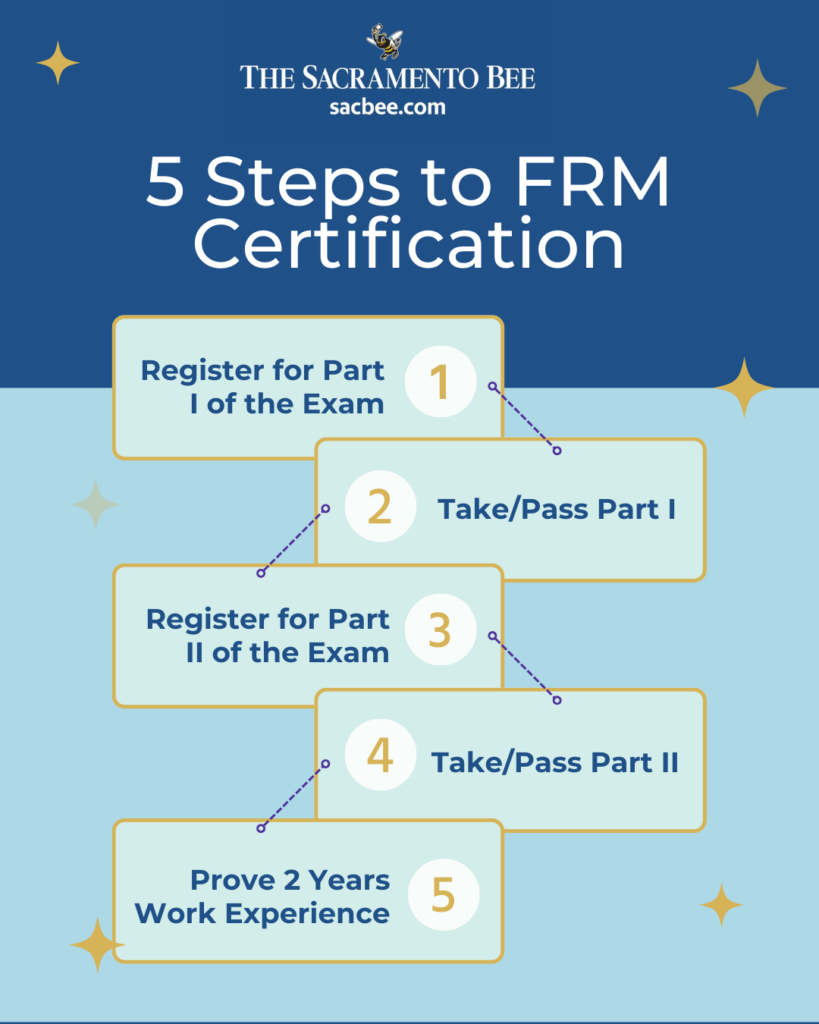
3. Register for the FRM® Exam Part II
After passing Part I, you can register for Part II. Note that you must pass Part II within four years of passing Part I. In your research, you’ll notice that a lot of people refer to Part II as the more exhausting of the two.
I’ll provide more details below.
4. Pass the FRM® Exam Part II
The Part II exam is more qualitative. For this section, the concepts are easier, but the content is so vast that it can feel impossible to learn everything. Many call it lengthy and a “beast” of sorts. It is testing your memory capacity, after all.
It includes 80 multiple-choice questions covering:
- Market Risk Measurement and Management
- Credit Risk Measurement and Management
- Operational Risk and Resilience
- Liquidity and Treasury Risk Measurement and Management
- Risk Management and Investment Management
- Current Issues in Financial Markets
Like Part I, you’ll have four hours to complete the exam. I can’t stress enough that you have to study. No, this isn’t the bar exam. You don’t have to stress that much. However, you absolutely want to dedicate time to preparing. Most candidates spend 200-250 hours studying the exam topics mentioned earlier, usually with FRM® study materials.
5. Submit Two Years of Relevant Work Experience
To earn the FRM® designation, you must demonstrate two years of job experience in financial risk management (or a related field). This experience can be accrued before or after passing the exams, but must be submitted within ten years of passing Part II.
Here’s an example: Let’s say you work in audit and insurance. Audit is one of GARP’s examples of “meaningful experience” on their website.
When you write about your meaningful experience, highlight or emphasize those that are included in the curriculum (like an audit). Make those your keywords. If you’re auditing banks and other financial institutions, it’ll be super easy to relate. GARP is pretty tolerant of what qualifies as work experience.
✅ More examples of relevant work experience:
- Credit Risk Analyst at a commercial bank or credit rating agency
→ Analyzing borrowers’ creditworthiness, monitoring credit exposure, and building credit risk models. - Market Risk Analyst at an investment bank or asset management firm
→ Tracking market movements, running VaR (Value-at-Risk) models, and reporting exposures. - Operational Risk Manager in a financial institution
→ Assessing internal controls, evaluating risk incidents, and designing risk mitigation strategies. - Risk Consultant at a Big 4 accounting firm (e.g., EY, PwC, Deloitte, KPMG)
→ Advising clients on enterprise risk frameworks, stress testing, or regulatory compliance. - Treasury Risk Specialist in a corporate treasury department
→ Managing liquidity risk, interest rate exposure, and currency risk using hedging strategies. - Quantitative Analyst (Quant) in a risk modeling team
→ Developing or validating risk models for credit, market, or operational risk using statistical tools. - Financial Analyst in risk-focused roles
→ Creating stress testing scenarios, analyzing capital adequacy under Basel III, or reviewing credit exposures. - Portfolio Risk Manager in an asset management firm
→ Monitoring risk-adjusted returns, rebalancing portfolios in response to market shifts, and using performance attribution.
❌ Here’s what may NOT qualify:
- Part-time internships
- Teaching finance courses
- IT roles unrelated to risk systems or data
- Administrative support roles in finance departments
- Sales roles not directly tied to financial risk management
The biggest takeaway here is to make sure you’re phrasing your words smartly. You can relate almost anything to risk, so be truthful (and make sense), and you should be fine.
Final Thoughts: Study HARD Before Exam Registration
Getting your FRM® certification is a major milestone. And half the battle is appreciating how much work is involved, so props to you for reading this. Again, study like your life depends on it, and you’re far more likely to pass both sections. Take your time, lean on friends and colleagues/peers for help, and try to get some good rest in your downtime.
FAQ
As of 2025, the early exam registration fee for each part is $600, and the standard fee is $800. There’s also a one-time enrollment fee of $400.
Yes, but Part II will only be graded if you pass Part I.
Experience in roles involving the identification, measurement, monitoring, or management of risk, like credit risk, trading, financial analysis, portfolio management, and consulting.
Yes, you have to submit your work experience within ten years of passing the FRM® Exam Part II.
No, there are no educational or professional prerequisites to register for Part I.