Picture this. You’re in a meeting or scrolling through job listings, and you keep seeing the letters FRM®. You nod like you know what it means, but deep down, you’re thinking, “Seriously, what is the FRM®?”
You’re not alone.
The FRM®, short for Financial Risk Manager, is a professional certification provided by the Global Association of Risk Professionals (GARP). It’s designed for people who work with risk—not the thrill-seeking kind, but the kind that impacts money, financial markets, and major business decisions. Think financial risk management, credit risk, market risk, and the tools used to measure it all.
If you’re interested in assessing financial risk or getting into areas like management or credit risk measurement, understanding the FRM® is a smart place to begin.
Key Takeaways
- Certification: The FRM® is a globally respected credential for professionals working in financial risk management.
- Exam: The FRM® exam has two parts, covering both the tools and real-world applications of managing financial risk.
- Experience: To earn the FRM® title, you’ll need to pass both exams and complete two years of relevant work experience.
- Value: The FRM® can boost your credibility, expand your job options, and help you stand out in the financial services industry.
Should You Become a Financial Risk Manager?
If you’re thinking about jumping into the world of risk management, the FRM® certification might be calling your name.
I started looking into it when I realized just how many roles require you to assess financial risk. And it’s not only people with “risk” in their job title. Understanding financial risk is part of the job in areas like:
- Investment banking
- Asset management firms
- Consulting and accounting firms
- Financial institutions and regulatory agencies
If you’re aiming for roles like financial risk manager, risk analyst, or even chief risk officer, the FRM® program gives you a strong foundation. You’ll learn how to work with:
- Risk models
- Credit risk and market risk
- Operational risk
- Treasury risk measurement
Even if you’re not in a traditional risk role, but you’re involved with financial markets, portfolio planning, or investment strategy, the FRM® exam can help you take the next step in your career.
The bottom line is simple. If you want to understand how risk works and gain the tools to manage it effectively, this certification is worth considering.
So… What Does an FRM® Actually Do All Day?
Financial Risk Managers are the people behind the scenes, making sure companies don’t walk straight into financial disaster. Whether it’s a shift in the market, a risky investment, or a credit issue, FRM®s are trained to spot the warning signs early and figure out how to deal with them.
Here’s what they usually handle:
- Looking at things like credit risk, market risk, liquidity risk, and operational risk
- Using risk models and math (yeah, a lot of math) to figure out where the biggest threats might be
- Coming up with game plans to manage financial risk
- Tracking trends in the financial markets to stay one step ahead
- Giving advice on stuff like treasury risk measurement and credit risk measurement
I didn’t realize how much goes into risk management until I started digging into the FRM® program. It’s not just about crunching numbers; it’s about using risk management concepts to help organizations make smarter moves.
Why Bother with the FRM®?
The FRM® is one of the most respected certifications for anyone who wants to understand and manage financial risk. We’re talking credit risk, market risk, operational risk, and more. In a world where financial uncertainty is the norm, having this kind of expertise is a real asset.
Here’s what makes the FRM® worth considering:
- It’s recognized around the world
- It can open up more job opportunities in the financial services industry
- It helps you connect with other risk professionals
- It adds credibility when applying to places like asset management firms and investment banks
- It can even give you an edge during salary talks
If you’re serious about working in the risk management field—or want to show that you can assess financial risk with confidence—this certification can definitely help you get there.
Here’s What to Expect from the FRM® Exam
When I first looked into the FRM® program, I found out it’s not just one test—it’s actually split into two parts. Both are pretty challenging, but they cover all the must-know stuff if you want to work in financial risk management.
Let’s start with Part I.
This part focuses on the basics—the tools and ideas risk managers use every day to assess financial risk. You’ll dive into:
- Core risk management concepts
- Quantitative analysis (yep, some math involved)
- How financial markets work
- Different types of risk models and how they’re used
Part II takes things further.
Once you’ve got the tools down, Part II shows you how to use them in real-life situations. Topics include:
- Market risk and how to measure it
- Credit risk and how to manage it
- Operational risk in businesses
- Risk management within investment management
- Liquidity risk and treasury risk measurement
- And the latest hot topics in financial markets
If you’re serious about becoming a financial risk manager, you’ll need to pass both parts of the exam, among other FRM® certification requirements. It’s challenging, but with the right prep and mindset, it’s absolutely doable.
Your Step-by-Step Game Plan to Becoming an FRM®
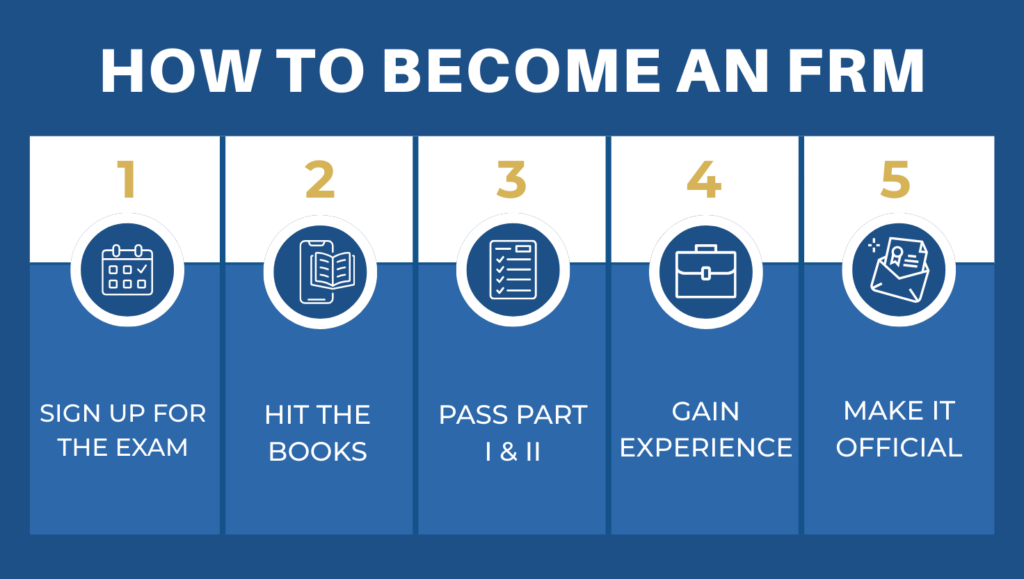
If you’re aiming to become a Financial Risk Manager (FRM®), here’s the path to follow:
- Sign up for the exam: First things first—you’ll need to register for Part I of the FRM® exam. The earlier you do it, the better the price. Just make sure you check the exam dates so you don’t miss your window.
- Hit the books: This part’s no joke. You’ll need to get familiar with financial risk, quantitative analysis, risk models, and how the financial markets actually work. You can use a mix of study guides, online FRM® courses, and practice exams to prep.
- Pass Part I: Once you’ve studied up, it’s go time. Part I focuses on the basics—think risk management concepts, financial markets, and math-heavy stuff like valuation models.
- Tackle Part II: After Part I, you’re cleared to register for Part II. This part is more about applying what you’ve learned—like figuring out how to assess financial risk in real-world scenarios across credit risk, market risk, and operational risk.
- Get real-world experience: To actually earn the FRM® certification, you’ll need two years of full-time work in a job that deals with financial risk. This could be in asset management, investment banking, consulting, or even portfolio management.
- Make it official: Once you’ve passed both parts and logged your work experience, you’ll earn your FRM® designation from the Global Association of Risk Professionals (GARP). That’s when the real career doors start opening.
If you’re ready to learn how to manage risk and level up in the financial world, the FRM® program is a solid place to start.
Conclusion
Now that I’ve done the research, I finally understand what the FRM® is all about and why so many financial risk professionals see it as a game-changer.
I’m not saying it’s an easy path. But if you’re serious about becoming a financial risk manager, building your knowledge of market risk, treasury risk measurement, and risk models, this is one of the most respected ways to get there.
Personally, I’ve come away with a much clearer picture of what this career path involves—and honestly, it’s way more interesting than I expected. If you’re on the fence, learning more about the FRM® program might be the best first step.
FAQ
It’s a global credential for professionals who manage financial risk. Ideal for roles like risk analyst, risk manager, or anyone in finance dealing with market or credit risk.
Yes—but it’s manageable with the right prep. It has two parts: Part I covers concepts; Part II focuses on applying them. Most candidates study for a few months per part.
Anyone working in or aiming for roles in risk management, banking, asset management, consulting, or financial regulation.
CFA is about investing and financial analysis. FRM® is focused entirely on financial risk—like credit, market, and operational risk.
About a year to pass both parts, plus two years of relevant work experience to get certified.

![UWorld Discount Codes: Save $1,800 [Verified 2026]](https://www.sacbee.com/careers-education/wp-content/uploads/sites/6/2026/07/uworld-discount-code-1024x768.jpg)