Light rail in Elk Grove moves closer to reality as implementation plan accepted
.JPG "One of Sacramento Regional Transit’s S700 low-floor light rail trains awaits riders at the Township 9 station in Sacramento in June 2024. The city of Elk Grove adopted a plan to extend light rail service into Elk Grove.")
The Elk Grove City Council accepted an implementation plan for bringing light rail to the city, moving one step closer to more public transportation for the area.
The City Council voted on the plan 4-0 at its meeting Wednesday. Mayor Bobbie Singh-Allen, who is the chair of the Sacramento Regional Transit Board, was absent but submitted a statement.
“Light rail will provide essential transportation options for our city and residents. Elk Grove will be better connected to Sacramento and our region,” Singh-Allen’s statement, read by Vice Mayor Darren Suen, said. “As SacRT chair, I look forward to working on this project to improve transportation options for our community.”
The adoption of the plan Wednesday was to study the feasibility of this plan and “does not commit the City to a course of action at this time, does not approve any physical changes to the environment, and does not have a legally binding effect,” the staff report reads.
The City Council also discussed exploring more ways to connect Elk Grove to the Sacramento region with public transportation and expanding the use of different technology.
Councilmember Rod Brewer said traffic congestion needs to be addressed as the city continues to grow in population, and public transportation in multiple different ways would aid that.
“We do need to reimagine how we do our transportation in Elk Grove as a whole and how light rail can play a role in that,” Brewer said.
Councilmember Kevin Spease said he hopes that people have “reasonable expectations” that any implementation of light rail will take years to approve and build.
The project is by the city of Elk Grove in partnership with Sacramento Regional Transit and funded by Caltrans, according to Kaley Lyons, the city’s transportation planning program manager.
It aims to reduce traffic congestion and household transportation costs, spur economic development, increase accessibility and prioritize underserved communities, the plan states.
Where would light rail go in Elk Grove?
The alignment would run on the west side of Bruceville Road south of Cosumnes River College to Calvine Road. It would then transition to center-running on Bruceville Road, turn east onto Big Horn Boulevard and continue south past Elk Grove Boulevard. Near District56, the line would shift to the east side of Big Horn Boulevard at Civic Center Drive and continue to Bilby Road. It would turn east at Bilby Road, remain on the north side of the street, cross via a new bridge and integrate into the city’s livable employment area community plan in a streetcar-style design.
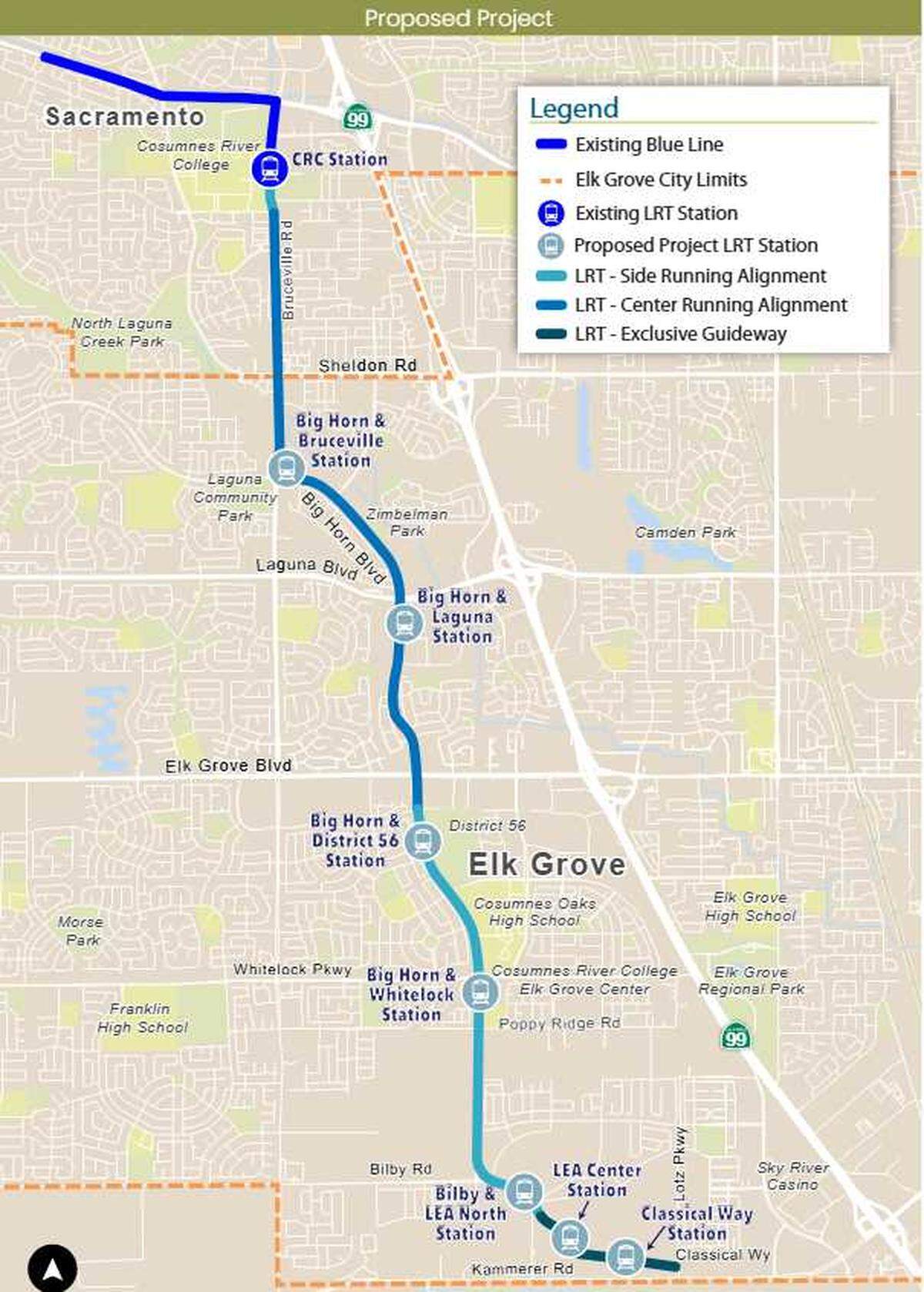
The plan includes proposed stations at Big Horn Boulevard and Bruceville Road, Big Horn Boulevard and Laguna Boulevard, Big Horn Boulevard and District56, Big Horn Boulevard and Whitelock Parkway, Bilby Road and a new area in the city’s livable employment area community plan, another center in the new community plan, and Classical Way.
Stations are proposed to include affordable housing, retail and pedestrian infrastructure.
Construction would likely occur in phases, according to Lyons and the staff report, starting with either one station at Big Horn Boulevard and Bruceville Road or three stations reaching District56.
An analysis of traffic impacts found “minimal additional delay at most intersections along the corridor,” the staff report reads, as the roadway would be widened to add dedicated transit lanes in most locations.
Light rail in Sacramento typically operates every 15 minutes throughout the day and every 30 minutes during early morning and late evening hours.
Elk Grove’s population nearly doubled between 2003 and 2018, creating increased demand for public transportation, the draft plan states. A 2024 census estimate put the population at 182,797 residents. Currently, RT’s light rail terminates at Cosumnes River College on Center Parkway, and many bus routes do not operate on Saturdays, Sundays or holidays.
Residents’ responses to the plan for light rail
Over 1,300 people viewed the draft plan, and 48 people left 73 comments, according to the staff report.
A majority of the concerns were regarding traffic, noise and crime.
“Traffic and noise impacts will be further evaluated, and the project team will work closely with both SacRT and the Elk Grove Police Department to implement crime prevention through environmental design principles and develop appropriate strategies,” the staff report read.
What would light rail in Elk Grove cost?
The estimated costs for the hybrid plan are approximately $1.06 billion in capital costs and $17.3 million in annual operating costs, according to Lyons. Fare revenue would contribute approximately $600,000 to operating costs.
“Any federal source will need to be accompanied by a substantial state or local contribution,” the city’s draft plan states. “It is likely that new local funding sources are necessary as part of the strategy for funding construction, operations, or both.”
Funding could include a future local sales tax measure dedicated to transportation, either countywide or regionwide, according to the presentation and the draft plan. Other sources could include grants from the Federal Transit Administration, the U.S. Department of Transportation and the California Air Resources Board, as well as funding from the Sacramento Area Council of Governments.
Other project stakeholders include the city of Sacramento, Sacramento County and the California Department of Transportation.
What’s next?
Lyons said the implementation of light rail is a “yearslong, complex effort.”
Next steps include coordinating with the Federal Transit Administration and state and local partners to identify funding sources and finalize a design, as well as updating city land use and zoning policies, Lyons said.
The adoption of the plan did not trigger a California Environmental Quality Act review, as it is a “conceptual design” going to be studied for feasibility.
“The implementation of any of the concepts identified in the Plan would include specific follow-up, CEQA analysis, and approval as needed, including further CEQA review before the commitment of funding for any construction,” the staff report reads.