Rocklin housing proposal raises concern for charter school garden, playground
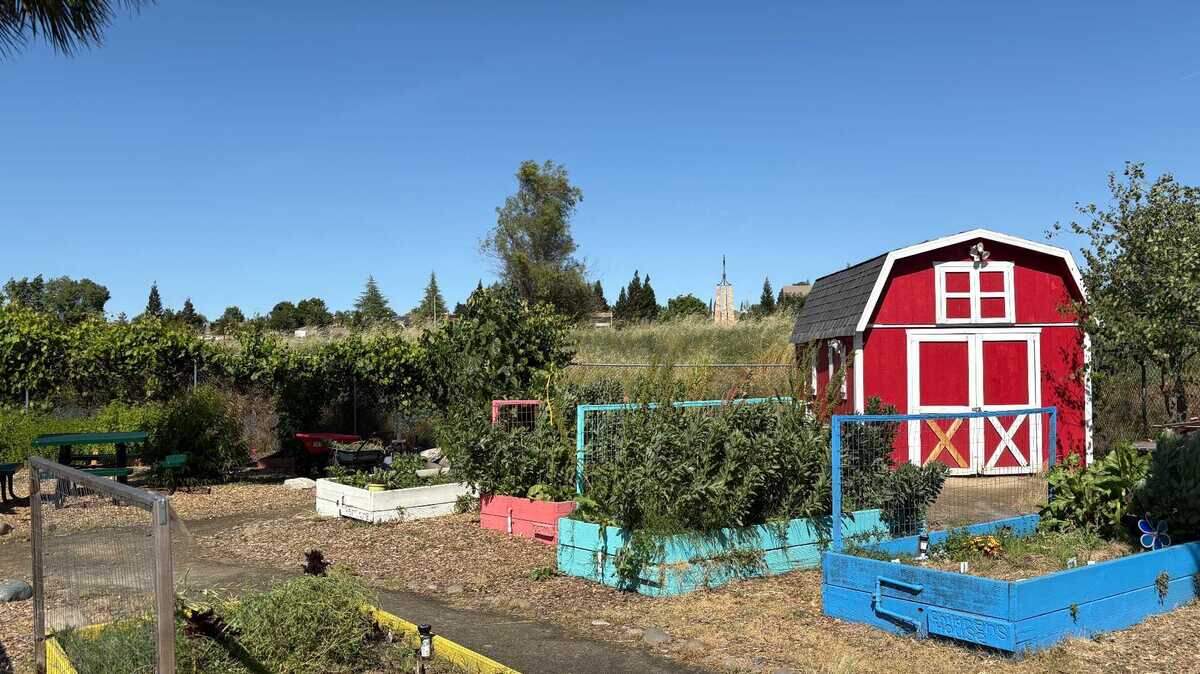
A proposed affordable housing project in Rocklin could displace a charter school’s community garden and part of its playground after the Rocklin Planning Commission approved a design review for a 118-unit development Tuesday night.
The proposed project would be built on land the school currently uses as a community garden, storage space and part of its playground. The property is owned by St. Augustine of Canterbury Episcopal Church, which previously entered agreements with Maria Montessori Charter Academy to allow use of portions of the land.
According to project documents, Sierra Wilds would include a three-story residential complex with apartments reserved for households earning between 30% and 80% of the area median income. The project targets residents earning about 60% of the area median income.
The area median income for the Placer County and Rocklin region is listed as $120,800 for a family of four and $84,550 for a single person.
Apartments would range from one to three bedrooms, with units between 607 and 1,166 square feet. Plans call for 180 surface parking spaces, landscaping and amenities including a community center, swimming pool, tot lot, barbecue area and dog park.
The church sold 3.4 acres in 2007 for the charter school’s construction.
Brent Boothby, principal of Maria Montessori Charter Academy, said the school later shared its facilities with the church.
“From December 2009 to January 2014, we shared our school site with the church — we were St. Augustine’s only home,” he said. “The church had exclusive use of half of our D Wing during that entire time.”
Over time, the two organizations also created a community garden and shared storage space on church-owned land adjacent to the campus.
Boothby said the garden operates under a lease that renews every five years unless either party provides 30 days notice. He said the church did not give notice in 2019 or 2024, which he believes extends the agreement until 2029.
However, Nathan Anderson, principal planner for the city of Rocklin, said church representatives told the city the lease has expired.
“The church has indicated that the lease allowing the garden has expired and that it must be removed to accommodate the proposed development,” he said. At this time, the matter remains a dispute between private parties regarding property ownership and control, and the City has encouraged the church and the school to work together to the fullest extent possible.”
Barbara Duval Jewell, an adviser for the church, said in an email to Boothby that the lease expired in 2019, though the church is willing to consider a month-to-month agreement.
“Any proposed lease would end no later than October 31, 2026,” she wrote.
Boothby said the school’s storage container has also been on the property for about 17 years in a location both sides agreed would be permanent.
The church and school entered another agreement in 2014 for use of a playground area about 6,000 square feet in size.
Church officials said the deed lists the property at 5,073 square feet, based on dimensions of about 57 feet by 89 feet. Boothby said his calculations show roughly 6,000 square feet, based on two sections totaling about 4,400 and 1,600 square feet.
Both sides said the fenced playground area extends beyond 6,000 square feet and is closer to about 6,600 square feet.
School officials said they were surprised when the church sold the property in 2024.
The Sierra Wilds proposal was submitted to the city in 2024 by developer Pacific West Communities,.
The design review lists the property owner as the Rector, Wardens and Vestry of St. Augustine of Canterbury Episcopal Parish in Rocklin.
City documents said the project site was originally zoned for business professional, commercial and light industrial uses, meaning the housing proposal did not initially comply with zoning.
In September 2025, however, the site was rezoned to allow a multifamily overlay after the city received a letter from the California Department of Housing and Community Development stating that under the Housing Accountability Act the city may not apply certain subjective standards to the project.
The development is also listed in the city’s 2021-29 Housing Element, which outlines how the city will meet state housing requirements.
Planning documents note that staff received several questions about the school’s agreements with the church.
“While staff acknowledges that portions of the site may be affected, these areas are located on church-owned land and consistent with private, recorded easements,” the application states. “Matters related to interpretations or disputes involving private agreements fall outside the city’s jurisdiction.”
Boothby said the proposed design would remove a required turnaround area for the school’s primary access road, making it noncompliant for a public elementary school.
Jewell disputed that claim, saying the project would not impair the hammerhead easement used by emergency vehicles.
“It is not being relocated,” she said. “Instead, the development will provide improved access for emergency vehicle ingress and egress through the project. This has already been approved by the Fire Department.”
Sundeep Dosanjh, chief of communications and community engagement for the Rocklin Unified School District, said the district recognizes the city’s responsibility to address housing needs.
“While we respect the city’s obligation to adhere to California housing development laws, we urge city officials to mitigate potential impacts on the school to the fullest extent of the law,” he said.
Parents at Maria Montessori Charter Academy said they are concerned about the environmental impact report included in a proposed design plan because the original study was conducted 14 years ago.
In 2025, the Rocklin City Council approved resolutions that allow projects considered to have minimal or no significant environmental impact to bypass a full environmental review under the California Environmental Quality Act.
“These actions aligned the city’s housing element with the Regional Housing Needs Assessment requirements for lower- and moderate-income housing,” the design review said.
Brandi Armstrong, a parent and member of the Urban Ethics Coalition, said families deserve transparency.
“Families deserve a transparent and legally sound site-specific review — especially when children are involved,” she said.