How quilting brought three Tahoe Park women — and a whole street — closer
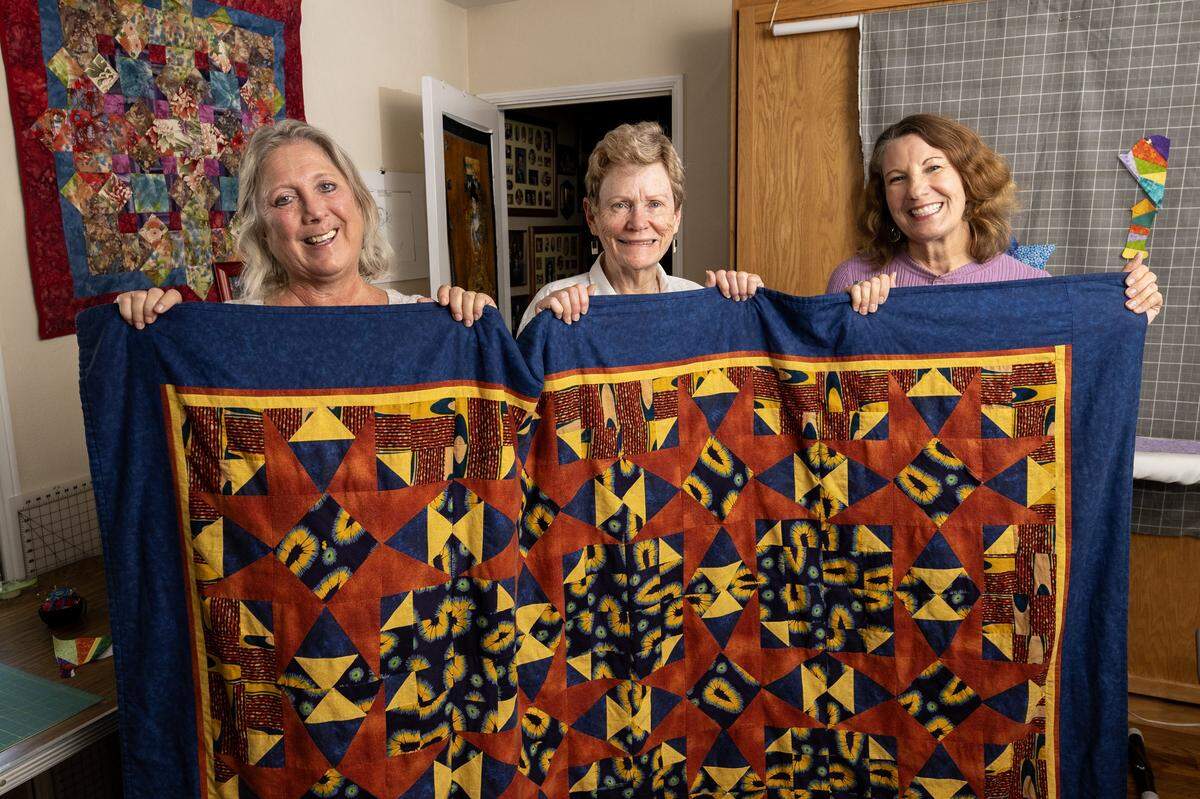
Colleen Megowan-Romanowicz was showing off a quilt she’d made when her neighbor Dion Peart had an idea: they should make one to celebrate a nearby high school graduation.
It was 2022, and the COVID-19 pandemic was still limiting many social gatherings to outdoor settings. Megowan-Romanowicz and Peart, who live on 13th Avenue in Tahoe Park, had dragged chairs to their neighbor Jessa Kay Cruz’s driveway on a Friday evening.
After Peart saw the quilt Megowan-Romanowicz had made for a baby born to her daughter’s neighbor, she realized they could create one for Cruz’s son, then a high school senior. Cruz had African prints, Megowan-Romanowicz had quilting knowledge, and Peart—recently retired from the Sacramento Municipal Utility District—had time to spare.
So began a tradition for Megowan-Romanowicz, Peart and Cruz, who have since committed to making quilts for every new baby born nearby. They’re up to about four or five quilts, with more planned and no plans to stop.
While each quilt takes months of weekend meetups, it’s a process that keeps them bonded and connected to their community.
“We had so much fun making that graduation quilt,” Cruz said. “We were like, ‘Let’s keep going.’”
How the quilts are made
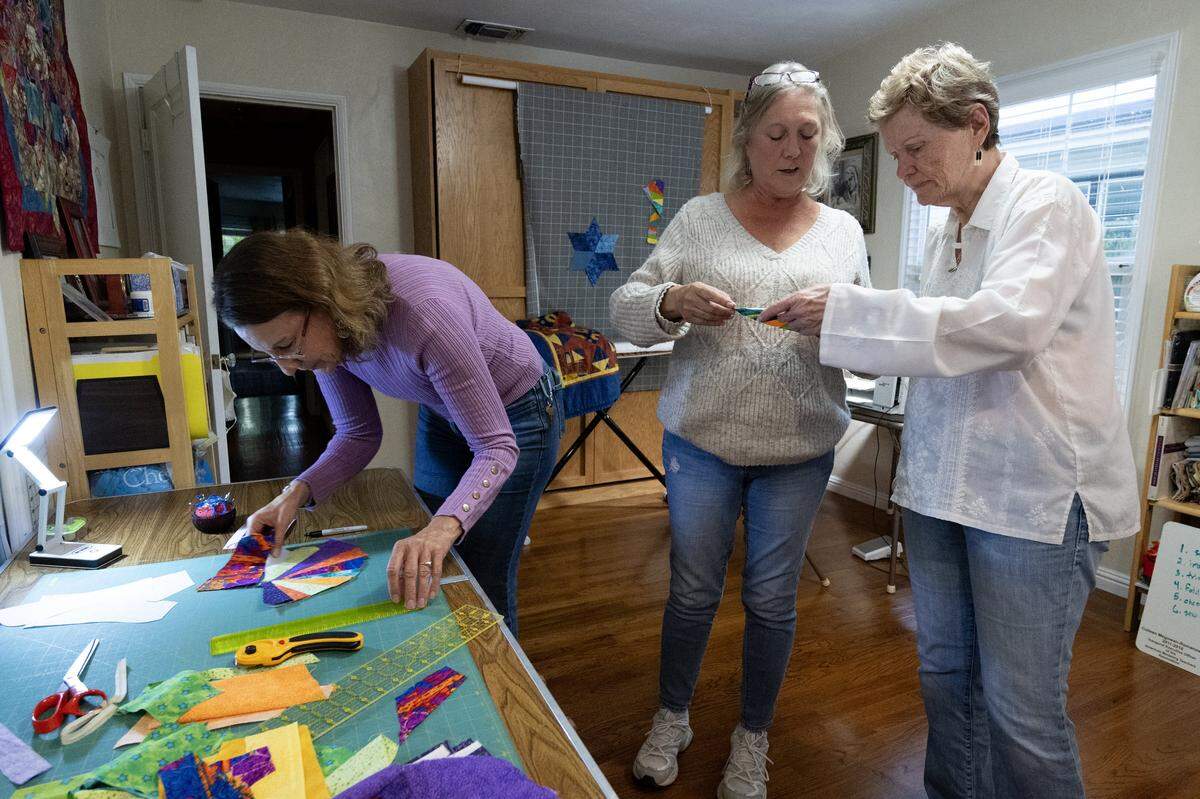
The three women gave a joint interview for this story from the crafting room at Megowan-Romanowicz’s house, where they gather to work. The room, about the size of a standard bedroom, was spacious enough to allow for social distancing while COVID-19 remained a concern.
Megowan-Romanowicz keeps loose fabric packed in the room.
“People have known that I quilt for a long time, so when their mother dies and she has fabric, guess who gets the fabric?” said Megowan-Romanowicz, a senior fellow for a science teacher’s organization. “Plus, I’m starting to get unfinished projects as well.”
Cruz, a biologist, had never quilted before, but welcomed the chance to learn.
“As you get older, you don’t tend to learn new things as often as when you’re a young person,” Cruz said. “It was really exciting to me that even at the age of over 50, I could actually learn something new and have a new hobby.”
Peart and Megowan-Romanowicz both had mothers who crafted. Peart said that gave her some sewing experience. For Megowan-Romanowicz, quilting came later.
“I love to quilt,” Megowan-Romanwicz said. “My mother quilted. I would never have quilted when she was alive because she would never have judged my work to be anything but common because I use a sewing machine. Mom made quilts by hand.”
A high school physics teacher before returning to school in her 50s to earn a Ph.D., Megowan-Romanowicz has devoted much of her life to education. She was a patient teacher for Cruz.
“I never felt like I was going to get judged if I screwed something up,” Cruz said.
Why the quilts matter
Before long, they were delivering quilts to neighbors, such as Ari Asher, who lived nearby at the time with her wife and their son Sam, born in 2022. The family has since moved to Chicago, but the quilt the women delivered still holds meaning.
“It felt really heartwarming to know that these people that you share so much physical space with — and we spent so much time together during the pandemic in particular — really worked hard at something that was so special and important for us,” Asher said.
While the neighborhood has an active text chain, some didn’t see the quilts coming. Omar and Elizabeth Muniz, who also live on 13th Avenue, welcomed their daughter Vida in 2022. At first, they were surprised, Omar Muniz said.
What’s stuck with him is the feeling that the quilt represents community.
“We live in a time now ... it’s easy to feel socially isolated,” Omar Muniz said. “I’m grateful that we on 13th Avenue are a very tight-knit community.”
Quilting’s place in history
The Crocker Art Museum has a small quilt collection, spanning the 19th and early 20th centuries, as well as more recent works — with a gap in between — according to Scott Shields, the Ted & Melza Barr Curator for the museum.
“They’re just as much an art form as any other,” Shields said. “And I think today, especially, a lot of artists are branching into media that would formerly be called crafts.”
Some early quilts in the Crocker’s collection don’t have artist names attached, Shields said, because quilts weren’t always recognized as fine art.
Still, quilts have served an important societal function over time, according to Michael F. James, an emeritus professor at University of Nebraska whose 2003 quilt “Dreamer (The Three Graces)” was recently acquired by the Crocker. He noted that quilts are generally made by women and that they often capture collective traumas.
“You can look at the Civil War and you’ll find Civil War quilts,” James said. “You can look at the world wars and same thing. Vietnam, same thing. Most recently, the wars in the Middle East, same thing. Women responded.”
He also said the pandemic gave crafting a boost, with many people turning to patchwork, quilting and knitting—activities that, he noted, “fit into the constraints that the pandemic imposed, because those have always been practices that don’t require a large space.”
Shelley Wardrop is president of the roughly 200-member strong Folsom Quilt and Fiber Guild. The members make quilts that can go to foster children or people experiencing homelessness, though it’s not just altruism motivating the quilters.
“I feel sometimes like quilt makers are like that gardener with zucchini,” Wardrop said. “Like, the neighbors shut the door and hide behind the curtain whenever they see you coming with zucchini. Because quilt makers love to make quilts and our families and our homes can only absorb so many quilts.”
Different motivations keep the women of 13th Avenue quilting. For Peart, it’s about friendship.
“This is fun, just to get together and just get caught up,” Peart said.
For Cruz, it gets back to what something like quilting can do to foster community.
“Things where people are coming together to support each other, I just think it’s a really important thing,” Cruz said.
This story was originally published November 16, 2025 at 5:00 AM.
CORRECTION: This story has been updated to correct Michael F. James’ name.