
Want authentic Asian ingredients delivered? In Sacramento, there’s now an app for that
Larry Liu has long enjoyed cooking, but finding common ingredients from his native China was once difficult in the Sacramento region. As a student at UC Davis 15 years ago, Liu could rarely find foods he often ate, including bok choy, pork belly and Beijing yogurt, also known as “suan nai.” He and his wife wanted to prepare meals for their children with tastes from home.
Decades-old Asian supermarkets scattered along Stockton Boulevard in south Sacramento – including Vinh Phat, Welco, Wing Wa and Oto’s Marketplace – mainly sold Vietnamese and Japanese products. Other supermarkets sold a smaller variety of Chinese food products. During his five years in Davis, Liu had to drive to Berkeley, the closest city with Chinese supermarkets, to stock up his kitchen.
He was not alone.
Liu was an active user of the Chinese texting app WeChat. In late 2014, after moving to the Bay Area, he became a member of a chat group that facilitated bulk purchases of black cod from Half Moon Bay to the organizer’s garage. To everyone’s surprise, 300 orders were made in one night. Liu and other neighbors showed up at the organizer’s house to pick up the cod. He brought the fish home, sprinkled green onion on it and steamed it with ginger and soy sauce, serving the fish Chinese-style.
“There were a lot of people who couldn’t find authentic Asian products, who has the exact pain point as me,” Liu said.
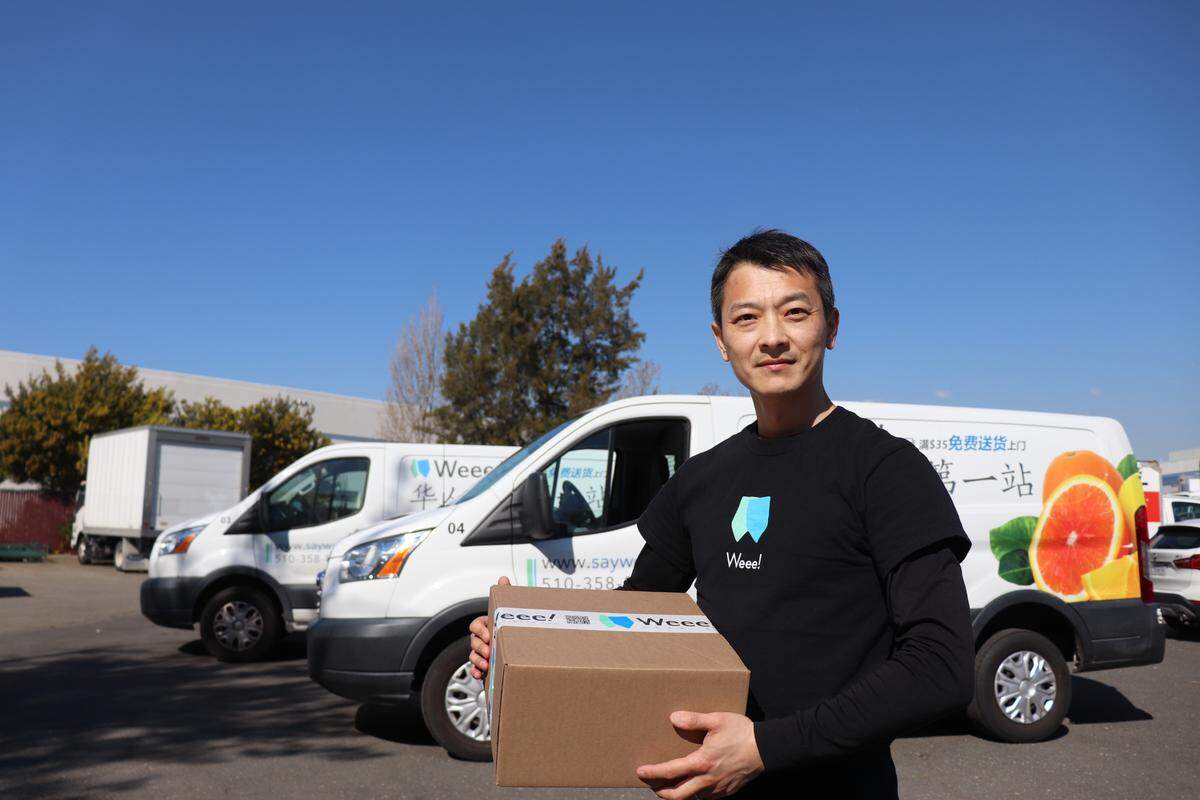
The “pain point” sparked the idea of an e-grocery start-up called “Weee” in 2015. Liu launched the platform in the Bay Area, made available in an app, and it now offers consumers fresh seasonal produce, snacks and seasonings from China, Taiwan, Korea, Japan and Hong Kong. The Weee app now serves 300,000 users and 70,000 active buyers in the Bay Area, Sacramento and Seattle. Around 5,000 clients make regular orders in the Sacramento region.
There is a large and growing demand for the service. Around 80 percent of Weee’s customers are originally from mainland China, followed by another 10 to 15 percent from Hong Kong and Taiwan. Around 1 percent are Korean, and the remaining 5 percent are English speakers.
Sacramento was the fastest growing major city in California in 2018, gaining more than 7,000 residents and adding more than 2,350 new housing units, according to the state Department of Finance. Much of the growth came from overseas, especially migration from Afghanistan, China and the Philippines.
About 2,500 products are available at the company’s warehouse in Fremont, and green onions, enoki mushrooms, Shanghai bok choy and soft tofu are the most popular. Pre-packaged Master Kong iced lemon black tea and Lan Fong Yuen Hong Kong milk tea are also very sought-after among consumers.
Weee’s products target mainly east Asian shoppers and provide far more choices than other companies, including Instacart and Amazon.
Weee’s delivery model also enhances efficiency. Some online shops deliver on demand, Liu said, meaning drivers have to stand by to deliver whenever there’s an order. By using next-day delivery, Weee’s drivers can combine orders with adjacent addresses and deliver to more locations per hour. This allows the company to keep costs down and pass savings to customers by offering cheaper products.
So far, Weee is delivering three days a week in Sacramento. Liu hopes to increase the frequency to five days – then launch delivery everyday in the upcoming months.
Brick-and-mortar grocery stores are still more appealing to online shoppers when it comes to fresh food, according to September data from market research giant Nielsen. According to the study, e-commerce accounts for “nearly one-third of the total growth” of grocery sales. However, online grocery shoppers spend 1.5 percent more in-store on fresh produce compared to the average consumer.
Surprisingly, many Weee customers purchase fresh fruits and vegetables on the platform, contrary to the common perception that shoppers would like to inspect and pick their produce.
Liu said he grows his client base through word-of-mouth marketing and building trust with customers.
“Our produces do not sit on the shelf and wait for customers. Once you try it you’d realize they are more fresh,” Liu said. “They (clients) just overcame their (shopping) habits and purchased to see their products in person.” Customers dissatisfied with the products are always welcome to get a refund, he added.
Weee has over 200 employees staffing its headquarters and warehouse in Fremont.
Liu said the company’s name refers to “we,” a social e-commerce made for a collective of people sharing and buying together. It also resonates with “Weee!” – the happy sound kids make when they go down a slide – which embodies an exciting experience for shoppers to buy food with the app.
Weee is expected to launch in Los Angeles in late 2020 and expand into several metropolitan areas across the United States and Canada in the next five years.
Please spread the word about our new newsletter produced in collaboration with Report For America and send to a friend. Sign up here to receive the newsletter each week.
This story was originally published October 24, 2019 at 3:46 PM.