El Dorado Hills sushi restaurant to open dining room this weekend, defying state order
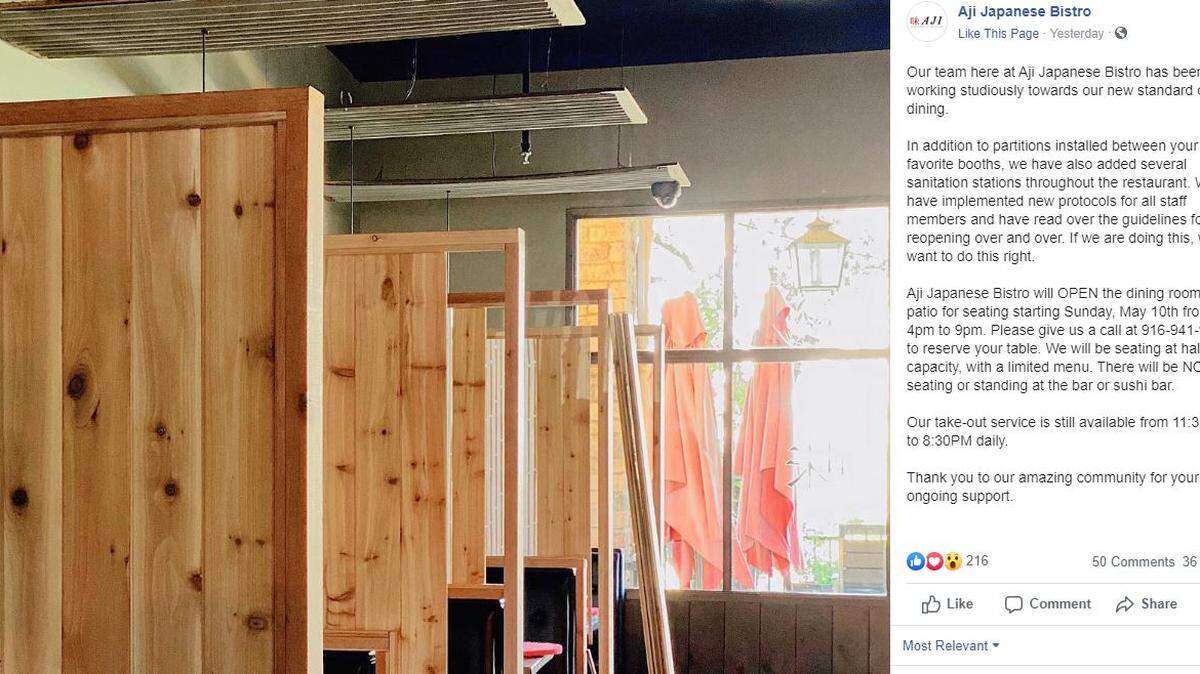
A sushi restaurant in El Dorado Hills says it will reopen for seat-in dining this weekend, even though California’s stay-at-home order continues to prohibit eateries from doing so throughout the state.
Aji Japanese Bistro, an Asian fusion restaurant and sushi bar that has stayed open for takeout since the coronavirus pandemic halted dine-in service at all establishments in March, announced Thursday on Facebook that it will reopen its dining room starting from 4 p.m. to 9 p.m. this Sunday — Mother’s Day — but with a number of modifications to promote social distancing and sanitation.
“We will be seating at half capacity, with a limited menu,” the social media announcement said. “There will be NO seating or standing at the bar or sushi bar,” and the restaurant has installed “partitions” between all booths and “several” sanitation stations.
El Dorado County last week became the first in the state, among those that had issued countywide stay-at-home or shelter-in-place directives, to allow that order to expire ahead of Gov. Gavin Newsom’s mandate. The governor’s order came March 19 as a measure to slow the spread of COVID-19, the disease caused by the highly contagious coronavirus.
Aji is located in El Dorado Hills Town Center, the suburban city’s main shopping center located just off Highway 50.
Dozens of Facebook users commented on the post, most of them supportive.
“Before making the decision to open we had several conversations with EDC officials as well as the EDC Environmental Health dept.,” the restaurant wrote Friday morning in response to a comment asking about its precautions.
Russell Okubo, the restaurant’s managing owner, told the Sacramento Business Journal this week that he could “only stay alive on to-go for so long.”
While local officials and a county spokesperson say El Dorado will use a communication-based approach rather than enforcing shutdowns or issuing citations, Okubo may face the risk of discipline from the state Department of Alcoholic Beverage Control, including the possible suspension or loss of Aji’s liquor license.
“If that happens, then I just have to get shut down,” he told the Business Journal.
The question remains: Will it happen, to Okubo or to others?
The ABC’s policy appears to be that restaurants and other licensed businesses will get one warning.
“In more than 98 percent of the cases the Department has investigated (in response to complaints), the licensee has agreed to shut down voluntarily pursuant to the Department’s request,” a post to the ABC website dated May 1 reads.
The department said it will not pursue disciplinary action against licensees who comply voluntarily with ABC regulators’ requests. But for those that continue to operate, ABC says it is “pursuing administrative action against the licensed premises, an action that could result in the suspension or revocation of the license.”
Whether that has happened yet in the greater Sacramento area is not clear.
Okubo is not the first restaurateur to open a dining room ahead of the state’s blessing. ABC regulators visited a handful of restaurants in Yuba and Sutter counties earlier this week, telling them to shut down. ABC regulators’ visits to Yuba and Sutter counties came Tuesday, one day after local health officials allowed a partial reopening of numerous businesses, notably restaurants, stores, hair salon and gyms.
It was not immediately known how many, if any, of the remaining 2 percent of licensed businesses — the ones that presumably did not agree to shut down voluntarily — have yet faced formal disciplinary action. If there were any, it is also unknown how many came in Yuba, Sutter, El Dorado or the rest of the four-county Sacramento region. An ABC spokesperson did not immediately respond to The Bee’s request for that information Friday morning.
“Agents asked those ABC licensed locations (in Yuba and Sutter) to close to in-house dining voluntarily, until it is safe to reopen, in order to help stop the spread of COVID-19,” ABC spokesman John Carr told The Sacramento Bee on Wednesday evening. State officials noted that failing to do so could constitute a misdemeanor crime. “As of (Wednesday), we have not filed any administrative actions against any businesses visited yesterday.”
How do restaurants figure into statewide reopening plan?
Newsom has laid out a four-phase plan for gradually reopening the economy: Phase 1 represented the full closure of non-essential businesses, including restaurants except for takeout and delivery service. During Phase 2, a number of businesses deemed “low risk,” including retailers, manufacturers, office spaces, shopping malls and restaurants’ dining rooms may be allowed to reopen but with “meaningful” modifications.
Phase 3 sees the reopening of businesses with a higher risk of virus transmission, including beauty salons, barbershops and gyms. And Phase 4 will represent the full lifting of the stay-at-home restrictions, which would allow crowd gatherings, such as sporting events and concerts, to resume.
Newsom just began the start of Phase 2, permitting a number of retail businesses to open for curbside pickup only as of Friday. Restaurants will have to wait, he said.
Local leaders in more rural and suburban, less densely populated parts of California have urged Newsom to allow counties greater autonomy in creating their own plans to open their economies back up, arguing that the statewide order is unfair to those counties, which have seen lower infection and death rates relative to urban hubs like Los Angeles County.
Yuba and Sutter County, which are joined under one bi-county public health department, directly defied Newsom’s order by allowing dine-in eating, gyms, salons and a shopping mall to reopen at the start of this week. During a daily press briefing, Newsom said the counties were making a “big mistake.”
Newsom announced this week that counties will be able to accelerate ahead of the state’s reopening, but still within Phase 2, with their own self-certified plans, if they meet certain criteria. He and state Health Director Dr. Mark Ghaly on Thursday shared a preview of some of the guidelines, which will be formally given to counties.
If they meet the requirements, they may begin to reopen restaurants for adapted, in-house dining. But it’s a tough test that Sacramento, El Dorado, Placer, Yolo, Sutter and Yuba counties all currently fail. Ghaly laid out some numbers for minimum testing rates, surge capacities and contact tracing staff levels per capita needed before counties could self-certify their plans.
All six of those counties come short of the required 15 contact tracers per 100,000 residents. El Dorado County would need 29 by that metric; it currently employs three such people full time and one half time, and had previously planned to increase to 10 full time to meet demands, a county official said.
Prior to the governor’s and Ghaly’s comments Thursday, El Dorado County health officer Williams had written that she believed the county had “well surpassed the minimum readiness standards and is in an excellent position to maintain them for the long run.”
“We’ll be ready to go at the soonest possible moment we’re allowed to,” county spokeswoman Carla Hass said Thursday.