
Are Sacramento restaurants safe after an inspection? A county expert answers
Restaurants are revolving doors of people and food, the perfect circumstances for bacteria to grow and lurking cockroaches to build a nest among food crumbs and scraps.
With so many opportunities for germs to spread, contracting a foodborne illness from eating at a restaurant is not unheard of. However, the California Department of Public Health and county-level health authorities are working to educate restaurant managers and the general public on proven methods for mitigating the risk of spreading bacteria and illness.
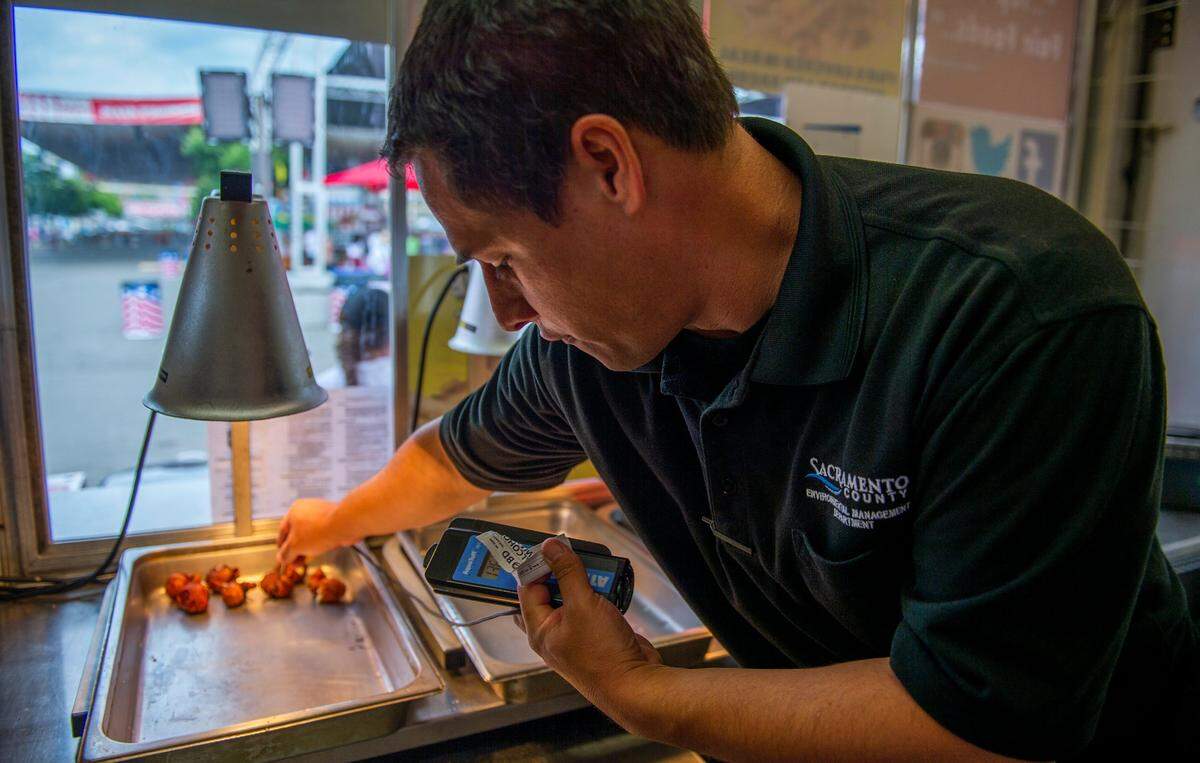
In Sacramento County, environmental health specialists travel to thousands of food facilities unannounced to verify compliance with California’s retail food code, which outlines how restaurants must prepare food safely for consumers, keep their facilities in top shape to avoid pests, ensure hygiene stations are in sanitary conditions for customers and employees, and more.
The Sacramento Bee spoke with Supervising Environmental Specialist Erica Uriarte of the Sacramento County Environmental Management Department to find out what the job is like.
Uriarte has worked for Sacramento County for over six years, starting as a health inspector and most recently being promoted to supervisor. Although she said she doesn’t go into the field as often as she used to, she works with the county’s current inspectors to verify inspection reports, informing her work with nearly two decades of inspection experience.
Most recently, Uriarte helped manage the more than 100 health inspections required to host the Terra Madre Americas festival Sept. 26-28 in downtown Sacramento, which included food trucks, alcohol and coffee sales, cooking and butchering demonstrations and free food sample handouts.
The following interview has been edited for length and clarity.
Q: What’s the process like for an environmental specialist finding violations during a food facility inspection?
A: Generally, an inspector will do four, sometimes five inspections a day. If the inspection goes smoothly, where they don’t have any questions, they don’t have to reach out to a supervisor.
Even if they’re going to give a yellow (conditional pass placard) — which is two or more major violations — they don’t have to contact their supervisor, they just have to do the report that day. But if it’s a closure, which is a red placard, that’s when they have to reach out to their supervisor, and then we notify the other supervisors. That way, in case we do get a phone call (about a restaurant, we can say) “Yes, this facility was closed because of no hot water, or their refrigeration went out, or there was a rodent infestation.”
Staff reach out to their supervisor if there’s a closure or to get their opinion on something. That way, we’re not discarding food or giving someone a major violation or changing their placard color because of, you know, a misunderstanding, or just not being sure.
We write our (observed) violations down, and then later that gets written or typed into a report that’s accessible to anyone who wants to view it.
Q: What are examples of major violations?
A: So a major violation, say you have no soap or no paper towels at a hand-wash sink, that would be a major violation. Or if the hand-wash sink was inaccessible — you just can’t get to it, or there’s a pot filling up with water, that’s an inaccessible hand-wash sink.
A temperature violation (is considered major). Below 41 degrees (Fahrenheit) ... and above 135 degrees (is expected) for food holding temperatures. Another major violation would be improper cooling. For hot foods, we want it to cool down from 135 degrees to 70 degrees within two hours, and then 70 degrees to 41 degrees within an additional four hours.
Unapproved food source (is a major violation) too. We need to make sure (food comes) from an approved source and you’re not bringing in a game animal that you happened to hit on the road and now (serve to) customers.
Q: How many inspections does the county perform? How often do restaurants fail?
A: Last fiscal year (from July 1, 2024, to June 30), we conducted about 11,000 inspections, and 97% of those resulted in a green pass placard. About 2% were yellow (conditional pass) placards, and less than 1% were (closures).
Q: How do restaurants get reopened after being shut down?
A: If there’s a closure, generally, it has to be at least 24 hours (until a re-inspection). So when a facility is closed, they have to be closed for up until the next business day and then we go out and do the re-inspection. We do a follow-up inspection generally within 30 days, and if we’re still seeing any signs of pests, even dead roaches on a sticky trap or mouse droppings, then we’ll continue to work with the facility and do follow-up inspections to get them in compliance.
Q: Can the Environmental Management Department permanently shut down restaurants?
A: Not that I’ve seen. It would have to be condemned by like, the (code enforcement division) if there was a structural issue, or there was fire damage and we couldn’t reinstate the permit.
Q: Are food facility inspections required by California law?
A: Yes. Under the California Retail Food Code, facilities are required to be inspected at least once a year. For smaller markets, generally, those are done once a year. Then, larger restaurants are done two to three times a year. (With) complaints or (foodborne illness) investigations, we could be out there more, hopefully not.
Q: How often are there complaints?
A: We get, a variety of complaints. ... I would say we get, maybe four to five a day that come in, so quite frequently. Monday is the busiest day because people, like over the weekend are out more.
Q: Do all complaints lead to investigations?
A: If (the complaint is) something we can enforce, or if (the restaurant is) due for a routine inspection. Sometimes it’s a phone call. It can be a quick thing, but if they’ve had a history of handwashing violations, we’ll send someone out there. Or if someone says (they) saw a rat, cockroaches or anything that could lead to a closure, then we will go investigate that.
Q: What resources are available for restaurateurs to ensure they are staying compliant?
A: We have made a booklet called the Retail Food Inspection Guide, and it breaks things down in a lot smaller and more readable way for operators. It gives them some reference as to why something was a violation, because sometimes the code is not the easiest thing to read. We have it offered in a few languages as well.
We do have inspectors (who) speak different languages, so if there’s a language barrier, we can reach out to them or use translation services to understand what the operator is trying to tell us, and that way there’s no hang ups.
Q: Should diners feel safe going to a restaurant that has a green placard, even if it was recently closed?
A: I think so, because (operators are) going to do everything they can to reopen. So they’re going to work with a pest control operator where that’s their bread and butter. They’re going to know what works, what they can use, what’s safe in a food facility to get rid of roaches. And not only did they do that, but they also clean in the meantime, because being closed will give you time to clean.
.jpg)