
Why has Sacramento never annexed Arden Arcade? Your Bee Curious question answered
Arden Arcade is not a city — nor does it belong to one. And its unincorporated, underrepresented status has irked some residents for decades.
“With the police protection we have here they couldn’t find an elephant in my bathtub,” said Arden Arcade resident Donald E. Halster, during a meeting in 1958 at Del Paso Manor School on 2700 Maryal Drive — now known as Del Paso Manor Elementary. Residents were gathered at the time to discuss the annexation of the district into the city of Sacramento.
“My house was burglarized six months ago and I haven’t heard a peep out of the Sheriff’s Office.”
Halster voiced one of the many irritations residents had about Arden Arcade’s footing in Sacramento County.
“I have my police department in my closet — my rifle!” said Halster, who signed a petition to bring Arden Arcade under Sacramento’s jurisdiction.
By 1959, the petition had 7,514 signatures and was validated for an election. Despite what seemed like widespread support for annexation and what became the largest proposal of its kind to be processed in Sacramento, Arden Arcade was never annexed.
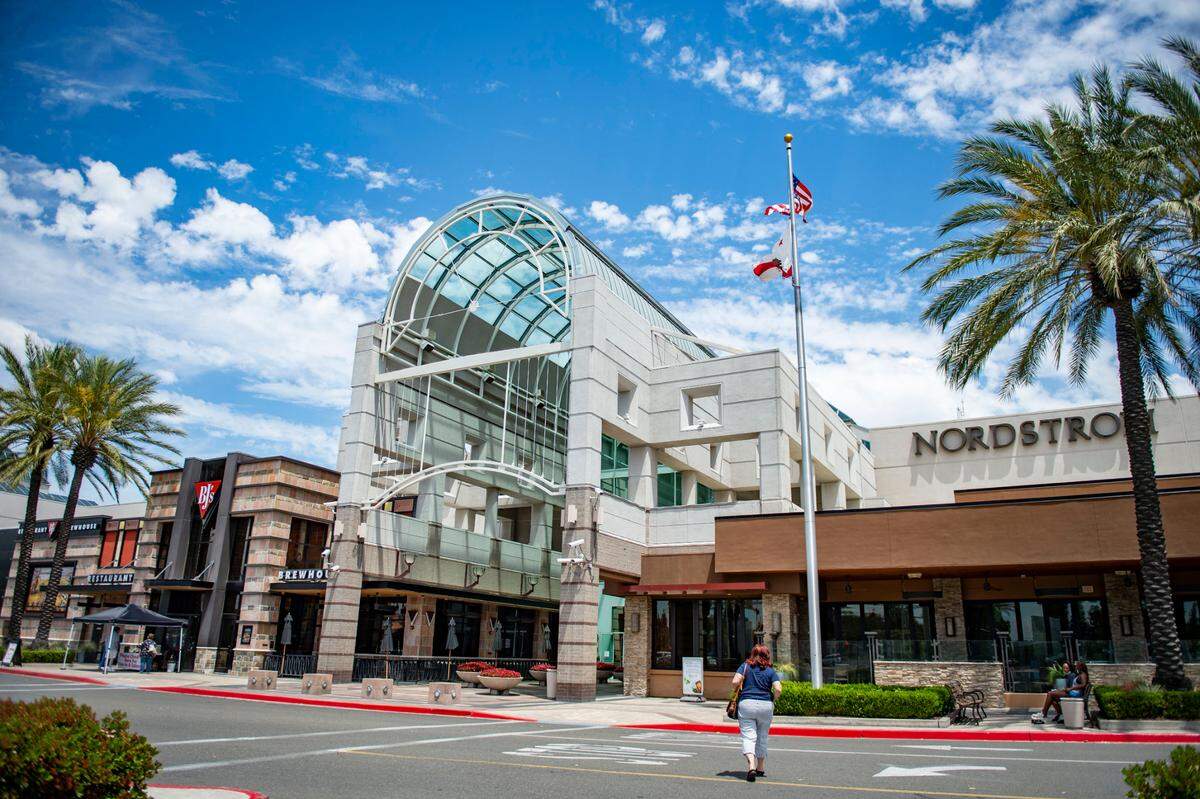
Years later, Arden Arcade continued to shed its agricultural roots and grew to more than 90,000 residents, adding diverse restaurants, shopping centers and housing developments. And as new generations made homes in Arden Arcade, questions about annexation lingered.
Arianna Smith, a resident of Arden Arcade for more than a decade, recently asked Bee Curious, a community-driven series: “Why hasn’t the city of Sacramento ever annexed Arden Arcade?”
“I love living here — we have great parks, wonderful libraries, awesome farmers’ markets, cool and unique businesses and restaurants in and near Arden Arcade,” Smith said in an email to The Bee.

But she said there are some things she doesn’t love, including the poor transit options, dangerous roads and a lack of homeless support services.
“I guess my question stems from both my happiness with Arden Arcade and my interest in seeing more help for the people who live in this place I care about,” Smith said.
To answer Smith’s question fully, we first dug into what a move like this would mean for Arden Arcade and Sacramento communities.
BEHIND THE STORY
MOREHow we did this story
This story is part of a community-driven series in which Sacramento Bee journalists answer reader-submitted questions. Arianna Smith, a resident of Arden Arcade for more than a decade, asked Bee Curious: Why hasn’t the City of Sacramento annexed Arden Arcade?
Reporter Hanh Truong used The Bee’s archives and online government documents pertaining to the proposed annexation of Arden Arcade, to answer the question. She then fact checked historical information with a senior city archivist.
What is Arden Arcade?
Arden Arcade, about 10 miles east of Sacramento’s core, is a sprawling unincorporated district. It’s U.S. Census Bureau designated, meaning it’s an area delineated by the government for statistical purposes, and does not have an elected mayor or city council.
Yet it is one of the “most intensely developed areas of unincorporated Sacramento County,” according to Sacramento’s 2035 General Plan, the city’s guide for the future.
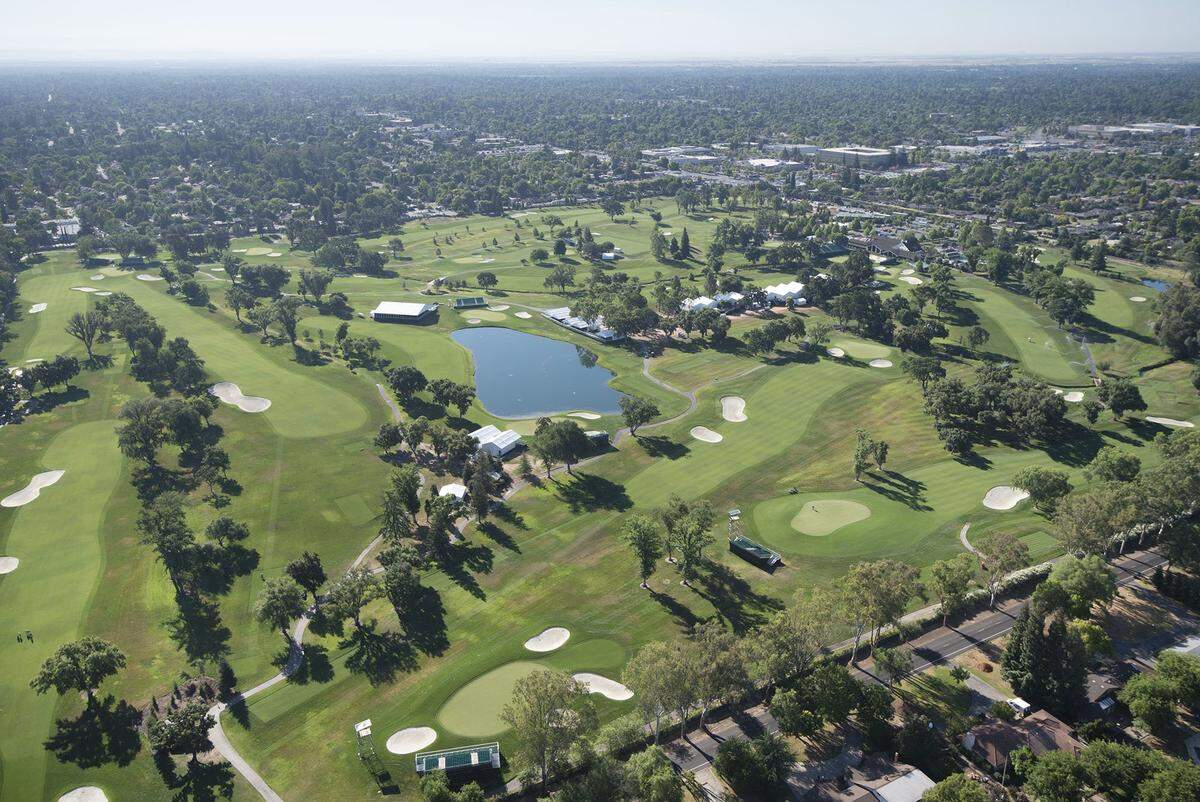
Tucked between the city’s eastern edge and the community of Carmichael, and neighboring the famed California Exposition and State Fair lies Arden Arcade. There, the Capital City Freeway and mature trees line Auburn Boulevard, hugging the community’s northern boundary while the breeze from the American River encloses the south.
Spacious suburbs with a scattering of schools, parks, churches and businesses are rooted throughout the district’s 17.8 square miles, between Mission Avenue and Ethan Way — the eastern and western borders.
Arden Arcade’s creation dates back to the 1800s, but its origin is complicated. According to a community plan, the lands that became Arden Arcade had “a history of muddled ownership and legal tangles.”
Arden Arcade was a part of Rancho Del Paso, a Mexican land grant in Sacramento County that also included present-day Rio Linda, Del Paso Heights, North Sacramento and parts of Carmichael. Initially, the Nisenan of the Maidu tribe resided in the area. Settlers eventually developed the lands in the 1910s and ’20s as farms before real estate speculation divided the land further, mainly in the 1950s.

As a community within Sacramento County, Arden Arcade is overseen by the county Board of Supervisors and is served by agencies such as the Sacramento Metropolitan Fire District, the North Central Division of the Sheriff’s Office and the Sacramento Regional Transit District.
Like a small city, but without the designation of a one, Arden Arcade is growing on a foundation of inadequate transportation, inaccessible food supplies and income inequality.
While manicured lawns and pristine mansions are etched into some parts of Arden Arcade, other areas are marked with unkempt streets and aging buildings.
According to a Bee report from 2018, people seeking inexpensive rent and refugees from Afghanistan, Iraq, Russia and Syria have huddled in the northern and western part of the community while affluent residents live south toward the American River.
In the last decade, the district has seen more Asian and multi-racial residents within its borders. But researchers from the University of California, Berkeley, found that racial segregation was still high in the Arden Arcade area in 2020.
Segregation has scarred the Sacramento region since the 1900s, having been built on racially restrictive covenants and redlining — and Arden Arcade was no exception, according to a case study of Sacramento for the National Commission on Fair Housing and Equal Opportunity.
New Deal housing programs in the 1930s allowed for covenants, which are formal restrictions on who can purchase or rent property. This gave housing developers the right to exclude Black people and other non-white communities from “housing tracts in elite neighborhoods” and areas such as Arden Arcade and Carmichael, the case study showed.
What annexation would mean
Annexation occurs when a city expands its limits into unincorporated territory, according to the city of Sacramento. With this expansion, the city also extends its regulations, voting rights, taxing authority and services, such as sanitation and water.
Sacramento has been annexing nearby territories since 1911 and continues to do so to this day, according to a map of the city’s annexation history.
.JPG "SAC_PK_FAIR_0428 (1).JPG")
In Sacramento, acquiring or bringing land into the city is a two-step process.
Cheryle Hodge, principal planner and the new growth manager for the city of Sacramento’s Department of Community Development, said in an email that an area must be in the city’s sphere of influence before an annexation can take place.
The sphere of influence is a plan for the potential extension of municipal services, she said. And only the Sacramento Local Agency Formation Commission, a state-mandated county-wide group, has the authority to determine or change the SOI or city’s boundary.
“It’s not unusual for an area to be in an SOI for years and annexation does not necessarily occur,” Hodge said.
Arden Arcade is not in the city’s existing SOI boundary, nor are there plans for annexation.
The ‘Matisse nightmare’ of Arden Arcade
Conversations about uniting Arden Arcade and Sacramento have long been in the air, with several meetings held in 1958 and 1959 to field public and city official opinions on annexing a proposed area that included Arden Arcade, the future Cal Expo and Del Paso Park, according to Bee archives.
“We have the most uneconomical and inefficient structures of government in the area,” an Arden Arcade resident said in the same meeting where Donald E. Halster shared his frustrations at Del Paso Manor School on Dec. 18, 1958. The gathering was held by the special committee of the Arden Arcade District Council of Improvement Clubs and is where Arden Arcade residents decided to seek annexation.
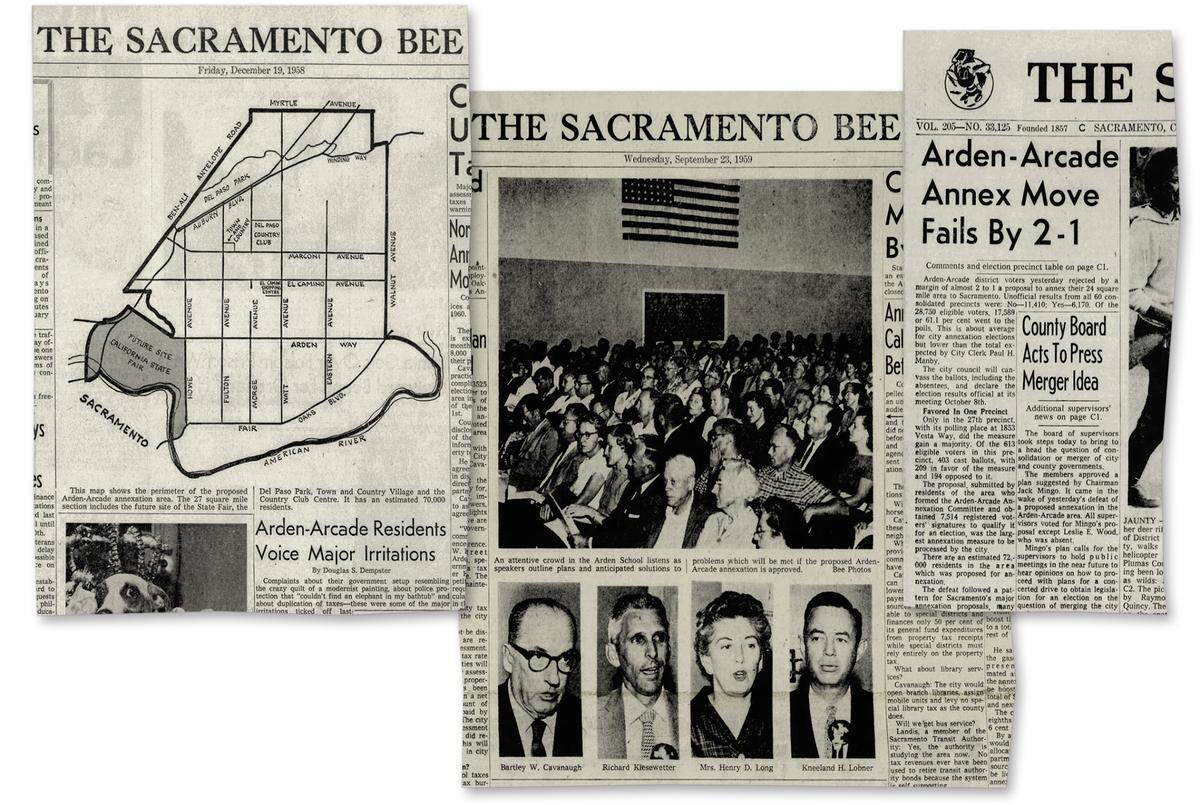
The resident called the area “jerry-built,” with its three elementary school districts, two high school districts, four park districts, three fire districts, six lighting districts, six water districts, six sewer districts and four drainage districts.
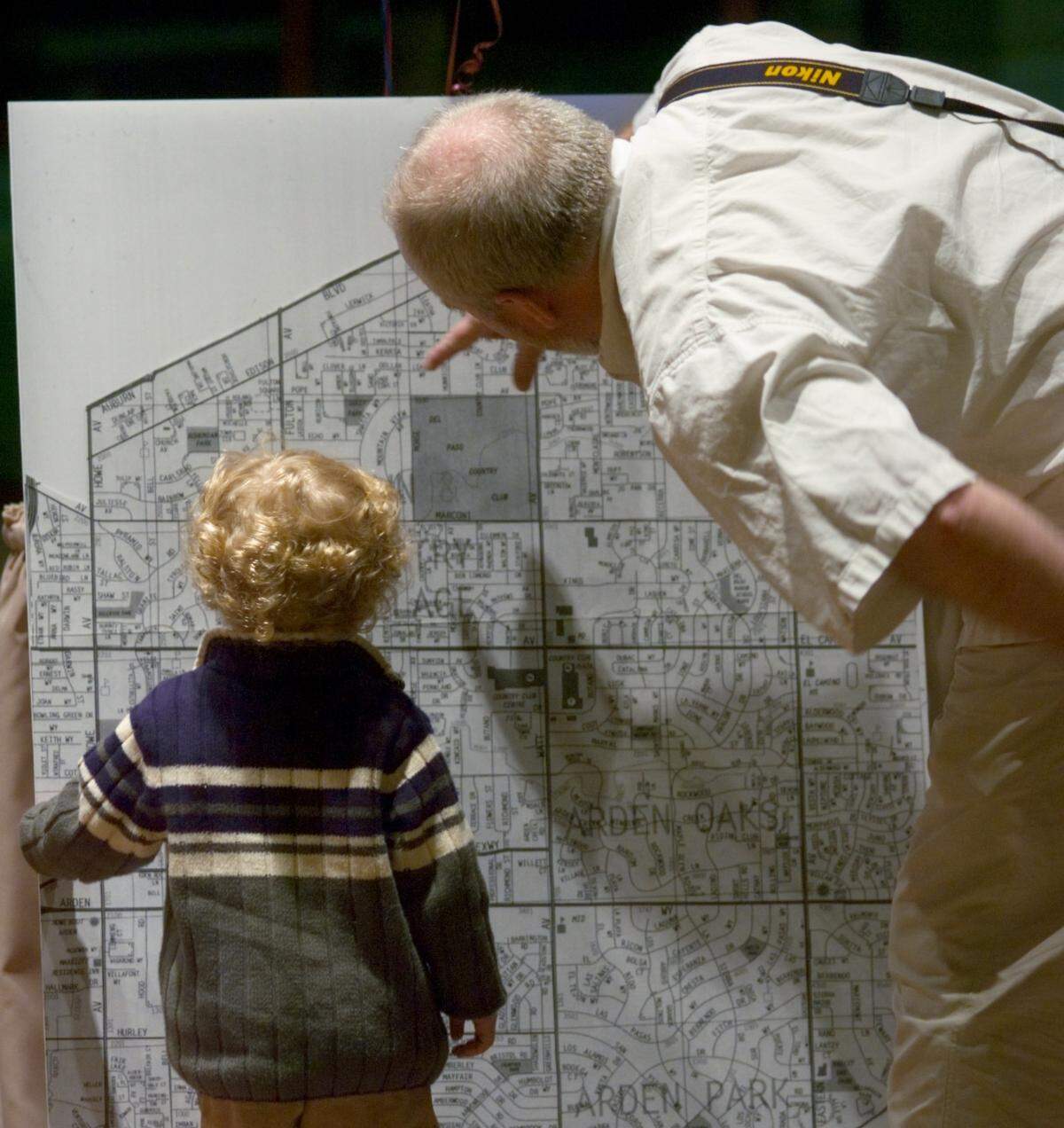
“This is not a Matisse nightmare,” Frank J. Stipak, another Arden Arcade resident, said during the meeting. Stipak, who was a civil engineer, created a map of the multiple district boundaries of the area at the time, using different colors for the various districts. “This is our government situation!” he said.
Reporting the next day about the meeting, The Bee wrote: “Complaints about their government set up resembling the crazy quilt of a modernist painting, about police protection that ‘couldn’t find an elephant in my bathtub’ and about duplication of taxes — these were some of the major irritations ticked off last night by residents.”
Over the years, many of those districts unified themselves: Schools joined together with other districts to the north and east to form San Juan Unified, and the various county fire departments banded together as Metro Fire in 2000. Multiple parks and water districts remain.
But the idea of bringing Arden Arcade under Sacramento’s wing had its critics. Benjamin D. Frantz, a chairman of a committee against annexation, asserted that services provided by the city would lead to “higher out of pocket costs” and taxes to area residents, according to a 1959 Bee story.
Frantz said in a statement that he and his group opposed the idea because it would mean Arden Arcade would be “subjected to the regulations of yet another governmental jurisdiction.”
In the same newspaper edition, Bartley W. Cavanaugh, Sacramento’s city manager from 1946 to 1964, answered questions from a reader about tax rates, school districts and police services if Arden Arcade was to join the city. When asked if the area would receive less police help than its current “combined forces of the highway patrol and the sheriff’s office,” Cavanaugh said that it wouldn’t.
In another section, Cavanaugh and other city officials answered more questions: Yes, you’d be able to keep your horses after annexation, as long as they’re not a nuisance. No, the city will not have control over the schools. Yes, a bus service may be established in the area.
Why didn’t Sacramento annex Arden Arcade?
On Sept. 29, 1959, residents in the Arden Arcade district voted at one of the 60 established polling places on what was the largest annexation measure processed by Sacramento at the time.
If passed, Arden Arcade would have become part of Sacramento sometime before Jan. 1, 1960, and city property taxes would have been imposed after July 1, 1960, according to The Bee.
At the time, Sacramento totaled 42.4 square miles. The unification of the proposed area would have expanded the city to 67 square miles and increased the region’s population by about 72,000 to an estimated total of 252,000, The Bee wrote.
But after more than 17,000 votes, the proposal was rejected by a margin of about 2 to 1.
Many residents did not entirely understand the idea of annexation. Others were satisfied with the existing district system, were worried about having higher taxes levied by Sacramento or were interested in a city-county merger where a city becomes one with a county, according to reports from the archive.
Although the plan of bringing Arden Arcade into Sacramento was stamped out that year, the idea stuck with residents and city officials.
In 2009, the city of Sacramento rekindled interest in eventually merging with the area, but officials said they were “nowhere near” beginning the annexation process and they wouldn’t do so without community support.
In the city’s 2035 General Plan, which was adopted in 2015, Sacramento expressed the possibility of expanding and annexing the area to combine public services. But the potential challenges, according to the plan, included issues with sharing revenue with the county, problems with infrastructure and lack of public support.
“Some Arden Arcade Study Area residents and businesses favor staying within the county or incorporating the area as its own city to protect existing special districts such as fire protection, water districts, and parks,” the city wrote in the General Plan.
Annexation would also be costly for Sacramento.
In a 2010 LAFCo-ordered analysis, a financial service said that with the level of city services at the time, annexation would cause a net deficit to Sacramento’s General Fund, the city’s reserve used to support government programs. To shield from this, Sacramento would have to find new revenue sources or provide a “lower level of service” to Arden Arcade residents, compared to those already living in the current city boundaries.
What could have been: The city of Arden Arcade
Unifying with Sacramento isn’t the only option for unincorporated Arden Arcade.
The territory can brand itself as its own city — a lone wolf, independent from another city’s jurisdiction. If it wanted to, Arden Arcade could become incorporated.
Meetings to discuss the community’s incorporation have been held as recently as 2019, though there was no action taken, according to volunteer group Advocates for Arden Arcade.
And resident Kathy Stricklin, who has lived in Arden Arcade since 1982 and is an admin on the Facebook group “Vintage Arden-Arcade,” recently told The Bee she wants a responsive local government that understands the history and needs of the community.
“A local government with (representation) that live in Arden Arcade,” Stricklin, who is also the chair of Fulton-El Camino Recreation and Park District, said in a phone interview.
Chatter about establishing the city of Arden Arcade overlapped discussions of annexation in the late 1950s. In 2010, the question of incorporating Arden Arcade appeared on the November ballot.

If the measure had passed, lands between Auburn Boulevard to the American River, and from Ethan Way to Mission Avenue, according to a map from the Sacramento LAFCo, would have been known as the city of Arden Arcade within Sacramento County and would not be governed by the county anymore.
Incorporation would allow Arden Arcade to establish its own services, such as public works, law enforcement, animal control and waste collection. As written in the Resolution Making Determinations on the Incorporation of Arden Arcade by the LAFCo, becoming a city would enable Arden Arcade to impose taxes — utility user tax, property tax, sales tax.
The measure was rejected with 75% voting no and 24% voting yes, according to Ballotpedia.
“People do not want more government,” a spokesman from Stay Sacramento told The Bee in a 2010 report about the voting results. Stay Sacramento was a group that formed in opposition to incorporation.
Those against the proposal cited risks to the new city’s finances and planned use of third-party contractors, such as consultants and attorneys.
According to the commission’s resolution, the “negative fiscal impact” of cityhood on the county’s general fund, over the following 25 years after incorporation, would have been $216,741,625.
Some Arden Arcade residents began advocating for incorporation more than six years before establishing the ballot measure, as reported by the Bee in 2010.
County deficits and cutbacks, such as in public safety, at the time drove supporters for cityhood because it would allow for more local control and improved local services.
In the 2010 report, proponents for the measure viewed those against the proposal as “out of touch” with the community and portrayed them as mostly “affluent residents from the Southern area of Arden Arcade who benefit from their own privately funded security services.”
While votes were cast for Arden Arcade’s incorporation in 2010, an election was also held for potential Arden Arcade council members.
Seven people won the election to serve as city council members for a city that didn’t get the chance to exist.
Have a question of your own? Ask in the form below or email beecurious@sacbee.com.
This story was originally published April 27, 2022 at 5:00 AM.