
Exclusive: Big Sacramento Democratic family woos Trump-loving college to build campus
Sacramento’s Tsakopoulos family, one of the region’s largest landowners, has been a powerhouse in Democratic politics for decades — from the time patriarch Angelo K. Tsakopoulos slept in the White House as a guest of President Bill Clinton to the 2018 election, when his daughter Eleni Tsakopoulos Kounalakis became California’s lieutenant governor.
Now, as a foundation led by the family tries to revive a 20-year-old plan to build a college campus in Placer County, it’s turned to a potential partner from the other end of the political spectrum: a conservative and sometimes controversial Michigan college with ties to President Donald Trump and other Republican politicians.
The University Development Foundation, a nonprofit run by the lieutenant governor’s brother Kyriakos Tsakopoulos, is negotiating with Hillsdale College of Hillsdale, Mich., on a plan to operate a small campus in downtown Roseville and a larger campus on a swath of farmland west of the suburban city. The farmland, totaling about 1,100 acres, was donated to the foundation in 2012 by the Tsakopoulos family and several other landowners.
Hillsdale, a private college with about 1,500 students, is known for a fiercely independent brand of conservatism. It staged graduation ceremonies this year in defiance of Michigan’s COVID-19 shutdown. (The school said it followed social-distancing protocols.)
It refuses federal aid rather than comply with government mandates that would require the school to disclose the racial composition of its student body. The school’s president endorsed Trump in 2016, and several alumni filled roles in the Trump administration.
Hillsdale’s politics wouldn’t be totally out of place in Placer County, where Trump beat Hillary Clinton by 11 points. Robert Weygandt, a member of the Placer Board of Supervisors who’s visited Hillsdale’s campus in Michigan, said he would have expected the Tsakopoulos family to be leery of doing business with the school.
But Weygandt, who accompanied Angelo and Kyriakos Tsakopoulos on a trip to the Napa area to hear Hillsdale’s president speak last year, said the Tsakopoulos men were impressed with the school’s emphasis on a classical education revolving around the so-called Great Books of Western civilization.
“It’s all the big books, it’s Plato and Socrates,” Weygandt said.
Officials from the college did not return calls for comment.
Kyriakos Tsakopoulos confirmed this week that the foundation is talking to a “world-class university” but he declined to identify it. However, he and his father named Hillsdale as the foundation’s potential partner in separate letters they wrote in January to Roseville Mayor John Allard.
Noting that his family has spent two decades trying to establish a Placer college campus, Angelo Tsakopoulos wrote: “We can succeed in fulfilling this vision, and this promise, by bringing Hillsdale College to our region.”
Eleni Tsakopoulos Kounalakis and her husband are part owners of a company that donated some of the land to the project in 2012, according to her financial disclosure statements. But she said she isn’t connected to the proposed campus development in any way.
“I was part of a group that made a donation eight years ago,” the lieutenant governor said in an interview. “The (nonprofit) entity operates independently. I am not involved.”
The size and scope of the project remain uncertain, Weygandt said. “They’re considering every different iteration possible,” Weygandt said. “They’ve discussed everything from a limited curriculum all the way to a full-size replica of Hillsdale in Michigan.”
The family’s vision has revolved around an unusual business model. The Tsakopouloses and other landowners donated an 1,100-acre parcel to the nonprofit, with the understanding that about half of the land would be set aside for a campus. The rest would be developed with homes and commercial properties, generating cash to build the campus. A smaller, satellite campus would open in Roseville’s historic downtown.
College’s ties to Trump
Founded by abolitionists in the 1840s, Hillsdale “was the first American college to prohibit in its charter any discrimination based on race, religion, or sex,” the college says on its website. The school refers to itself as a “nonsectarian Christian institution”; since 2019 the chairman of its board of trustees has been Pat Sajak, the host of TV’s “Wheel of Fortune.” Sajak didn’t attend the school.
But it was a legal battle over race, not a Hollywood celebrity, that put Hillsdale on the map. Beginning in the 1970s, the federal government demanded that the school comply with regulations requiring an accounting of the student population’s racial makeup. If the school refused, its students would no longer be eligible for federal loans.
Hillsdale’s board of trustees vowed to “resist, by all legal means, any encroachments on its independence.” Years of lawsuits followed, with the U.S. Supreme Court ruling in 1984 against Hillsdale. The school decided that “rather than complying with unconstitutional federal regulation, it would instruct its students that they could no longer bring federal taxpayer money to Hillsdale. Instead, the College would replace that aid with private contributions,” the school says on its website.
Hillsdale’s website points to its policy of non-discrimination. Yet the New York Times, in a 2017 profile, said the college has “an overwhelmingly white student body.”
In 2013, the college was briefly placed in an uncomfortable spotlight. During a hearing on education issues before the Michigan legislative Hillsdale President Larry P. Arnn complained that state officials had once visited the campus to count the student population.
The officials, he said, were trying to show Hillsdale “didn’t have enough dark ones.” According to the New York Times, Arnn issued this apology: “No offense was intended by the use of that term except to the offending bureaucrats.”
Hillsdale’s 2016 graduation speaker was conservative Supreme Court Justice Clarence Thomas, who called the school a “shining city on a hill.” He was followed two years later by Vice President Mike Pence; he praised Hillsdale’s “long, and often lonely, stand for freedom in America.” Last month it hosted a speech by Attorney General William Barr, who belittled the Black Lives Matter movement and compared coronavirus shutdowns to slavery.
Arnn endorsed Trump in 2016 and was reportedly among the candidates for education secretary in the Trump Cabinet. The post went to Betsy DeVos — whose family has been a donor to Hillsdale and whose brother, Erik Prince, the founder of the controversial military-security firm Blackwater, is an alumnus.
Others with Hillsdale connections found positions in the Trump administration. DeVos’ first chief of staff was a Hillsdale graduate. Another became associate counsel to the president, while two became speechwriters for Pence. More recently, a Trump administration spokesman on national security issues has joined Hillsdale’s Center for Constitutional Studies and Citizenship in Washington, D.C.
Hillsdale’s D.C. connections became evident in late 2017, as Congress was debating the massive tax cuts championed by Trump. As reported by Politico, Republicans proposed requiring colleges with an endowment fund of at least $1 million to pay taxes on their investment incomes. Matthew Spalding, the head of Hillsdale’s Washington programs, lobbied for an exemption for colleges that refuse federal funding. That would include, of course, Hillsdale.
Republicans took up the cause, and an intense debate erupted on the floor of the Senate. Democrats belittled the plan as the “Hillsdale carve-out” and said the proposal was a favor to DeVos and her family. Democratic Sen. Jeff Merkley of Oregon ripped the school’s refusal of federal dollars, saying it “wanted to have permission to discriminate in selecting students.”
Merkley and his colleagues persuaded enough Republicans to block the exemption.
College project has struggled
The campus project has been embraced by Roseville and Placer officials. It’s been viewed at times with suspicion by environmentalists, who argued that the Tsakopoulos family was using the college as a kind of stalking horse to win approvals for other land in the area owned by the family. The family has denied that, saying the college would benefit the entire region.
In any event, the project has been on the drawing boards for years. A Catholic religious order’s plans to build a new university on the rural site called De La Salle faltered in 2005, when the order grew weary of delays in permitting.
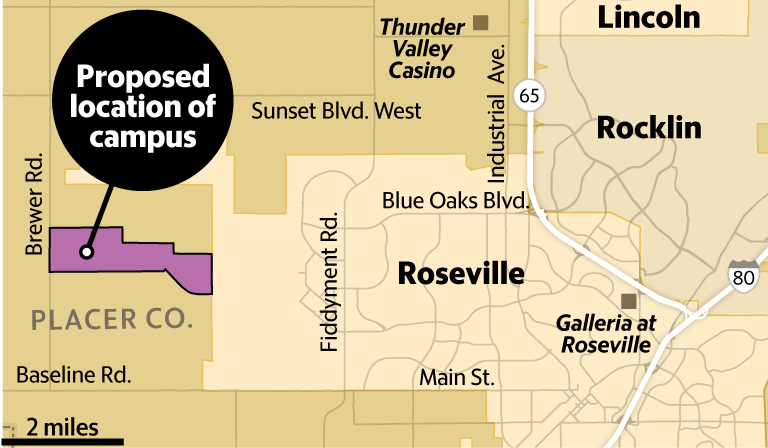
Map: Sacramento Bee
Angelo Tsakopoulos then recruited Philadelphia’s Drexel University to the region. Drexel opened a campus for its MBA program in a Tsakopoulos-owned building in Old Sacramento but never got the Placer project off the ground; it closed the business program a few years later.
The most promising prospect was England’s Warwick University. The school’s governing board agreed to build a 6,000-student campus on the Placer farmland. To jump-start the project, the city of Roseville sold the University Development Foundation a municipal building in 2016 for use as a graduate school.
But Warwick abandoned the project in 2017, largely because of political complications following Brexit — Britain’s decision to leave the European Union — said Laura Matteoli, Roseville’s economic development director.
The courtship of Hillsdale followed Warwick’s departure and hasn’t always gone smoothly. Notably, last fall the Roseville City Council voted to buy an office building that Hillsdale was on the verge of buying. In a letter to the mayor, Kyriakos Tsakopoulos said the decision “caused catastrophic damage” to the prospects of bringing a college campus to downtown.
Since then, relations appear to have improved. City Manager Dominick Casey wrote the college a letter of apology for the “misunderstanding.” In August the council agreed to sell the University Development Foundation the city’s historic Tower Theatre in downtown Roseville for $1.
The sale represents “an effort to support the recruitment of higher education to the region,” according to a city staff report, which notes that Angelo Tsakopoulos donated the theater to the city 31 years ago.
“We’ve gotten past that difficult moment,” Kyriakos Tsakopoulos said.
Matteoli, the economic development director, praised the nonprofit foundation’s commitment to the project and said she believes the campus is tantalizingly close to coming to fruition.
“This is almost something — you can reach out and grab it,” she said. She, like Tsakopoulos, declined in the interview to identify Hillsdale as the project’s partner.
This story was originally published October 9, 2020 at 5:00 AM.