Is free rent key to revitalizing Sacramento’s downtown retail? SF has an idea
The Sacramento City Council, looking to fill vacant storefronts and energize struggling commercial corridors, may borrow a page from San Francisco’s downtown playbook.
Civic leaders across the country have struggled for years to revitalize office-heavy, downtown districts in the era of telework. One relatively straightforward tactic — easing the process of establishing coffee shops, art galleries and stores on a “pop-up” basis — has, in San Francisco, emerged as a strategy for bringing about new vibrancy.
Business owners there told The Bee that San Francisco’s “Vacant to Vibrant” program has brought them into storefronts they never would — or could — have rented otherwise. And many have opted to sign long-term leases after an initial rent-free, 3-6 month pop-up.
“We’re trying to build a downtown in San Francisco that’s not just that five-day-a-week, 9-to-5, central business district,” said Simon Bertrang, executive director of SF New Deal, a nonprofit that has helped the city operate and pay for the program. “We think small business is going to be the key.”
Some Sacramento leaders believe that mimicking the program here may help small business owners and fill vacant storefronts.
When Sacramento City Councilmember Caity Maple toured businesses in San Francisco’s program earlier this year, she saw galleries, vintage clothing stores and cafes in storefronts that were previously vacant.
“That’s what’s possible in Sacramento,” she said.
Other cities might follow suit. An Assembly bill backed by businesses in Los Angeles would create a new path, statewide, for retailers and restaurateurs to establish four-month pop-ups.
Still, while the San Francisco program is simple in concept, it required buy-in from large property owners, willing to forgo several months’ rent in downtown districts. It needed grant money to get the businesses started and funding to cover landlords’ utility costs. It required program staff, acting as an intermediary between the groups, to research the properties and the small businesses that sought to occupy them.
But so far, a number of property owners have bought in. Thirty-two storefronts have opened since October 2023. Of those, a dozen signed long-term leases at the end of the initial, pop-up period.
Filling vacant storefronts can build foot traffic and make it easier for those same properties to attract tenants over the long term, Maple said.
Jessilee Windhaus, a Sacramento comedian, tried for years to find a local brick-and-mortar space to teach improv classes. But when she found a site in Old Sacramento, and signed a lease, she was hit with $500,000 of reality.
The space needed upgrades. She couldn’t afford to meet fire and accessibility standards. She’d had a lawyer look over her lease, but she hadn’t had an architect look at the property, she realized. Although she’d already publicly announced the project, she had to back out.
“I’ve never rented a space like that before,” Windhaus said. “You just don’t know what you don’t know.”

Playing matchmaker
In Sacramento, Maple said, there is a disconnect between landlords and small businesses owners. The city is filled with entrepreneurs and artists vying for space, and landlords need tenants.
But practical problems often thwart would-be small business owners.
“Everybody always says that the permit process is slow, that it takes a lot of money to start a brick-and-mortar, and that it really takes all your energy,” said Tyler Jimenez, a Sacramento native who has long dreamed of establishing a pizza restaurant. “Those three things proved to be true.”
Small businesses often have limited staff time to scout properties. And the stakes are high. Small oversights are expensive, and success or failure doesn’t only depend upon finding the right neighborhood, but also the right spot within that neighborhood.
“It’s a time-consuming process. You kind of have to go out and walk the neighborhoods, and really get a feel for an individual location or street,” said Dave Mogridge, COO of Dandelion Chocolate in San Francisco. “The ‘Goldilocks’ piece of real estate for us, it’s got a lot of requirements, and we have a very limited amount of time to spend on it… One street away can make all the difference in the world.”
At one of his San Francisco cafes, Rich Lee once received an unexpected $13,000 bill for common-area maintenance. At one store, there is no receptacle for trash bins, so he pays $1,000 each month for daily trash pickup. He didn’t think of those potential costs before signing lease agreements, and now knows he could have negotiated them.
“That’s a lot of pure profit that goes, literally, into the trash,” Lee said. “How is any small business owner able to survive?”
When he applied for the Vacant to Vibrant program to create his newest cafe, The Wild Fox on Battery Street, the city acted as a mediator between him and the property owners, offered him guidance, and program staff provided him with research on the neighborhood and the property.
“I’ve never had anybody help me,” he said.
Maple likened San Francisco’s program to matchmaking, allowing small businesses and landlords to “date” for a short period of time, and determine whether to sign a long-term lease.
Mogridge and Lee both said the storefronts they established through the program were in neighborhoods they may not have chosen otherwise.
“Immediately, I would have said, ‘I cannot afford that,’” Lee said. “‘Starbucks can’t survive. How can I?’”
Mogridge said Dandelion Chocolate had passed on a property in Union Square before applying to the program. The neighborhood felt quieter and less “buzzy” after the pandemic, and they were uncertain how much foot traffic it would get.
Through the program, they were matched with a different Union Square storefront, and it has exceeded expectations.
“I think that we kind of had this impression of Union Square, broadly, that was sort of more informed by the experience coming right out of the pandemic, but was maybe a little bit out of date. And it seems like it was already better, when we moved in, than we thought, and it’s getting better still,” Mogridge said. “Traffic is just picking up, and it seems like it’s really on the upswing, still.”
Some property owners are reluctant to sign short-term lease agreements, for fear that they may miss out on a great deal in the meantime, said Steve Edwards, president and CEO of The Edwards Company, a boutique brokerage in Sacramento.
But he predicted that a lot of Sacramento landlords would be interested in such a program, especially for properties that have been vacant for a long period of time.
He worried the trial period may not be long enough for entrepreneurs to test out an idea and a neighborhood, and determine whether they’re willing to sign a more standard, 5 or 10-year lease.
“From a retail perspective, three months and six months go by so quickly,” Edwards said.
Business owners, though, said that even a six-month trial is a major investment for an entrepreneur — one they wouldn’t make if they doubted the outcome.
“The reality is, if you aren’t ready and have a concept that you really trust, then maybe it’s not a good idea,” Lee said. “I truly believed in my product and my abilities. And, excuse my language, but I have to bust my a--, and I have to make enough money to pay my bills. I’m not going to just relax because I got a free space.”
$50,000 apiece
Many of Sacramento’s vacant downtown retail spaces have sat empty for years, said Chandler Eden, an associate at Newmark who handles retail leasing for property owners and tenants.
“Tenants will comment and say, ‘Hey, the space has been vacant for five years. I know the landlord wants $2.50 a square foot, but why wouldn’t they take $1 a square foot?’” Eden said. “The landlords don’t look at it that way.”
Still, retail leasing in Sacramento has remained relatively resilient — perhaps surprisingly so — in recent years. The vacancy rate for retail properties in the city is 5.8%, compared to a 10-year average of 6%, Josh Ohl, senior director of market analytics for CoStar, said in an email.
But, experts said, in downtown Sacramento, pockets of neighborhoods have fared better, others worse, and the district has historically struggled with the narrow windows of foot traffic created by office workers.
“You’re paying rent seven days a week, but you only have your customers, really, Monday through Friday,” Edwards said.
Sacramento has a program — “Calling All Dreamers” — that offers cash prizes of $5,000 to $20,000 to small businesses. Entrepreneurs learn about marketing, finances, raising capital, HR policies and leasing, said Andrew LaFrance, business development manager at the Downtown Sacramento Partnership, which operates the program.
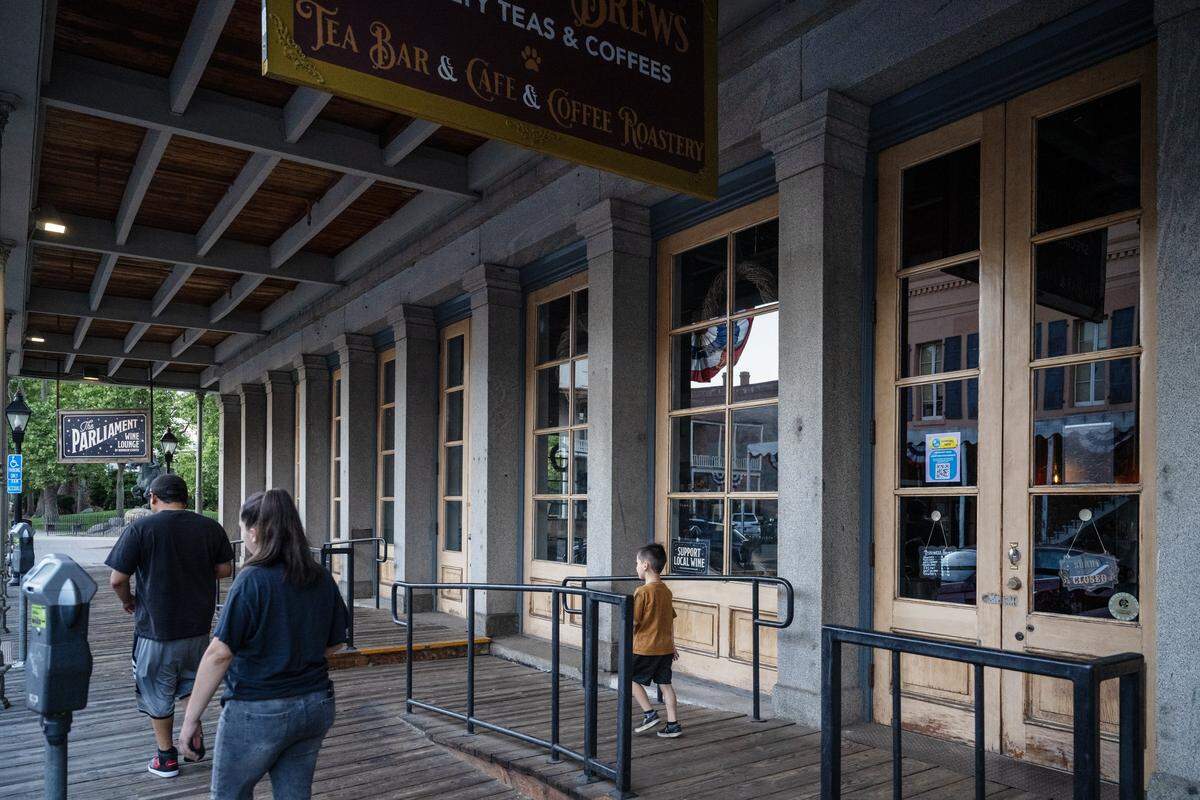
But local officials said Sacramento doesn’t have any small business programs that offer the kinds of services provided by San Francisco’s “Vacant to Vibrant.”
Should Sacramento leaders opt to pursue such a program, funding will be a key question. The council is struggling to fill a $66 million budget deficit, and the San Francisco program required up-front spending by the city.
San Francisco invested about $700,000 in the first cohort of businesses, and around $4 million overall, according to the city’s Office of Economic and Workforce Development. The nonprofit, SF New Deal, raised $2 million in private funding for the effort, a spokesperson said.
The cost per pop-up varies widely depending on the neighborhood and the space, said Bertrang, of SF New Deal. But a six-month pop-up tends to average around $50,000 — about half for the business, and half for operating costs.
A level of trust
A bill moving through California’s Assembly would create a framework for small businesses to occupy vacant storefronts for up to 120 days. Assemblymember Mark González, D-Los Angeles, hoped it would help fill properties in his city’s downtown.
He said he was motivated in part by the testimony of small business owners who have been thwarted by bureaucratic problems. But he was also aware that his city would soon be on the world’s stage, first when SoFi Stadium hosts a series of World Cup games this summer, and again during the 2028 Olympic Games.
“We want the lights to be on,” González said.
By trying short-term “pop-ups,” businesses can test out ideas before making expensive commitments to long-term leases and full-scale renovations, said Eddie Navarrette, president of the Independent Hospitality Coalition, a Los Angeles-based group backing the bill.
“I want to see my community thrive,” Navarrette said. “I feel like this is going to do that.”
Some business owners in the Vacant to Vibrant program believed starting the real estate conversations with a shared purpose — and the city’s backing — made all the difference.
“They’re engaging with all of these landlords with the overarching mission of bringing activity to the city,” said Victor Gonzalez, whose firm, GCS Agency, opened two storefronts through the Vacant to Vibrant program. “Landlords, it seems like they’re a lot more willing to listen to those types of conversations. Working with small businesses can be kind of risky, so having a trusted mediator — where they’re vetting the small businesses that will come and occupy these spaces — it creates a level of trust.”
Lee, the coffee shop owner, was shocked when he reached the end of his initial, six-month trial period, and his landlord proposed extending for another six months, rent-free.
“Everyone, I feel, is trying to extend their hand,” Lee said.
Sacramento Mayor Kevin McCarty said in a statement that he was encouraged by San Francisco’s strategy. Maple said city leaders could examine possibilities for funding such a program in the next fiscal year.
“My question to Sacramento property owners with long-vacant storefronts,” Maple said, “is, ‘why not give it a try?’”
Windhaus, the Sacramento comedian, has spent years searching for a home for her improv classes. In January she started using the Eagle Theatre, owned by California State Parks, in Old Sacramento.

But she’s still looking for a more permanent location. The space is small, and shared, so she has to schedule her classes around the other tenants. She spends a half-hour before each class lugging heavy equipment up a set of stairs, because the storage space available for her is downstairs.
In an area with few women-run comedy theaters, Windhaus wants to show Sacramento that comedy “is not just a boys’ game.”
“I really love what I do. I really believe in what I do. My community is awesome,” she said. “I don’t want to let them down.”
It’s not just about maintaining a business. It’s also about establishing a community.
When Windhaus walked into the theater on a recent evening, one of the performers was crying over a hand-painted sympathy card that the rest of the cast had signed, after a beloved cat had passed on.
“How could I give up on that?” she said. “How could I make it so that no longer exists?”

This story was originally published May 21, 2026 at 6:00 AM.