
Immunocompromised California prisoner could be detained by ICE. He worries about COVID-19
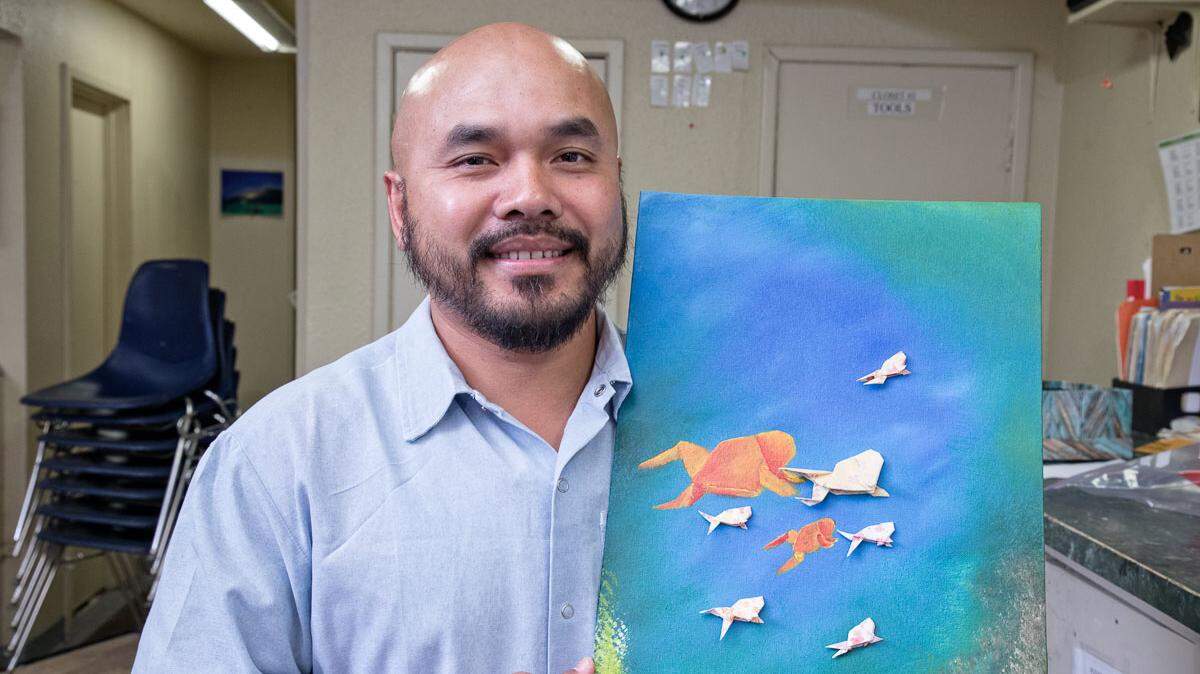
A man who was recently granted parole faces the risk of being transferred to an Immigration and Customs Enforcement detention facility and eventually deported. He is immunocompromised and worries about contracting the coronavirus.
Chanthon Bun, a 41-year-old refugee, faces the possibility of being transferred from state prison to ICE custody. The California Supreme Court has refused to order the state to halt the transfer of immigrant inmates to federal immigration facilities amid the COVID-19 pandemic. Detention centers lack facilities for inmates to practice social distancing and could be life-threatening for medically vulnerable prisoners like Bun.
Born in Cambodia in 1979, Bun and his family survived the Khmer Rouge regime, that resulted to a genocide and death of one third of the country’s population. Bun spent his early childhood in a refugee camp in Thailand.
In 1985, Bun and his family fled to Texas and eventually settled in Los Angeles. Bun said he was bullied by schoolmates due to his limited English proficiency, while his family struggled with poverty and war trauma just to get by. He joined gangs as a way to protect his family because he did not trust the authorities to keep him safe.
“For every injury that we had, we never called the authorities because we were scared of them,” Bun said in an interview with San Quentin Radio on KALW in 2018. “ ’Cause where we came from, the authorities robbed us. We would not call the authorities whatever it was.”
Turning his life around after a long sentence
In 1998, a 19-year-old Bun was convicted of second-degree robbery and use of a firearm. No one was physically hurt as a result of the crime, according to Anoop Prasad, attorney at Asian American Advancing Justice – Asian Law Caucus.
“I always seen myself as a survivor, and it was surviving through any means; robbing, stealing, killing,” Bun said, of what he had seen in the refugee camp and how that affected him. “It was a point of survival, it led to the way I lived my life, it led to my crime. It led to my belief system, the way I thought, the way I interact with humans.”
Bun was sentenced to just under 50 years in prison during what The Sentencing Project called the “tough on crime” era of the 1980s, which resulted in a growth of incarceration of people of color, who now take up 67 percent of the prison population.
Since then, Bun has been incarcerated at San Quentin State Prison. He dedicated himself to several self-help programs on alternatives to violence, nonviolent communication and submersed himself into courses like computer literacy and electronics to turn his life around. According to the Asian Law Caucus, Bun facilitated many of these groups and mentored other members.
On Feb. 8, Bun was found suitable for parole. However, because he is not a United States citizen, he could possibly be transferred to an ICE detention center after his release.
“Mr. Bun was informed that ICE had placed a detainer on him,” Prasad said.
The California Department of Corrections and Rehabilitation voluntarily notifies ICE when prisoners who aren’t U.S citizens are scheduled to be released, Prasad said, citing two policy CDCR and ICE memos dated in 2016 and 2018, respectively.
“Nothing in state or federal law requires this level of cooperation.” he said.
According to the Asian Law Caucus, Bun suffers from a rare blood disorder called thrombotic thrombocytopenic purpura, hypertension and hypokalemic periodic paralysis, all which make him more at-risk to contract COVID-19, the respiratory disease caused by the coronavirus.
In March, Gov. Gavin Newsom granted an early release of 3,500 inmates in California in response to the COVID-19 crisis to reduce the inmate population, but Bun was not considered a nonviolent offender, said Nathaniel Tan, an organizer with the Asian Prisoner Support Committee. However, the decision did not take into account that Bun is one of the 34 percent of inmates in California’s state prisons granted parole at the board of parole hearings of the CDCR between April 1 and May. 15.
Bun is sharing a cell with two people, Tan said. While he doesn’t know which detention center he would be sent to, no immigration detention facility allows for social distancing or performs even minimal levels of testing, Prasad said.
Detention facilities could be riskier for the medically vulnerable, like Bun. There has been more than 150 confirmed positive cases at San Diego’s Otay Mesa ICE detention facility. One prisoner contracted the virus and died, according to the San Francisco Chronicle. At Mesa Verde ICE Processing Center in Bakersfield, a 74 year-old man who cited lung cancer, diabetes and a history of heart attacks as reasons to be released were all rejected. He committed suicide earlier this month, the Los Angeles Times reported.
“Going home will be a lot safer for him to be safe and not infect others,” Tan said of Bun.
Family could be ‘devastated all over again’
Sarah Lee, community advocate with the Asian Law Caucus, said it is hypocritical for the CDCR to hand Bun over to ICE for deportation after the state government granted him parole. It would also mean Bun would likely be deported to a country he hasn’t been in more than 35 years. Lee said it is important to think about solutions that don’t perpetuate harm.
“What are the conditions that led people here, and (what is) the U.S. government‘s responsibility in that? Does deportation make it better?” she said.
Lee said Newsom can use his executive authority to stop ICE transfers from CDCR and county jails.
“We hope that Governor Newsom can start by stopping Chanthon Bun’s transfer to ICE, and release him to his family on his parole date where he can weather this storm with loved ones safely at home, rather than risk dying from ICE’s negligence and cruelty,” she said.
Bun has two children with his wife, and all his family members are based in the U.S. His sister, Sunny Meas, said it is heartbreaking to know Bun may be immediately transferred to a detention facility after years of waiting for parole. Bun has no family in Cambodia. To him, America is home.
“This might be the last time we’re going to see him,” she said. “My family and I would be devastated all over again.
“My brother deserves a chance to live his life. He has a whole future ahead of him with full support.”
This story was originally published May 29, 2020 at 11:06 AM.