
How pandemic delivered humbling defeat for California’s struggling farmworkers union
The United Farm Workers had itself a win. But the celebration didn’t last long.
In late January, the legendary labor union obtained a court injunction requiring Foster Poultry Farms to follow COVID-19 rules at its main chicken-processing plant in Livingston, a small farming-dependent town in Merced County. Hundreds of UFW members had been sickened at the plant and as many as nine workers died.
Six days after the judge ruled, the plant’s workers voted the United Farm Workers out.
The lopsided “decertification” vote, covering a bargaining unit representing 1,800 workers, represented a humbling defeat for an organization that has struggled in recent years to maintain membership and shore up its finances. Just three years earlier, the UFW was tossed out by workers at a massive farming operation in Fresno County.
Financial problems have surfaced along the way. The UFW’s health insurance plan has been propped up since 2014 by a subsidy created by the state Legislature. The U.S. Department of Labor has said the funding for the UFW’s pension plan is in “critical status.”
Another major headache now looms in the U.S. Supreme Court, where agriculture organizations are challenging a 1970s-era state regulation that allows union officials to walk onto growers’ properties to organize workers. Court observers said a majority of the justices seemed ready to weaken the regulation to limit organizers’ on-the-job access to the workers.
It adds up to challenging times for the union, whose membership rolls have shrunk considerably since Cesar Chavez led the organization. Today, Chavez’s bronze bust sits behind President Joe Biden’s desk in the White House, but the union Chavez built into a global symbol of worker liberation is a shadow of its former self.
“The UFW has made major contributions to the benefit of California farmworkers,” said Don Villarejo, a one-time UFW volunteer and founder of the California Institute for Rural Studies. But Villarejo said the UFW’s ongoing relevance lies mainly in its role as a source of inspiration to “help workers learn what their rights are” — not its everyday operations as a labor union.
Membership peaked at around 30,000 or 40,000 in the 1970s, said Phil Martin, a UC Davis economist who tracks farm-labor and immigration issues. According to the union’s latest annual report to the U.S. Department of Labor, the headcount has fallen to 6,240 active members as of December 2019, plus another 1,205 retired members.
As for the defeat in Livingston, the union might have been a casualty of the lethal COVID-19 outbreak. Across the Central Valley, where Latino farmworkers dominate the workforce, the pandemic has hit harder than almost anywhere else in California. Merced was the last county to leave the purple tier in the state’s rankings of coronavirus dangers. The Foster Farms plant was a coronavirus hot spot.
“It’s a very tough circumstance when something like a pandemic comes along,” Villarejo said. “(Union officials) were not able to respond in a way that mattered to the workers in the plant.”
But Elizabeth Strater, union spokeswoman and director of strategic campaigns, said workers became discouraged after they voted to ratify a contract nearly a year ago, only to see Foster Farms ignore the new contract. The National Labor Relations Board, the federal agency that governs union-management issues, refused the union’s request to step in.
“It became very clear that membership in a union was not enough to protect workers and improve ... the conditions in such a deeply toxic workplace,” she said. “Union membership isn’t enough to protect them if the NLRB won’t enforce the contract that we ratified.”
Foster Farms spokesman Ira Brill declined to comment. Kayla Blado, a spokeswoman with the National Labor Relations Board, also declined comment.
Jill Biden visits UFW sacred ground
It felt like a scene from the UFW’s glory days — a group of leading lights from the Democratic Party descending on the San Joaquin Valley to pay tribute to the union and its historic struggle for farmworkers.
On March 31 — Chavez’s birthday — first lady Jill Biden visited The Forty Acres in Delano, the spot where Chavez staged his first public fast in 1968. It’s the place that once served as UFW national headquarters and was designated a National Historic Landmark in 2008.
Biden, accompanied by Gov. Gavin Newsom and other elected officials, met with union members and spoke in favor of the Farm Workforce Modernization Act, which would strengthen the legal status of undocumented farmworkers in the United States. Though she produced a cringe-worthy moment by mangling the UFW’s “si se puede” motto, she spoke movingly of the workers’ dedication during the pandemic.
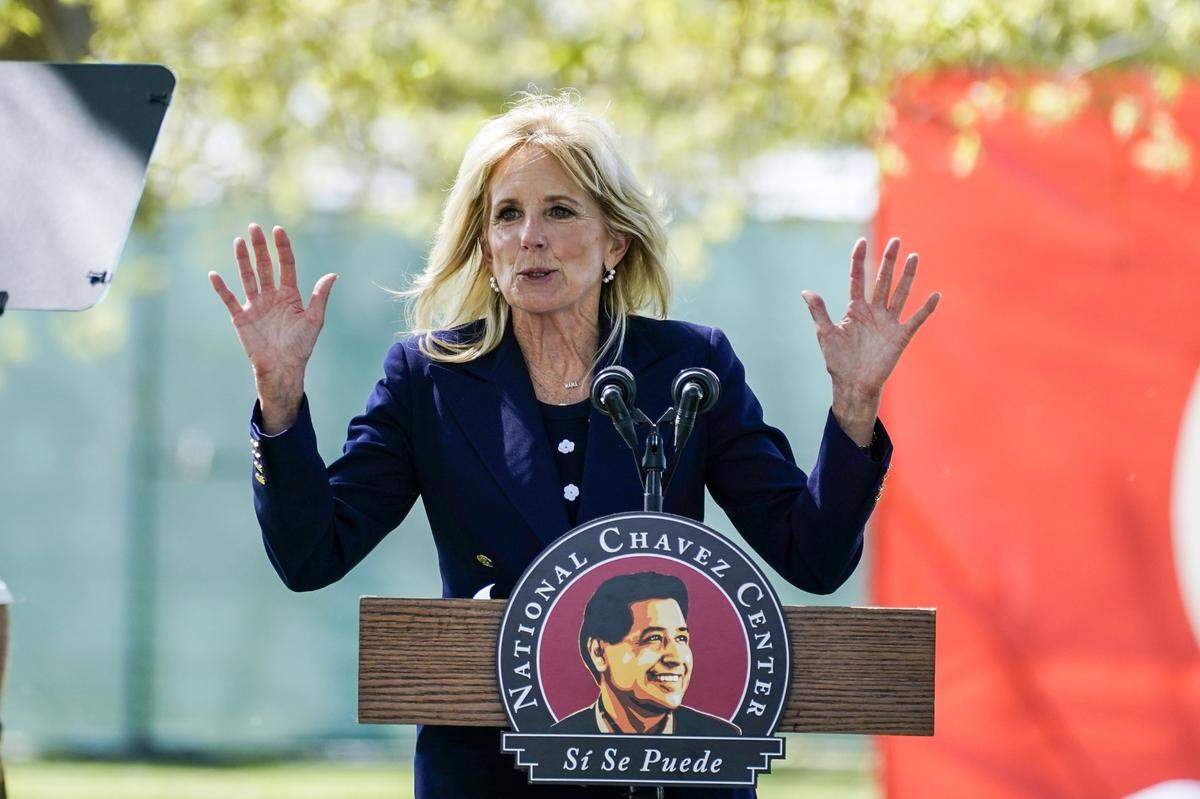
“Even in our darkest hour we can find hope in each other,” she said. “We stand with you and we are grateful for all that you are doing for your call to service.”
For the union, Biden’s visit was emblematic of the UFW’s unique role in American labor — an organization that doesn’t just negotiate contracts but also advocates for immigration rights and similar causes. The union has notched several legislative victories over the years, including its sponsorship of AB 1066, a bill signed by former Gov. Jerry Brown in 2016 that requires farmers to pay overtime to their workers.
“The UFW has always been in a space between a movement and a union,” said Strater, who was in Delano that day and walked the grounds with Chavez’s son, Paul. “The UFW has never weighed into a fight based on what union dues they could collect; they weighed in based on where they could save lives.”
UFW’s membership has fallen
Much of the decline in the UFW’s membership occurred abruptly, nearly 20 years ago, after the Labor Department ordered the union to use end-of-year figures to count its membership. UFW officials complained that using Dec. 31 figures would severely under-count the rolls in an industry in which employment balloons in the summer and shrinks in the winter.
But the federal rule prevailed. In 2001, using the new counting method for the first time, the UFW reported that its membership had fallen from 27,000 to just under 5,000. Since then it’s fluctuated between 5,000 and 10,000 — a small fraction of the approximately 400,000 farmworkers in the state.
Some observers believe the union’s decline is less about how the membership is counted — and more about its sense of purpose.
Martin, the UC Davis economist, said the UFW has long struggled with how to balance its main role of “being a business trade union” — an organization narrowly focused on negotiating contracts and dealing with grievances — and the broader idea of advocating for human rights.
While most unions have locals — led by locally elected officers who handle many of the bread-and-butter chores — the UFW operates largely out of its headquarters in Keene, Martin said.
“The union has increasingly taken on broader causes — for Latinos, immigrants,” Martin said. He found it striking that Chavez once told him that he was disappointed to learn that most of his members simply wanted better pay and benefits, not a fundamental overhaul of the agricultural system that Chavez desired.
Strater, the union spokeswoman, insisted the UFW hasn’t strayed from its core mission, but is wrestling with some of the same difficulties many unions are facing in America.
“Since the 60s, in every sector, the odds have been stacked against organizing and union membership, in general, has declined greatly in the country,” she said, adding that it’s much harder to organize in an agricultural setting, where so many workers are undocumented. “You have all these systemic barriers that make them more vulnerable to be exploited, so much more vulnerable to be retaliated against,” she said.
The UFW has suffered some painful losses. In 2013, a group of union members started campaigning to decertify the UFW at Gerawan Farming, a major grower of peaches, nectarines and other tree fruits in Fresno County. The union represented around 3,000 Gerawan workers.
It was a lengthy, nasty fight. A vote was held but the ballots were impounded by the California Agricultural Labor Board after the UFW filed a complaint.
The UFW said the decertification effort was a sham, funded in large part by an organization of growers, the California Fresh Fruit Association, in violation of state labor law.
The state board agreed with the UFW, saying the fruit growers’ association provided “the financial muscle” for the vote. The board refused to count the votes, and the decertification drive was seemingly dead.
But Gerawan sued the state board and won. The votes were finally counted in 2018 and the results were overwhelming: The UFW was decertified by a tally of 1,098 to 197.
Pension plan in ‘critical status’
The UFW’s dual identity as somewhere between a union and a movement, as Strater put it, manifests itself in the organization’s finances. In 2019, dues from its members accounted for barely half of the UFW’s $7.4 million in revenue, according to the annual report filed with the Department of Labor.
Relying on outside donations is unusual for a labor union. But it’s been a common practice at the UFW since its earliest days in the 1960s, said Ken Jacobs, chairman of the UC Berkeley Labor Center.
“They’ve always relied very heavily on outside assistance,” Jacobs said.
In recent years, though, the UFW’s financial structure has come under pressure.
In 2019, the U.S. Department of Labor issued a “notice of critical status”— a warning of significant financial stress — for the union’s Juan de la Cruz Pension Plan, named for a striker who was shot to death on a picket line decades ago. The notice was based a finding from the plan’s own actuary — a professional who analyzes pension fund finances. The plan paid $8.1 million in benefits in 2019, according to an annual report filed with the Department of Labor.
Despite the critical status, union spokeswoman Strater said: “We have confidence the pension plan will make it through these rough times.”
The union’s healthcare plan, named for Chavez’s ally Robert F. Kennedy, has fared better: It got a rescue package from the Legislature in 2014.
The plan was facing financial woes of its own, brought about, ironically, by the Affordable Care Act.
The federal law, designed to expand access to health insurance, forbids health plans from placing limits on annual benefits. The UFW plan limited annual benefits to $70,000.
Petitioning the Legislature for relief, the union said it couldn’t afford a plan to run a plan without limits. The UFW told lawmakers that if the plan failed, thousands of farmworkers and their families would be forced onto Medi-Cal.
The Legislature approved a subsidy, now at a maximum of $3 million a year, reasoning that a subsidy would be cheaper than expanding the Medi-Cal rolls. The subsidy has been extended several times and now runs through 2026.
The subsidy has proven controversial, particularly in labor circles. It likely helped the UFW when it successfully campaigned to replace the United Food and Commercial Workers at a series of farms and nurseries in Oxnard in 2016.
“It’s a substantial amount of money,” said Pete Maturino, an official with the Food and Commercial Workers. “They came in with a subsidized plan. I don’t know if that tipped the scales — it may have had something to do with it.”
COVID infests Foster Farms’ plant
The International Association of Machinists had represented workers at Foster Farms’ Livingston plant for about a decade when it lost a decertification vote to the UFW in 2016.
Kenneth Stoner, president of Machinists District Lodge 190, said his union wasn’t all that upset at losing the plant. Because California is an “open shop” state, workers don’t have to belong to the union, and only a few hundred Foster Farms workers joined the Machinists. As a result, the union was losing tens of thousands of dollars a year at Foster Farms, Stoner said.
The Machinists’ suggestion that it would have to raise dues didn’t go over well with the members. Even so, Stoner said Machinists officials were puzzled by what appeared to be a deep-seated hostility to the union.
“All the years they were with us, they hated us,” he said. “If anyone needs a union, it’s those people.”
For the UFW, the troubles in Livingston began last spring.
Not long after union members ratified a new contract, in a vote carried out electronically because of the coronavirus pandemic, the UFW charged that Foster was refusing to honor the agreement. The union filed a formal complaint with the NLRB in late June.
By that point, the coronavirus pandemic was sweeping through the plant. The Merced County Department of Public Health says it declared a COVID-19 outbreak at the plant in late June, and in late August the agency released a grim tally: 392 employees had tested positive and eight had died.
County officials spent weeks trying to get their hands around the problem. Internal emails, first reported by KQED radio in San Francisco, revealed county health officials frustrated with their inability to get accurate information from the company. The county learned of one death from the UFW, according to the emails.
Records show a union member filed a petition for decertification of the UFW with the NLRB in mid-June. Nonetheless, the union kept pressing the company for information even as it realized it was losing its grip on the workforce, Strater said.
“Even when there was a point when writing was on the wall, as far as moving toward decertification, it was really important for us to play out as long as we could, to continue to have access to that worksite, to do what we could to save as many lives as possible,” she said. “Regardless of dues, or contracts or things like that, we were able to have eyes inside that worksite.”
However, she said that, with Foster ignoring the new contract, the union was limited in how much it could do on the workers’ behalf. The new contract called for the creation of a health and safety committee that could have helped protect employees, she said.
“Certainly we were curtailed from taking some steps that we legally should have been able to do,” she said.
Was UFW ready when pandemic erupted?
Villarejo said the UFW simply couldn’t get a grip on the crisis unfolding inside Foster Farms.
The company’s secrecy complicated matters greatly, Villerajo said. But the UFW’s lack of experience inside a factory setting like Foster Farms also appeared to hamstring the union, he said.
“They were really not fully equipped to handle something of that magnitude and bring pressure to bear,” he said.
As the outbreak continued, county officials ordered the plant closed in September for a deep cleaning. It reopened six days later. Then, in early December, another, smaller outbreak was reported at the plant, and two weeks later the UFW took Foster Farms to court.
In a lawsuit filed in Merced County Superior Court, the union said the company was ignoring protocols on social distancing, failing to supply masks to workers and acting “in naked disregard of both national and local guidelines.” It said the death toll was now up to nine and it demanded an injunction forcing the company to protect its workers.
Foster fought the lawsuit, arguing that it was following all health guidelines. Judge Brian McCabe agreed that the company had made “a credible and impressive showing” of its compliance. But he decided there was no harm in ordering Foster to comply with the rules and issued a preliminary injunction Jan. 29. The union issued a statement declaring the ruling “a clear win for workers.”
Less than a week later, the workers voted on the decertification petition, and it wasn’t close: The UFW lost, 560 to 101.
Strater said the company’s refusal to honor the new contract was the underlying reason the union was defeated. “It was another illustration of how deeply the odds are stacked against workers,” she said.
But at least Foster employee who considers himself a union loyalist said the massive COVID outbreak played a role in the outcome.
“We had almost 400 cases of COVID in that plant,” said the employee, who would only speak on conditions of anonymity. “I’m pretty sure that had a very heavy hand in it.”
In any event, the UFW will continue to pursue the lawsuit. Union lawyer Gary Messing said hundreds of employees remain members of the UFW. Even though the UFW can no longer negotiate a contract on their behalf, the union can represent their interests on matters like health and safety, he said.
This story was originally published April 22, 2021 at 5:00 AM.