
Strike at UC Davis and other campuses shutters classes as thousands of academic workers walk
Instead of heading to her Monday instructors meeting for the class she teaches, graduate assistant Paige Kouba joined the UC Davis picket line.
Kouba, along with tens of thousands of UC academic workers across the system’s 10 campuses, walked off the job Monday morning, three weeks before final exams, after contract negotiations with the University of California failed to reach an agreement by the union’s Nov. 14 strike deadline.
The 48,000 workers, represented by four different units of the United Auto Workers, include graduate student teaching assistants, researchers and tutors, as well as postdoctoral and professional researchers. They’re calling for higher pay to reflect escalating living costs, transit passes to cover their commutes, and child care reimbursement, to assist families, among other items.
The UC Davis administration emailed undergraduates last week asking them to continuing attending classes during the strike.
“Unless you hear otherwise from your instructor of record, please attend classes as scheduled on Monday and for the duration of the strike,” wrote John Marx, UC Davis’ interim vice provost and dean of undergraduate education.
Marx encouraged undergraduate students to be “polite and respectful” of the striking members of the UC Davis community.
“Your education is important is important to all of us at UC Davis, and we regret the potential disruption,” Marx wrote.
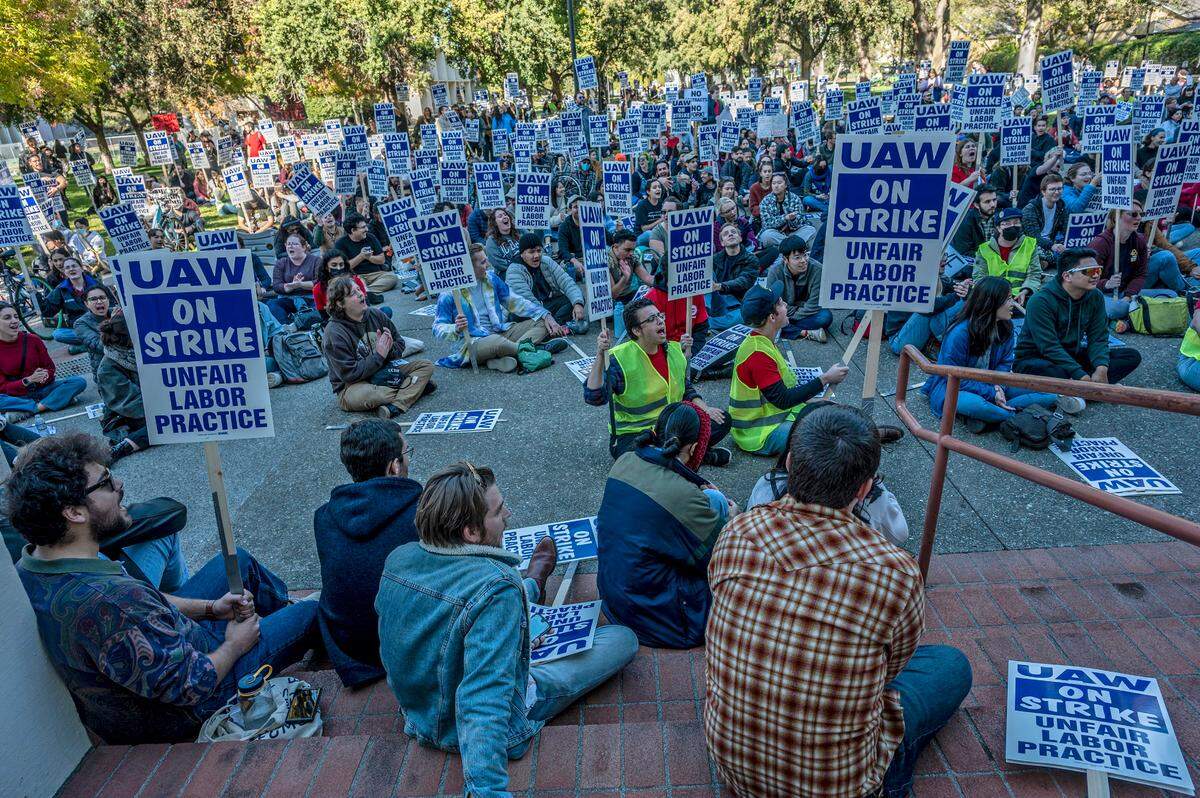
A fifth-year doctoral candidate at UC Davis, Kouba is an instructor for EVE 101 (Introduction to Ecology) and leads the all-graduate student teaching team. The course has 120 undergraduate students enrolled this term.
“It kills me to not be with them right now, my students mean the world to me,” Kouba said. She’s striking because she wants UC to pay graduate instructors a salary that reflects the value of the education they’re providing and to ensure that students of all backgrounds can afford to pursue graduate work.
Kouba said she’s fortunately able to afford rent on her salary, which is about $2,500 a month, she estimates. But she recognizes that many other graduate student instructors and researchers aren’t able to live on that.
“Just because I’m okay though doesn’t mean that my fellow union members are okay,” she said.
Marchers’ chants rang out across campus through the crisp autumn air.
“Forty-eight thousand ready to fight, postdocs, ARs, grads unite!” strikers chanted as they marched through fallen leaves and under bright scarlet trees.
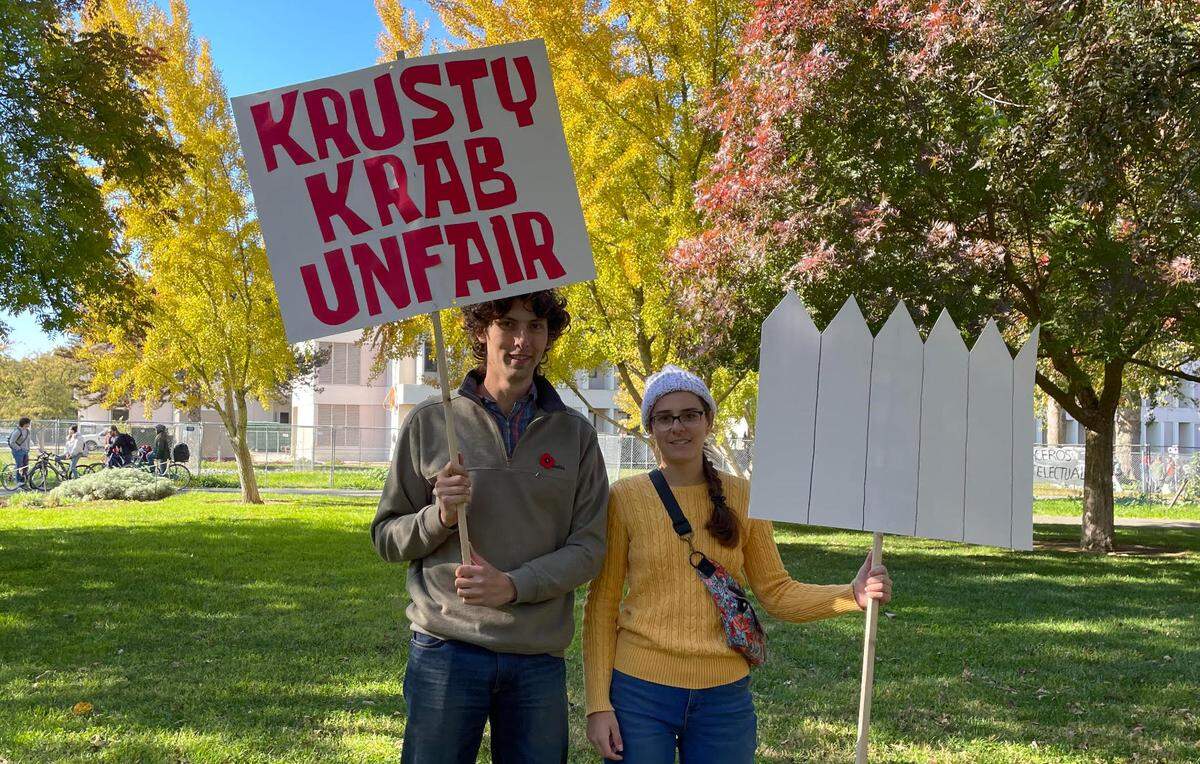
Some of their handmade signs read, “UC works because we do!” and “Krusty Krab Unfair” — a reference to an episode of the TV show SpongeBob Squarepants where Squidward and SpongeBob go on strike.
Undergrads, professors join picket lines
Lucas Sterzinger, 28, and Argel Ramirez, 31, are both Ph.D. candidates in UC Davis’ atmospheric sciences program. They’ve signed up for strike shifts nearly every day this week, even though they know they probably won’t reap the benefits of the new contracts since they’re so close to graduating.
“We certainly would’ve liked to,” Sterzinger said with a laugh, “but we want it for future grad generations.”
Before his partner moved in with him recently, Sterzinger was paying 70% to 80% of his income on rent.
“My rent kept going up by $100 a year, but my salary didn’t,” he said.
Sterzinger, a member of UAW 2865, also works as a teaching assistant this quarter for ATM 5 (Global Climate Change). He and three other TAs run discussion sections, hold office hours and grade papers for 130 students.
Both Sterzinger and Ramirez, who’s a member of SRU-UAW, thought they wanted to work in academia after graduating, but they no longer want to pursue that route after experiencing tough working conditions as Ph.D. students.
“I don’t want following students to face the same things that we had here,” Ramirez said,citing the low wages, bad work-life balance and the power disparity between faculty advisors, their employers, and graduate students.
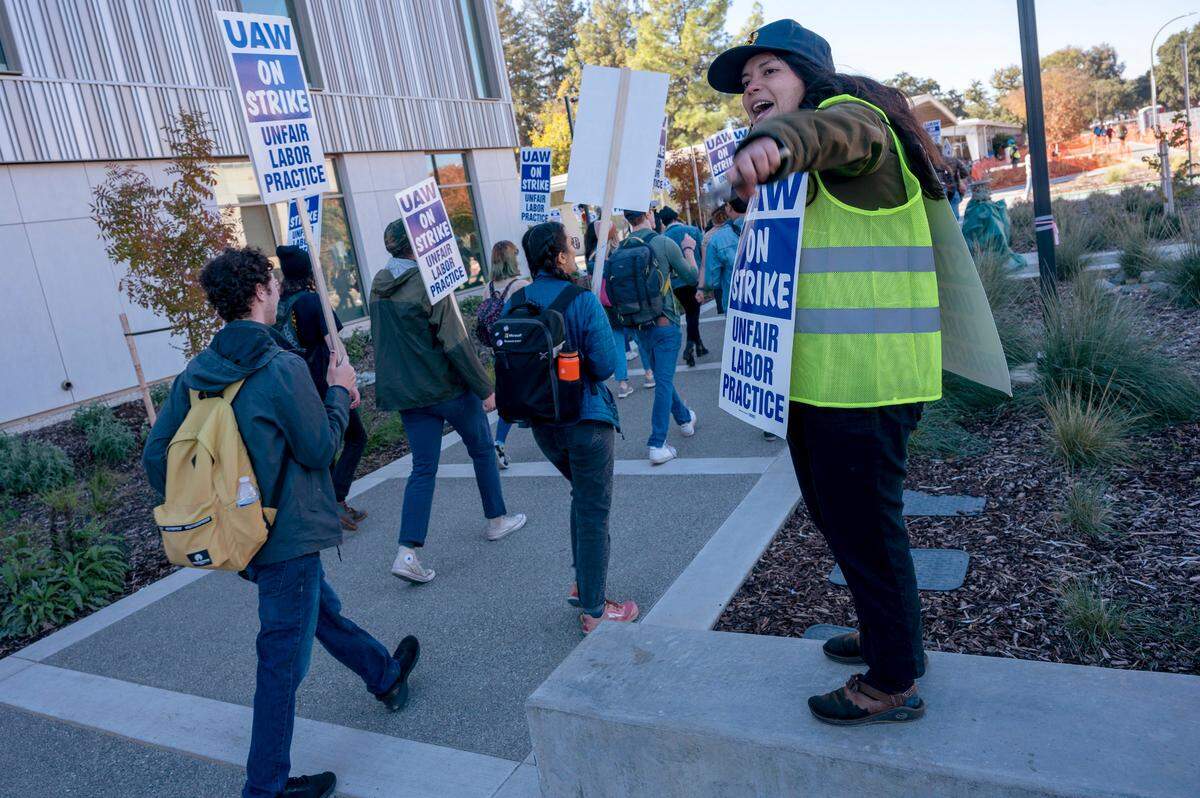
Strikers at UC Berkeley shared similar motivations for joining the picket lines Monday. Undergraduate students and professors joined the academic workers as well.
Grace McGee, an undergraduate studying society and the environment, said she’s spent hours with her graduate student instructors and that they’re the reason why she’s been able to pass some of her classes. She said she hopes their sacrifices today will help make academia more accessible for future graduate students like herself.
“Grad student workers are the first people we go to for help with material,” said McGee. “Their working conditions are our learning conditions.”
“We’re the workers of tomorrow, so living in a world where unions are strong and people can keep up with costs of living is something we want when we enter the workforce,” McGee said.
Mel Chen, a Berkeley professor of gender and women’s studies, joined the strikers in solidarity.
“We talk a lot about intersectionality and the way folks are affected, so as someone with relative privilege on this campus with tenure, I think it’s my responsibility to show support,” they said.
This story was originally published November 14, 2022 at 2:51 PM.