
California drought enters dangerous territory. What’s ahead for fish, farms and cities
In just a few weeks, California’s water conditions have gone from bad to terrible.
Sacramento residents have been asked to cut water usage 10%. Their counterparts on the Russian River are being told to reduce their consumption 20%.
Farmers across the Central Valley are letting fields lie fallow and dismantling their orchards. Government agencies are warning of extensive fish kills on the Sacramento River.
After a warm spring dried up practically the entire Sierra Nevada snowpack — and robbed California of enough water to fill most of Folsom Lake — state and federal officials have been forced to dramatically ramp up their drought response plans.
After Gov. Gavin Newsom declared a drought emergency for 41 of the state’s 58 counties, state regulators began drafting an order that will prevent thousands of farmers from pulling water out of their neighboring rivers. A separate agency is preparing to install a $30 million rock barrier on the Sacramento-San Joaquin Delta to keep salt water from rushing into the critical freshwater estuary. There’s talk of floating a temporary pump on Folsom Lake to help move water out of the withered reservoir.
On Wednesday, the federal Bureau of Reclamation announced a new round of cutbacks, reducing deliveries from the Central Valley Project to 2015 levels.
In a state known for almost chronic water shortages, the drought of 2021 is shaping up as a disaster.
“It’s drier than the very deep drought that just ended,” Karla Nemeth, director of the state Department of Water Resources, said at a regulatory hearing last week.
As recently as late March, the snowpack was about 30% below average — bad, but certainly not catastrophic. Then the sun came out with a vengeance. Much of the snow evaporated or trickled into the dry soil. Very little reached Shasta, Folsom and Oroville, the three major reservoirs of Northern California.
By the time the snow was gone, approximately 685,000 acre-feet of water expected to replenish the state’s reservoirs had vanished instead. That’s enough water to fill up two-thirds of Folsom Lake — or supply as many as 1.2 million households for a year.
The disappearing snowmelt quickly turned the drought into a disaster — “a turning point,” said Jay Lund, a watershed scientist at UC Davis.
Will Sacramento, other California cities have enough water?
This is how bad it’s become: Even parts of California that aren’t in a drought are scouring the state for additional water.
In April the Metropolitan Water District of Southern California budgeted $44 million to bolster its supplies. The mega-agency, which serves 19 million residents, is eyeing water that could become available from farm irrigation districts north of Sacramento.
Metropolitan might not need the water; its current supplies are probably the best in the state. Newsom’s drought emergency declaration left Southern California out.
But the $44 million allocation is a sign of the anxiety that’s hitting urban California.
When former Gov. Jerry Brown declared the state’s last drought emergency in 2015, he ordered urban Californians to reduce water usage by 25%. Newsom — perhaps reluctant to impose restrictions on a pandemic-weary populace with a recall election looming — has refused to go that far. But a similar order could come next year, administration officials have said, if California goes through a third straight dry winter.
In the meantime, urban water agencies are keeping a close eye on their supplies. Sonoma County’s water agency has announced it will reduce diversions from the Russian River by 20% — and is urging residents to reduce their usage by a similar percentage.
“If you have a lawn, let it go brown or remove it,” Sonoma Water Board of Directors Chair Lynda Hopkins said in a prepared statement. “If you have a leak, fix it. Reduce your showers by two minutes, or better yet, in this remote work environment who can smell you on a Zoom call?”
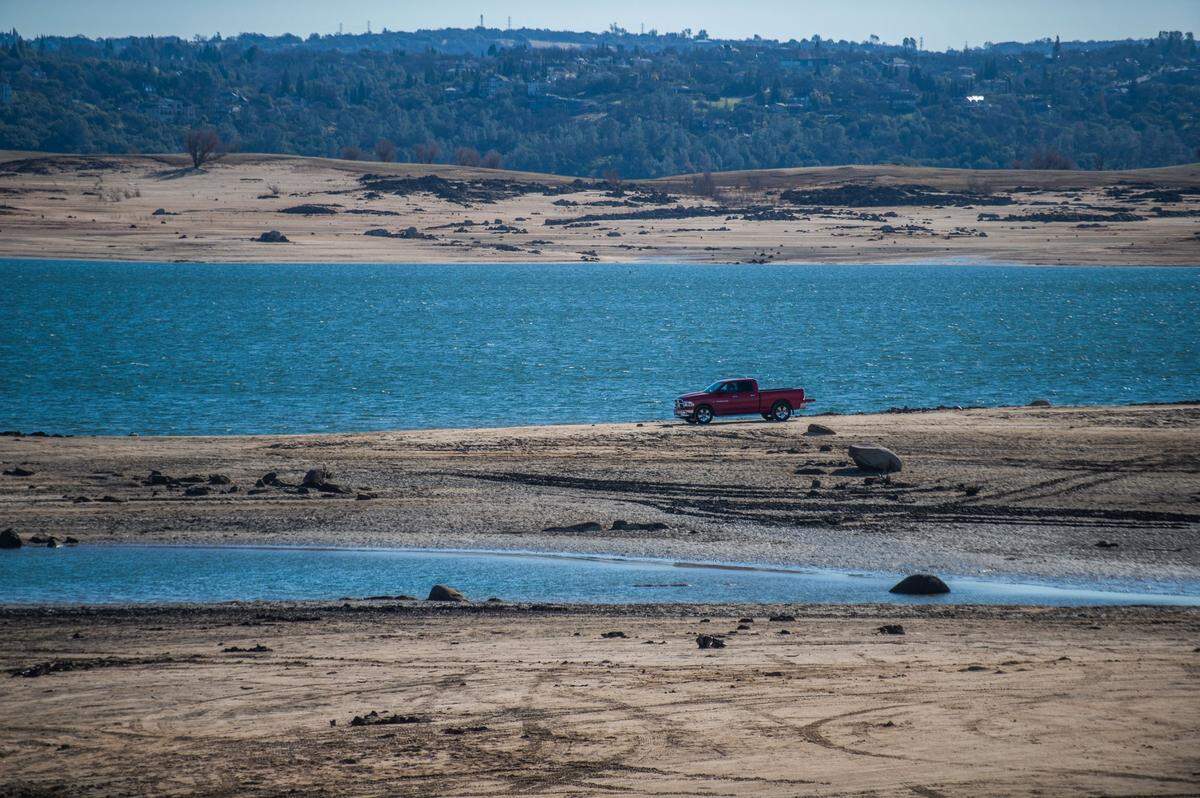
The situation isn’t as dire in the Sacramento area. Groundwater is expected to deliver enough water to maintain reliability for area residents even as Folsom Lake — normally the workhorse of the region’s supply — wallows at astonishingly low levels. The reservoir is holding less than half as much water as it usually should for late May.
That doesn’t mean the Sacramento area will breeze through the drought. The Regional Water Authority, an umbrella agency that oversees a water-sharing agreement among 23 private and municipal agencies, has called on residents to voluntarily lower their consumption by 10%.
The federal government Wednesday said municipal water agencies that belong to the Central Valley Project will receive just 25% of their allocations, down from the previously announced 55%. That was the same amount delivered in 2015.
There’s another complication. As low as it is, Folsom Lake will be called upon this year to release water to keep fish alive on the Lower American River. Yet area officials fear the reservoir could reach “dead pool” status — that point where water levels fall below the valves near the base of the dam that deliver water to the region.
That almost happened during the last drought, and the federal Bureau of Reclamation, which runs Folsom, considered putting portable pumps on a barge to push water up to the valves. As it turned out, the plan didn’t have to be implemented, but Jim Peifer, head of the Regional Water Authority, said it’s possible the idea could be revived in the new drought.
Folsom Lake has to be able to deliver water “for both people and fish,” Peifer said.
Drought disaster looms for endangered fish
Chuck Bonham is the state official in charge of protecting wildlife. Everywhere he looks — in California and across much of the West — he sees environmental disaster looming.
“The same thing that’s happening in the Klamath just happened in the Sierra and the Central Valley,” said Bonham, the longtime director of the state Department of Fish and Wildlife. “It’s the same thing that’s happening in the Colorado. The same thing is happening in the Rio Grande. The same thing is happening in the Upper Missouri headwaters.”
In the Klamath region, which straddles the California-Oregon border, conditions are extremely perilous already. Around 150,000 acres of farmland that rely on the federal government’s Klamath Project will receive practically no water this year. Because of the irrigation water shutoff, two vital wildlife refuges in California — Lower Klamath and Tule Lake — could dry up this summer, depriving millions of migratory birds of wetland habitat.
At the same time, the federal government said there’s no water available to flush out the Klamath River and fight a disease that’s killing young salmon — fish that are critical to the livelihood and cultural identities of the Yurok, Karuk and Hoopa Valley Indian tribes.
A problem in one area creates environmental issues elsewhere. Conditions are so dry in the Klamath, waterfowl heading south this fall along the Pacific Flyway will skip their usual stops in the Klamath. Instead, they’ll gather in rice fields of the Sacramento Valley, where they’ll struggle to find marshy spots because of reductions in plantings, Bonham said.
“We’re likely to find far more birds in much less space, which is a recipe for disease,” Bonham told the State Water Resources Control Board recently.
Meanwhile, environmentalists and government scientists fear for the continued existence of the endangered winter-run Chinook salmon, which was nearly wiped out in the last drought by conditions on the Sacramento River.
As many as 95% of the juvenile Chinook population perished in 2014 and 2015 when the water pouring out of Shasta Lake turned so hot — the flash point is 56 degrees — that the young fish were literally cooked in the river. In mid-May, the National Marine Fisheries Service wrote a letter to the U.S. Bureau of Reclamation, which operates Shasta, warning that salmon mortality this summer could reach 88%.
Federal and state officials are trying to ward off a repeat catastrophe by making emergency changes in how water flows through the Delta.
Ordinarily, state environmental rules require a certain amount of water to flow through the Delta and follow its natural course to the ocean, helping prop up the populations of Chinook and other fish that ply the estuary.
In early May, though, the Bureau of Reclamation and state Department of Water Resources, which operate the two big projects that supply many of California’s farms and cities, asked for permission to weaken those Delta outflow requirements. Reducing the outflows would enable the projects to store water for months longer in Shasta and other major reservoirs — and keep the water cool enough to keep more of the salmon alive when the water is released into the rivers later this year. The State Water Resources Control Board will rule on the petition soon.
Environmentalists like Doug Obegi, a lawyer with the Natural Resources Defense Council, said ignoring the outflow rules will further degrade conditions in the Delta. And he’s skeptical that the reservoirs will store enough water to save the Chinook.
Reservoir operators failed to control water temperatures in the last drought, and “that’s the track we’re on again today,” Obegi said. The problem lies in the two projects’ desire to deliver water to their urban and agricultural customers, he said.
“We’re in a tough spot because the projects deliver too much water in dry years,” Obegi said.
Why farmers say this drought is worse
The two big delivery systems in the state — the State Water Project and the federal Central Valley Project — have been a staple of California life for decades. Through a complicated array of reservoirs and canals, they deliver billions of gallons of water annually to farms and cities. Much of the water flows through the Delta, diverted into giant pumping stations near Tracy, and shipped to the San Joaquin Valley and Southern California.
Even in a drought, some of their agricultural customers retain special rights that mean they get a lot of water. Some farmers on the Sacramento River are due to receive 75% of their contract allocation this year from the Central Valley Project.
Most other farmers, though, are making do with a lot less.
The State Water Project is limiting deliveries to 5% of what’s been contracted, and the Central Valley Project told most farmers Wednesday they’ll get nothing this year.
Separately, the State Water Resources Control Board in June plans to cut off approximately 2,900 farmers and others with so-called junior water rights, prohibiting them from drawing water from rivers and streams. Thousands of other rights holders could lose their water supplies as well later this year.
The results could be devastating for California’s $50 billion-a-year agricultural industry. The California Rice Commission has predicted a 20% decline in the state’s rice crop, leaving 100,000 acres unplanted in the Sacramento Valley.
Some are selling water instead of planting. A group of Sacramento Valley farmers plans to sell as much as 150,000 acre-feet of water to growers south of the Delta. The price: $550 an acre-foot, or $82 million.
Thad Bettner, general manager of the Glenn-Colusa Irrigation District in the western Sacramento Valley, said growers are making difficult calculations based on the scarcity of water: Is it better to sell or to try to maximize their crop?
“It’s a market decision,” he said.
Still, the water sales won’t do much to alleviate shortages on the receiving end. To preserve cold water in the Sacramento Valley system, the water won’t even get delivered until after the south-of-Delta planting season ends this fall.
Sarah Woolf, a prominent Fresno County farmer, growers in the San Joaquin Valley are fallowing fields. Her husband’s family is even tearing out some of its almond orchards, which cost thousands of dollars per acre to plant, to conserve water.
Woolf said the drought is already worse in the Valley than it was in 2014 and 2015.
Back then, conditions deteriorated more gradually and farmers could rely on water that had been saved up in San Luis Reservoir, the major reservoir south of the Delta. This year, there’s no comparable backup.
“Oroville’s not dumping into the Delta, Shasta’s hanging onto water,” Woolf said. “Overall, the Delta is much drier than it was in 2014 and 2015.”
This story was originally published May 27, 2021 at 5:00 AM.