
‘Crisis reveals character.’ Pastor leads a Sacramento church with a coronavirus cluster
Pastor Jeff Chapman first began to pay attention to coronavirus in late February, when one of his parishioners approached him with requests for changes in how Faith Presbyterian Church operates.
“She’s someone who’s had an organ transplant, and so she was particularly concerned about being susceptible,” Chapman said. “She wanted us to make some changes in worship and to socially distance.
“I didn’t know that term at the time. She wanted no shaking hands, no passing plates, things like that. To be honest, I was a little resistant.”
But the woman was persistent, and Chapman agreed to make the changes in time for Sunday services on March 1.
The church stopped passing the offering plates. Communion, which typically used a shared loaf of bread and shared cup, was switched to individual offerings. The ritual of shaking hands and offering “peace” to each other was halted.
“I thought it was premature, overkill,” the 53-year-old pastor recalled. “But in retrospect she probably helped us save some lives. We had no idea any of this would hit so close to home for us.”
Within 12 days, Chapman’s Greenhaven neighborhood church was the epicenter of Sacramento’s COVID-19 outbreak and church leaders rushed to close the historic Florin Road facility for the first time in its 50-year history.
The mother of one church member – a resident of an Elk Grove assisted living center who did not attend the church – became the first person in Sacramento County to die from the virus on March 10.
Five days later, a substitute teacher and long time church member died from the virus. Six days after that, another member died.
Six others tested positive. Chapman was forced into quarantine for a week with symptoms of the virus, but would later test negative. And his 82-year-old mother, who had been on a cruise in Australia when coronavirus swept over many passengers, found herself alone, locked in a 14-day quarantine inside a Holiday Inn room in Melbourne.
Chapman, speaking to The Sacramento Bee in an interview in the courtyard of the church adjacent to John F. Kennedy High School, said he has no idea how the virus began to spread among the 450-member congregation.
“It would all be speculation,” he said. “Clearly, some of these people did not have contact with each other.
“We just happened to be a place where it was just a concentrated number of people. But since that first wave nobody’s tested positive.”
As coronavirus spread into a worldwide pandemic, much larger concentrations of people with the illness began turning up at churches, nursing homes and assisted living centers in the Sacramento region.
Church shut down immediately
Chapman says he believes part of the reason Faith Presbyterian did not suffer more losses is the speed with which the church shut down after staffers first noticed congregants displaying COVID-19 symptoms, including the organ recipient who first asked him in February to take more precautions against the virus. (She later tested positive, but has recovered, Chapman said).
Chapman formed an advisory group of three church members with backgrounds in public health, infectious diseases and medicine, and they decided to close down March 12.
“Once again, I thought it was overkill,” he said. “But I’ve told people I struggle with the decisions we are trying to make, and it was a huge relief to me to turn the decision-making over to these three experts because they were going to make decisions based on health and not on instinct and pastoral sense.
“We have a lot of outside groups that use the church and we called them all and said, ‘We’re sorry, but the church is completely shut down, the staff has to stay home.’ So since that Thursday night, we haven’t had a single in-person meeting in the church or outside even. Anywhere. They’re all shut down.”
The next Sunday, March 15, no services were held. Yellow signs were posted on all building doors warning “NO ENTRY” and explaining that the church was dealing with coronavirus.
“The first Sunday, we didn’t have worship at all,” Chapman said. “The church celebrated 50 years in December, and I’m guessing that’s the first Sunday ever we’ve suspended worship.”
Online preaching, Lord’s supper on Zoom
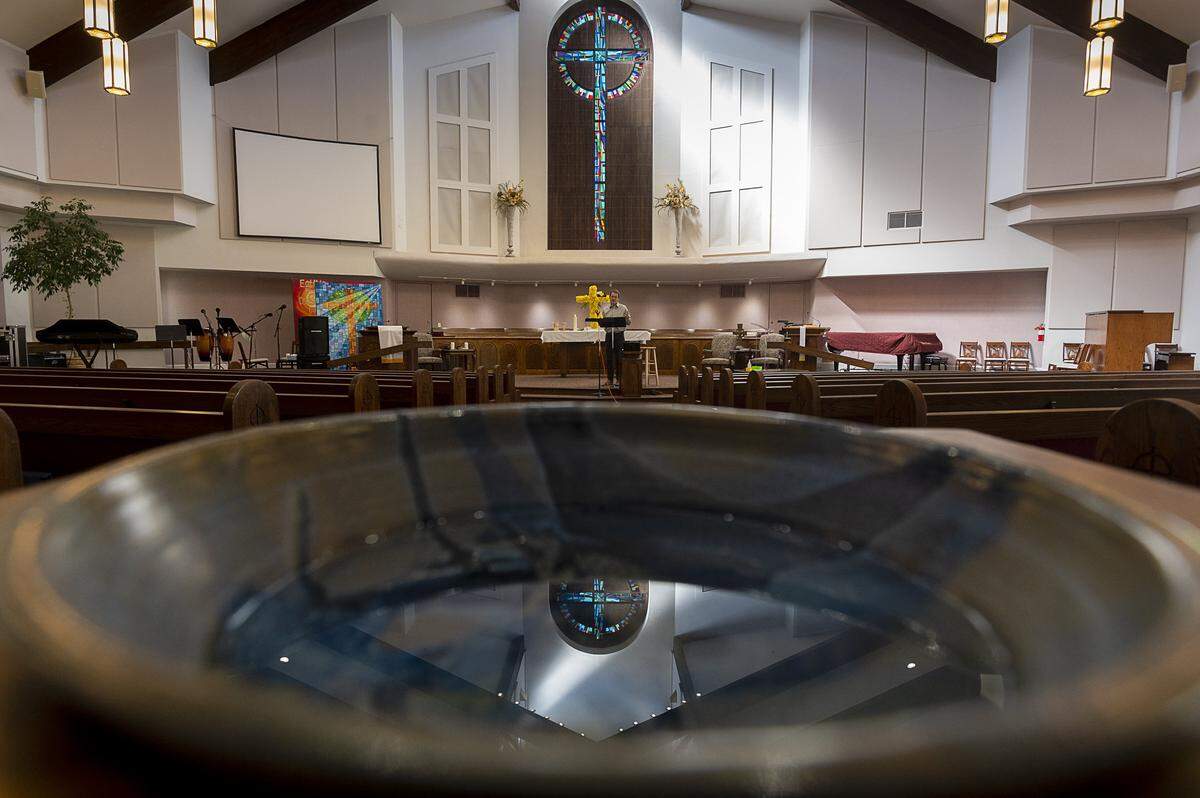
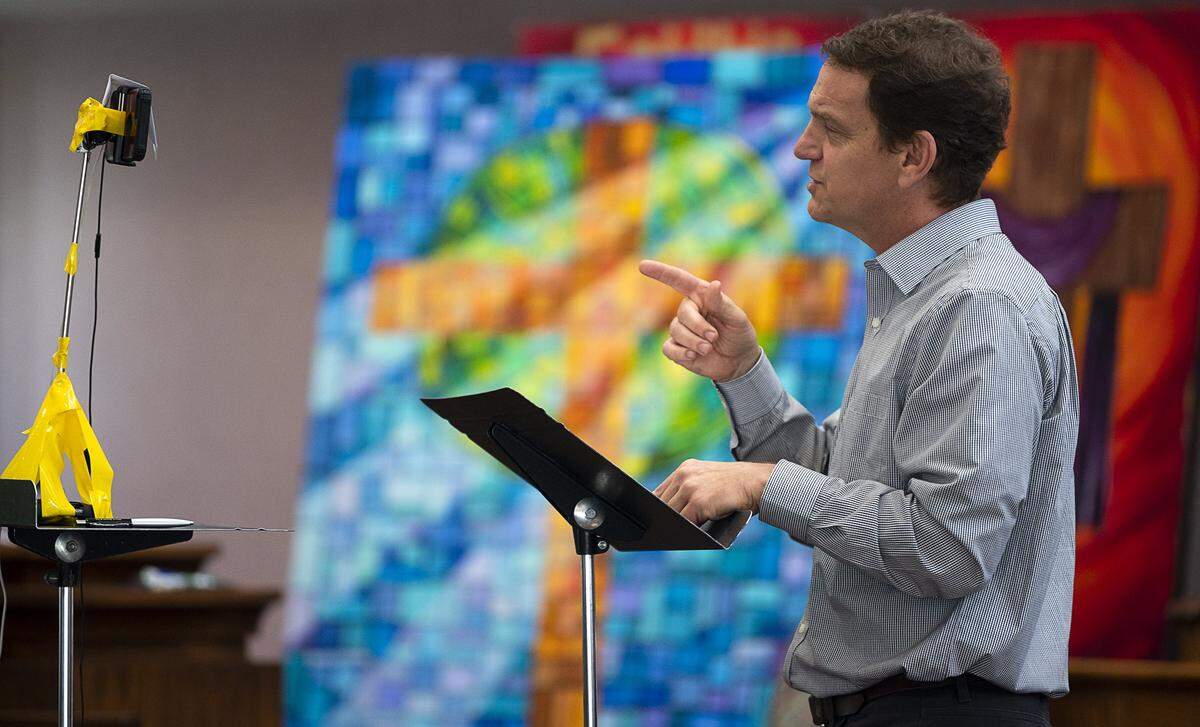
A week later, on March 22, Chapman conducted his first online service, preaching from his home. Since then, with the help of digitally savvy members of the church, he has preached from the pulpit of his church, standing completely alone and talking into an iPhone attached to a makeshift stand one of his sons, Godebo, helped to build.
“I have to tell you, it’s unfortunately getting to feel somewhat normal,” Chapman said before pausing. “That’s the wrong word. It’s a new normal.”
Since the crisis began, some of the holiest days of the year have gone by, forcing the church to improvise. Easter sunrise services were conducted online from outside the church with only Chapman and Associate Pastor Brett Shoemaker present, “but we didn’t get within 10 feet of each other,” Chapman said.
“We’ve done the Lord’s supper on Zoom now, the kind of things I never would have thought,” he said. “I don’t think we can do a baptism on Zoom. I’m not sure that would work.”
Trapped in quarantine in Australia
As Chapman tended to his parishioners’ needs, he also had to contend with his mother, Mary Ann, being stranded in Melbourne, Australia, after a coronavirus outbreak aboard the Ruby Princess cruise ship, which has had 21 deaths linked to the cruise.
“She doesn’t know anybody in Australia, she was by herself, literally,” he said. “So I just sent some emails by Google to some Presbyterian churches in Melbourne and the next day I get an email through WhatsApp from a pastor in Melbourne who heard about my mom and said, ‘Our church is nearby. What can we do to help?’
“And so they brought her food every day, they had a woman in her church who was her age calling her every day. They tapped her in by phone to their Bible study. They brought her some reading material, and then the pastor himself came and took her to the airport in a mask when she had no way to get to the airport.”
Once she was released from quarantine, Chapman’s mother flew to Sydney, then San Francisco and arrived in Sacramento the weekend of Palm Sunday. Chapman has his congregants pray for the Melbourne church, Hume Presbyterian Church, and email them.
“They’re a brand new church over there, they’re small and trying to get off the ground,” he said, adding that he invited the Australian pastor to visit some day.
“I told him, ‘When you want to come to the states I’ll set you up, all over California,’” he said. “You can stay for free with people I know. We want to try to reciprocate for him.”
Long-term financial, personal hardships
Chapman also has been spending time evaluating the long-term effects coronavirus will have on the church, its various programs and its individual members.
“It’s still hard to navigate the economic impact on individuals in our church,” he said. “A friend of mine described this to being in a tornado.
“You’re sheltering in place in a tornado and the storm’s going overhead and you’re waiting it out. And then when it’s all over you’ll come up and you’ll see the the damage it’s done.”
The damage for some may be financial because of lost jobs and wages, or may be deeply personal because of the emotional strain of the crisis. Or it may be both.
“Crisis reveals character,” Chapman said. “In an earthquake, you see the buildings that have integrity stand. The ones that don’t fall.
“And I know families that were already fractured that now they’re stuffed in the same household and it’s really putting strain on marriages and relationships. So the damage isn’t just going to be economic.”
So far, he says, he has not seen a dip in offerings to the church, although it is difficult to say for certain because of church policy.
“We struggle on a practical level just to count people’s offerings because we have a system in place that requires, for accountability, two people to do that,” he said. “And how do we get two people together when we’re not supposed to be together?”
He also worries about the future of work the church does with tutoring programs in the Fruitridge area and with an area food closet, as well as the church’s work fighting poverty in the western Kenya village of Mahondo.
Chapman said he has been encouraged by the congregation’s reaction to the initial steps he took to lessen the threat, and to the shutdown and switch to virtual services and online classes. Some of the changes may become permanent.
“A lot of churches are learning how to do things now that we may continue to do to some extent,” he said. “We’re doing all of our classes online, and we’re getting two three times the attendance.”
Some older parishioners say they do not want to return to church services until there is a vaccine available, meaning he may eventually do an in-person service when the church re-opens as well as an online service.
When will church reopen?
Some churches have resisted stay-at-home orders, going as far as to sue over them. But Chapman said the decision on when his church reopens will be left entirely to county and state officials.
“We’re totally subject to what the public health officials say, so we’ll gather together when we’re given the green light to do so,” he said.
While he waits, Chapman is living the same type of existence thousands of other Sacramento-area families are dealing with. His four children, two in high school, two in college, are at home along with one’s college roommate.
“Our food bills have gone through the roof,” he said. “But my gas bill is really down, so we’re using our gas money to buy our food. That’s the trade off.
“There’s no leftovers, though. I used to take leftovers for lunch, but there’s no leftovers. It’s like vultures live in my house now.”
This story was originally published May 13, 2020 at 5:00 AM.