Coronavirus updates: Over 20,000 cases, 275 dead in Sacramento area; some schools to open
It has now been one month since California Gov. Gavin Newsom announced re-instituted social distancing restrictions on businesses, churches and other gathering places in response to coronavirus numbers that started surging around mid-June.
Newsom did so July 13, expanding on other shutdown orders he issued July 1 for counties on the state health department’s watchlist. That list, which also determines whether school campuses can be allowed to reopen, remains frozen at 38 of California’s 58 counties that combine for more than 97% of its 40 million residents.
A data error and resulting backlog of COVID-19 case reports traced to July 25 have muddied the state and individual counties’ understanding well into August about how virus activity is trending, as well as important contact tracing efforts. But Newsom and other state leaders, including Health and Human Services Secretary Dr. Mark Ghaly, have recently expressed some optimism that true spread is declining.
The number of COVID-19 patients hospitalized statewide has fallen by 25% in about three weeks, below 5,250 as of Thursday after a peak in July of nearly 7,200 in hospital beds with the respiratory disease. The ICU patient total was down to 1,672, falling from a peak of over 2,050 in late July for more than a 17% drop.
Newsom said in a Wednesday news conference that of about 11,600 new infections added that day, roughly 6,200 were from the backlog and the remaining 5,400 were from a more typical reporting period. The latter total, if accurate, would be one of California’s smallest case increases since early July. The state then added 7,085 new cases Thursday morning.
The data glitch, which involved an outage of the electronic system that labs statewide use to report disease data to counties and to the state, led to a backlog of about 295,000 COVID-19 case reports.
Still sorting through that backlog, California’s all-time case total for COVID-19 has surpassed 593,000 for the course of the pandemic. At least 10,808 Californians have died, with 180 fatalities reported Wednesday and 160 more Thursday, according to a data update from the California Department of Public Health.
Until the data problem is fully resolved, CDPH has paused adding or removing counties from the state’s monitoring list.
The timing for that freeze is unfortunate. Newsom and the state announced last month that a county would need to be off the list at least 14 consecutive days before being permitted to allow K-12 schools to reopen for in-person instruction. And at the start of last week, one day before state officials publicly acknowledged the data problem, the state unveiled a waiver process that would allow schools to seek permission to reopen early in watchlist counties that are averaging fewer than 200 daily new cases per 100,000 residents.
The start of the academic year is fast approaching, with some districts starting this week or next. Sacramento City Unified School District starts the 2020-21 school year Sept. 3.
Sacramento area passes 20,000 total coronavirus cases, nearly 280 dead
The six-county region of Sacramento, El Dorado, Placer, Yolo, Sutter and Yuba counties has reported 279 combined coronavirus deaths. The region on Thursday morning surpassed 20,000 confirmed cases for the course of the pandemic.
Sacramento County has now tallied 13,216 confirmed infections, disclosing 738 cases Thursday after reporting 204 Wednesday. It’s unclear how many of those recently reported cases are from the backlog as opposed to more recently tested cases.
At least 194 residents have died, the county reports, with at least 80 deaths occurring in July and 18 over the first eight days of August, the most recent on record. The death toll is composed of 127 deaths in residents of the city of Sacramento, 11 in Elk Grove, 11 in Citrus Heights, seven in Rancho Cordova, six in Galt, four in Folsom and 28 in unincorporated territories.
State data show 253 COVID-19 patients in Sacramento County hospitals, with that figure having plateaued for a little more than a week after a slight drop from its peak of 281 on July 30. ICU cases are down to 85 from a high of 91. Another 81 ICU beds remain available countywide.
Placer County has reported 2,487 cases and 27 deaths, disclosing one death Thursday after reporting two each on Tuesday and Wednesday. The county has reported 11 deaths in 11 days, after the first 16 deaths came over a span of nearly five months. Placer added 73 cases to its count Thursday.
The county says 55 patients in Placer County hospitals are being treated for COVID-19, 11 of them in the ICU, down from 61 and 13, respectively, a day earlier.
Yolo County on Thursday reported nine new COVID-19 cases with no new deaths from the virus. The county reported a record-high 75 new cases Monday due to a backlog and it has now reported a total of 1,927 cases and 45 deaths. The county reported one death each on Friday and Sunday. Eight infected people in the county were hospitalized Wednesday, six of them in intensive care, according to state data. The county has only four ICU beds available.
El Dorado County added nine new cases Thursday, bringing its total to 802. The county reported its second death from COVID-19 on Monday.
The county now has two COVID-19 patients in its hospitals, both of them in the ICU. Currently, the county has eight available ICU beds. The county remains the capital region’s only one not placed onto the state’s coronavirus watchlist, reflecting its relatively low case total, but changes to the watchlist have been frozen until the state’s backlog issue is fully resolved.
In Sutter County, 1,041 cases and seven deaths have been reported through Wednesday evening. Sutter hospitals are currently caring for 17 with the virus, with six in the ICU.
Yuba County has reported 688 cases and four deaths. Thirteen were hospitalized there as of Wednesday, including three in intensive care.
Folsom prison outbreak nearly doubles in size
Early Wednesday, the California Department of Corrections and Rehabilitation data tracker for COVID-19 showed 56 active cases in inmates at Folsom State Prison, all confirmed within the past two weeks.
By 6:30 that evening, the outbreak had swelled to 99 active cases; by 6 a.m. Thursday, it had reached 109. Another seven who previously tested positive either recovered or were released with their infections still active, according to CDCR.
The California Prison Industry Authority, a state agency that trains inmates for work after release from prison, on Wednesday confirmed to The Bee that one employee who had worked at Folsom State Prison died from potential complications of COVID-19.
Prisons have been one of California’s worst hotspots for coronavirus. As of Thursday morning, over 9,000 incarcerated people have tested positive for the virus: 1,044 of those cases are still active, at least 53 people have died, 7,633 have recovered and 316 were released while active.
The most severe inmate outbreak to date came at San Quentin State Prison, where more than 2,200 inmates have contracted the respiratory disease, at least 25 of whom have died. More than 100 COVID-19 cases remain active at San Quentin, according to CDCR’s data tracker.
Prior to the CalPIA worker’s death, CDCR had reported nine employee deaths at nine separate prisons from COVID-19.
The deadly state prison outbreaks have been attributed by lawmakers, prison reform activists and other groups to poorly handled transfers between institutions, as well as the challenge of adequate social distancing in California’s crowded prisons. Folsom State Prison had an inmate population of just under 2,400 as of Aug. 5, according to CDCR.
El Dorado County: Schools prepare to open, another restaurant put on notice
El Dorado is the only county in the Sacramento area that’s avoided a spot on the state watchlist, due to its relatively low COVID-19 numbers. The county of about 200,000 people is therefore part of the less than 3% of California by population that’s playing by different rules at the moment.
Some K-12 campuses will open next week, including the five elementary schools and two middle schools included in Rescue Union School District, which serves about 3,700 students. About 800 of them will continue distance learning, being assigned teachers who chose to work from home because they identify as high risk.
In line with state and county safety protocols, masks at Rescue schools will be mandatory for third-graders and older, desks will be 6 feet apart and teachers will sanitize desks between classes. Books that students touch will be placed in bins labeled “need to be cleaned” and sanitized before returning to shelves.
Kindergarten teacher Gretchen Belleci said she’ll use a clear face shield rather than a mask while teaching phonics, so that the children can see her face and her smile.
Other area campuses, including El Dorado County high schools, won’t reopen and will start the academic year remotely.
Though El Dorado is not on the watchlist, all restaurants statewide have been ordered since July 13 to close their indoor dining rooms. County officials on Tuesday suspended another restaurant’s health permit for COVID-19 safety violations considered flagrant, the county’s third such suspension in recent weeks.
Danette’s Brick Oven, on Ray Lawyer Drive in Placerville, was subject to numerous complaints from locals, including three in the week preceding the suspension, county environmental management department manager Jeffrey Warren said.
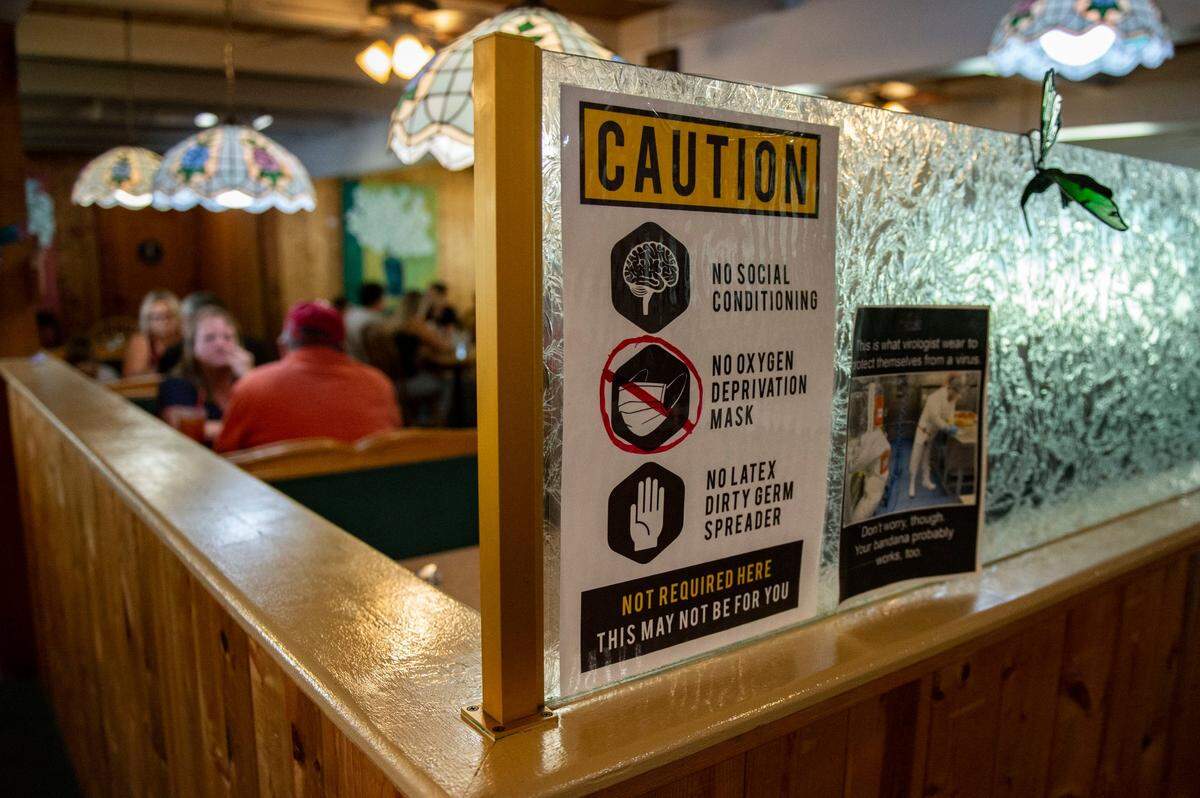
Danette’s had posted memes on its Facebook page criticizing state restrictions on restaurants and bars and, when allowed to reopen for indoor dining back in May, Danette’s told customers to “leave your masks at home.”
El Dorado County previously suspended health permits for Apple Bistro in Placerville and Cafe El Dorado at the end of July for blatant health violations; both have stayed open in defiance of the county order, subjecting each of them to monetary fines of up to $500 a day.
“It is unfortunate that we have some facilities that are not willing to comply as our goal is to continue educating them on how to stay open and safe during this economic hardship time,” Warren wrote in an email.
California unemployment claims falling; Trump proposes $300 a week
The U.S. Labor Department in Thursday’s weekly report says Californians filed about 213,500 unemployment claims for the week ending Aug. 8, down from 222,000 the prior week and the lowest one-week total for the state since the week ending May 23.
Nationwide, the U.S. saw 963,000 initial claims last week, a decrease by nearly a quarter-million from the 1.19 million filed the previous week. The national figures are seasonally adjusted; the state numbers are not.
President Donald Trump is proposing unemployment benefits of $300 a week, after $600 in federal unemployment benefits expired at the end of July and as talks in Congress to continue that benefit or one of a different amount have stalled.
Newsom during Wednesday’s news conference called $300 a week “not enough,” while adding that he won’t “look a gift horse in the mouth.”
Newsom said the changes that Trump’s executive order include for eligibility requirements will create distribution issues.
“When you introduce new eligibility rules into these ancient systems, and trust me California is not the only one, it creates a processing problem that can delay the distribution of these checks,” the Democratic governor said. “We’re grateful to take those dollars. We’re happy to accept them, we believe they are not enough. But you can’t change the eligibility rules in a way that will impact our capacity to get them in the pockets of people that need them the most.”
World numbers: Global death toll reaches 750,000
More than 20.6 million lab-confirmed cases of the coronavirus have been reported worldwide and 750,000 people have died as of Thursday morning, with the United States leading the globe at more than 5.2 million infections and 166,000 deaths, according to data compiled by Johns Hopkins University.
Brazil is next in terms of death toll, recently surpassing 103,000. After that are Mexico at nearly 55,000, the United Kingdom at almost 47,000, India at more than 46,000, previous European epicenter Italy at 35,000, France at just over 30,000, Spain at just over 28,500 and close to 22,000 in Peru.
The long list of countries with five-digit death tolls continues with nearly 19,000 dead in Iran, over 15,000 in Russia, close to 14,000 in Colombia, just over 11,000 in South Africa and more than 10,000 in Chile. Belgium is just shy of 10,000 deaths, according to Johns Hopkins, and Germany and Canada have each recorded more than 9,000 fatalities.
What is COVID-19? How is the coronavirus spread?
Coronavirus is spread through contact between people within 6 feet of each other, especially through coughing and sneezing that expels respiratory droplets that land in the mouths or noses of people nearby.
The Centers for Disease Control and Prevention says it’s possible to catch the disease COVID-19 by touching something that has the virus on it, and then touching your own face, “but this is not thought to be the main way the virus spreads.”
Symptoms of the virus that causes COVID-19 include fever, cough and shortness of breath, which may occur two days to two weeks after exposure.
Most people develop only mild symptoms, but some people develop more severe symptoms, including pneumonia, which can be fatal. The disease is especially dangerous to the elderly and others with weaker immune systems.
This story was originally published August 13, 2020 at 8:55 AM.