
‘Enjoy the skiing while we can’: Tahoe’s winter resorts face a future of climate change
They’ve been skiing at Lake Tahoe for more than a decade, and love the area so much they’re thinking of buying a vacation home here.
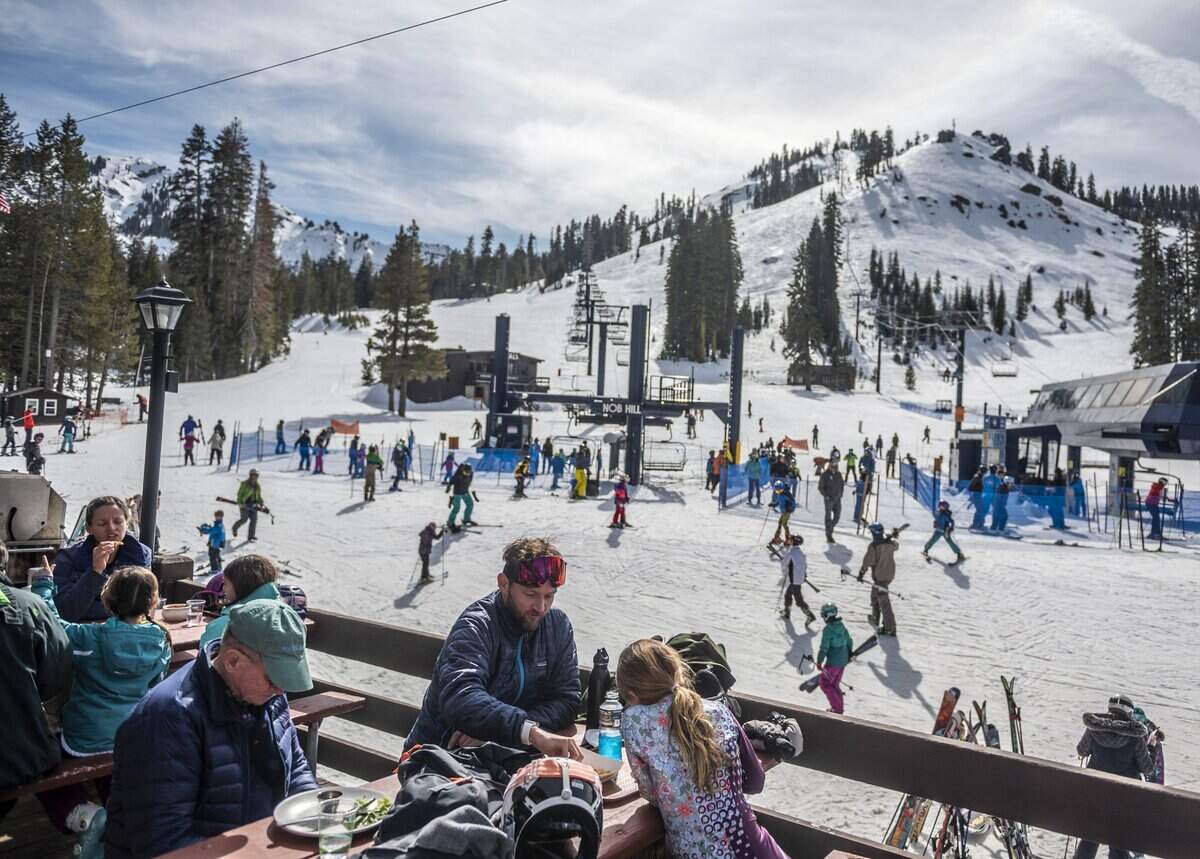
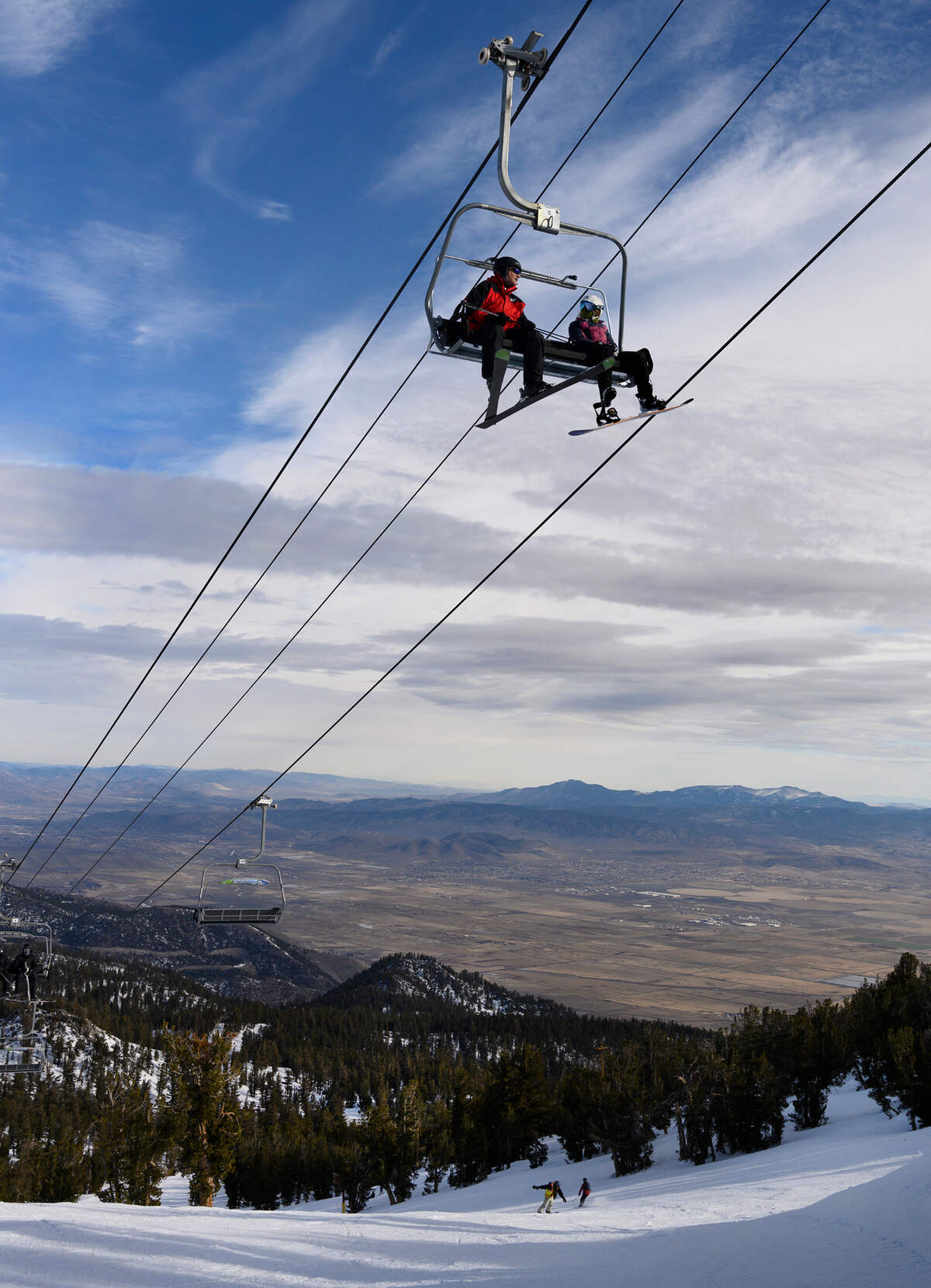
But on a recent afternoon, with the sun beating down on the slopes of Sugar Bowl and the temperature approaching 50 degrees, Michael and Courtney Clamp of Santa Rosa were second-guessing the idea.
“We’ve always talked about buying a vacation home,” Michael Clamp said as his daughter Piper devoured a basket of chicken fingers near the base of Sugar Bowl’s famed Mt. Judah. “But I don’t know if that’s a great investment with the winters becoming less reliable.”
Even in what promised to be a bountiful season, with the early snow the deepest it’s been in several years, Northern California’s winter getaway is under assault from climate change. California Department of Water Resources’ monthly survey of snow conditions Tuesday revealed a substantial loss of snow following a bone-dry January.
Scientists say warmer weather is turning much of Lake Tahoe’s snowfall into rain, particularly at lower elevations, and is compressing the winter season into fewer days. The future is looking bleak: A study published last fall in the journal Nature Reviews says “persistent low-to-no snow conditions” will plague the Sierra Nevada in 35 years.
“It’s not great news,” said the study’s co-author Daniel Feldman, a scientist at the Lawrence Berkeley National Laboratory. “We’ll have to be flexible here and enjoy the skiing while we can.”
Tahoe ski resorts are scrambling to preserve their business models and stave off disaster. Mindful of global warming and the disastrous drought year of 2015 — when many had to shut down for the season in March — resorts such as Sugar Bowl are buying more powerful snow-making equipment to compensate for the shortages in natural snowfall.
Just as significantly, many resorts are diversifying. They’re investing millions to create mountain-bike trails, rope courses and other facilities for summer recreation, calculating that they can no longer count on a successful winter.
Homewood Mountain, the lakeside resort on Tahoe’s west shore, purchased a boat marina five years ago. In 2020, it dove into the business of renting and selling zero-emission electric boats. Summer at Homewood includes RV expos and arts and crafts fairs.
“We’re more and more becoming a year-round resort,” said Homewood’s general manager, Kevin Mitchell.
Nonetheless, for generations of Californians who think of Tahoe as a winter escape, the prospect of a dwindling Sierra snowpack is depressing. That includes skiers like Grass Valley resident Don Farber, who’s held a season’s pass at Sugar Bowl since 1967.
“I worry about it a lot,” Farber said, gesturing toward Mt. Judah. “This is my temple.”
Boom and bust on Tahoe’s slopes
California has enjoyed a decent winter so far, with enough rain and snow to ease one of the worst droughts recorded. Overall precipitation is above average in Northern California. The central Sierra snowpack, which includes Tahoe, is just slightly below average for this time of year despite a dry January. A year ago, the snow was half as deep as usual.
But a closer look at the data reveals a troubling boom-and-bust pattern. Snow depths have dropped substantially in the past month, according to figures compiled by the state Department of Water Resources.
At Blue Canyon, the spot at 5,280 feet elevation where snow chain restrictions often take effect during storms, nearly 3 feet of snow disappeared, leaving just under 4 feet on the ground. The same held true at higher elevations: Caples Lake, at 8,000 feet near Kirkwood ski resort south of Tahoe, lost more than a third of its snow.
“We’ve already seen quite a bit of melt on the snowpack,” said Andrew Schwartz, manager of UC Berkeley’s Central Sierra Snow Lab. “We hope the snow holds out, but it might not.”
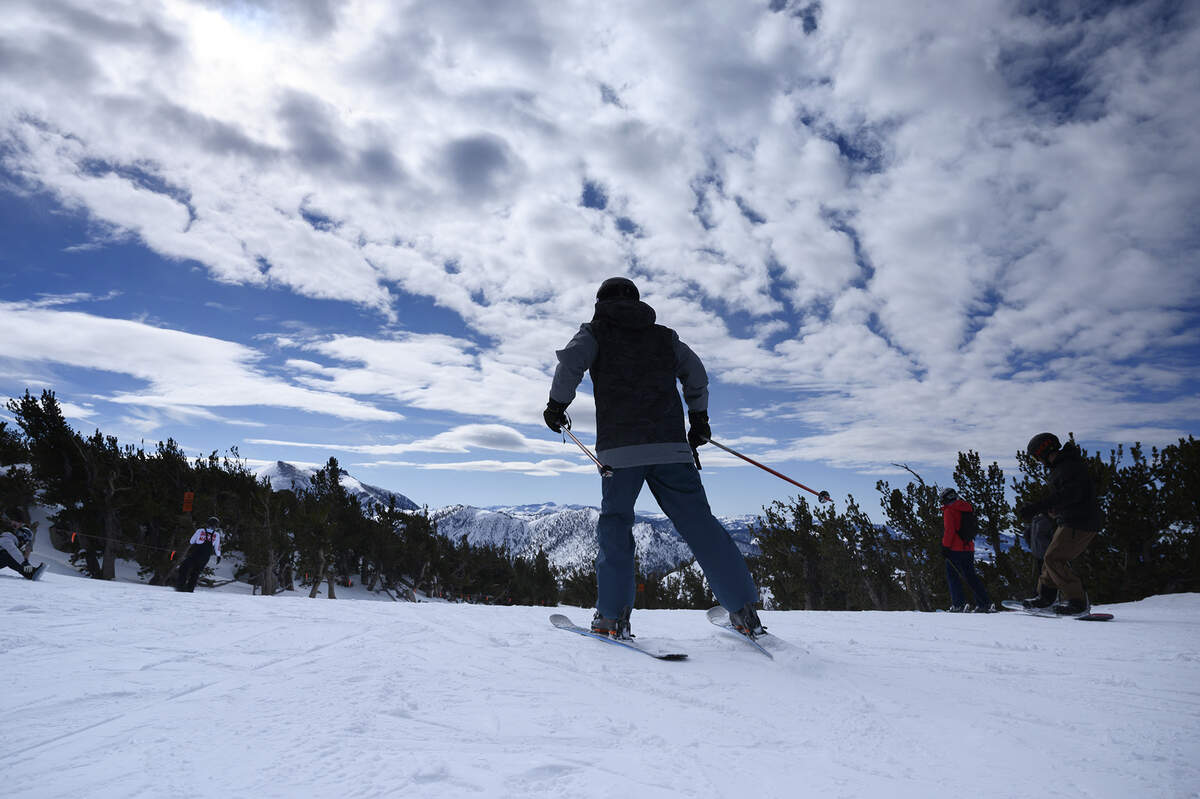
Without fresh powder, skiers and snowboarders sometimes have to navigate icy patches in the morning and mushy conditions as the temperatures rise. “It can be very icy and then it can get slushy,” said Ben Hatchett, a skier who’s a scientist at the Western Regional Climate Center in Reno.
The dry spells can also kill business altogether, as when Thanksgiving came and went a few months ago with little to no snow in the mountains. No ski resorts were open for the big weekend.
“They miss the big holiday,” said Patrick Tierney, a tourism and travel industry expert at San Francisco State University. “That’s a significant loss for the ski areas.”
Although summer is usually Tahoe’s busiest season for tourism, the snow is a major draw, too. Hotels on the south shore recorded 460,000 room nights during the four months ending in March 2019, the last pre-pandemic winter, according to the Lake Tahoe Visitors Authority.
So a lost Thanksgiving is particularly hard.
“Those big weekends really help the small businesses survive and do well,” Tierney said. “That’s their bread and better.”
The rest of this winter is looking iffy.
“Conditions will remain below average through February and March,” said Michael Anderson, the state hydrologist.
The Sierra’s shrinking snow season
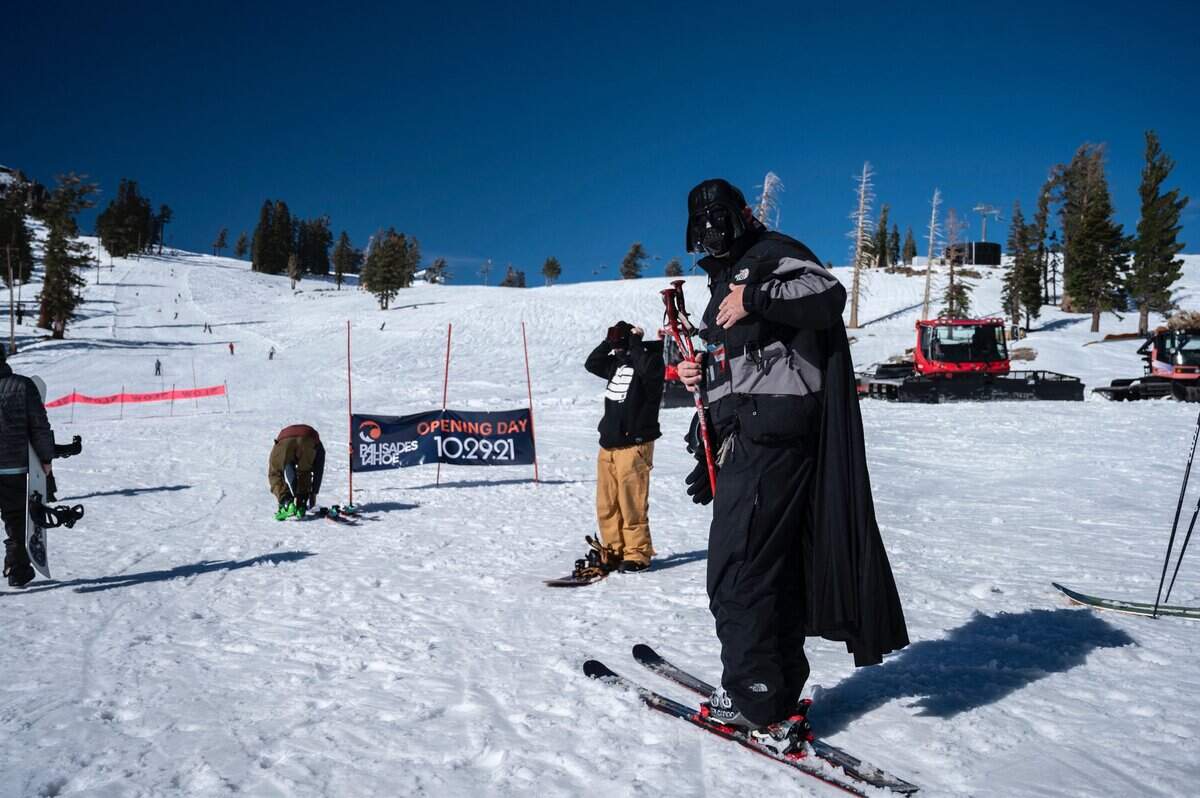
The season began with an epic late-October storm that allowed many Tahoe resorts to open early, followed by a dry November that forced many of them to close again. Then came the snowiest December on record, measured at 214 inches at Berkeley’s snow laboratory near Donner Summit. Then came the dry January.
To a certain extent, there’s nothing new about this year’s weather. California winters have revolved around a relatively small number of significant storms that generate the lion’s share of the state’s annual rain and snow.
Lately, though, climate change appears to be intensifying that pattern, said UCLA climatologist Daniel Swain. That’s producing “increasingly wide swings” between intense winter storms and prolonged dry spells, he said.
This winter “does not look like it’s a fluke,” Swain said.
Climate change is the reason. Hatchett said increased Arctic temperatures disturb the traditional shape of the jet stream — the band of strong winds that account for California’s winter weather .(On a weather map, the disturbance makes the jet stream more wavy.)
The result is greater variability — “extreme dry, extreme wet,” Hatchett said.
Not only is winter weather becoming more erratic, it’s also getting compacted into a narrower slice of the calendar.
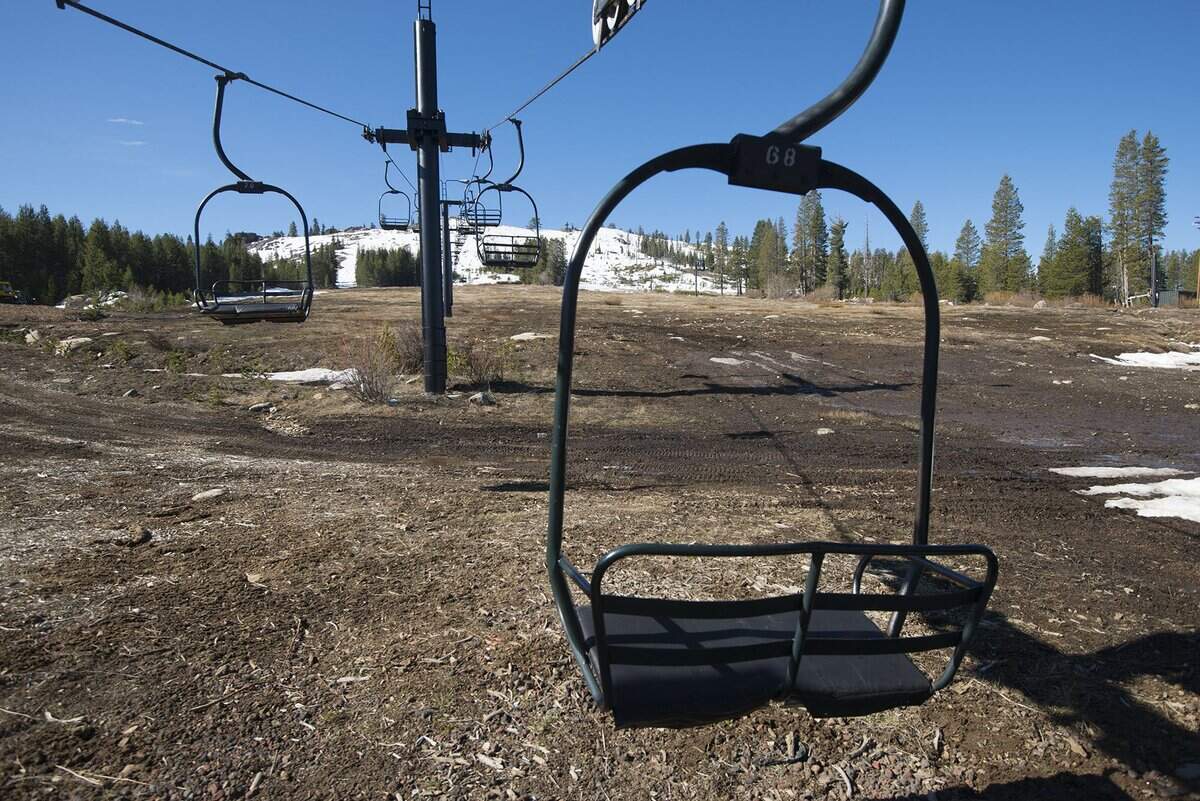
The snow season has diminished by an average of 34 days in the West since the early 1980s, according to a 2018 study published in the scientific journal Geophysical Research Letters.
The shrinkage amounts to “about one day per year,” said lead author Xubin Zeng, a hydrologist at the University of Arizona.
The shortened season is another consequence of climate change, scientists say.
Typically, cold winter storms are delivered to California from weather systems that begin in the fall and originate in the northern reaches of the Pacific Ocean. But global warming is scrambling that pattern, pushing more of the precipitation northward, to the Pacific Northwest, while leaving California comparatively dry, said Jelena Lukovic, a geographer and climate expert who’s studied the delayed onset of winter in California.
When precipitation finally does arrive in California, it’s increasingly likely to originate in a more southerly part of the ocean, bringing more rain and less snow.
These are “moisture plumes coming straight from Hawaii,” said Feldman of the Lawrence laboratory. “Banana belt storms, quite warm.”
When it does snow, it’s likely to evaporate more quickly than in previous years, due to rising temperatures in late winter and early spring.
Tahoe’s warm-weather woes were on full display in the sports world last February, when a National Hockey League game staged on an outdoor rink at Edgewood golf course was interrupted for eight hours by slushy conditions.
The consequences were more severe a few weeks later, when a spring heatwave evaporated a substantial portion of the Sierra snowpack, depriving the state’s reservoirs of much of their usual runoff and dramatically worsening the drought.
“To have a really good and long winter, you need a lot of snow and cool temperatures to make sure it stays on the ground,” said Schwartz of the Berkeley snow lab.
UCLA’s Swain said the upper elevations — 9,000 feet or more — will probably stay cold enough to accumulate a decent snowpack most years.
But most of Tahoe resorts top out at just under 9,000 feet, and are likely to become increasingly vulnerable as temperatures rise.
“It’s difficult to envision the lower-elevation ski resorts surviving,” Swain said.
Snow machines and skateboards
Heavenly towers over Tahoe, with a peak of 10,067 feet — high enough that climatologists say it should do OK despite global warming.
Nevertheless, it’s trying to cope with climate change, too. Sara Roston, a spokeswoman for Vail Resorts Inc., the Colorado conglomerate that owns Heavenly, Northstar and Kirkwood, said the company has been investing in “improved grooming technology” at its Tahoe resorts to improve snow coverage.
Vail has also installed cooling towers to make its snow machines more effective. It’s getting more aggressive about trimming trees and shrubs close to the ground to reduce forest “duff,” the layer of pine needles that can interfere with a smooth run down the slopes.
In other words, Tahoe’s ski resorts aren’t about to give up on winter.
Sugar Bowl — founded in 1939 and so steeped in history that it named a mountain after Walt Disney, an early investor — has placed an $8 million bet on new snow-making equipment.
“These low-energy guns ... double our pumping capacity,” said Sugar Bowl spokesman Jon Slaughter. “Snow-making is definitely where we’re focusing our future operations.”
But the resorts are also diversifying. Sugar Bowl promotes its summer wedding venue and a summer camp. A few miles away, Boreal offers mountain biking, skateboarding, a summer camp and an indoor trampoline and foam-pit center.
Several years ago Heavenly opened rope courses and zip lines, and introduced a new sport altogether: “summer tubing,” which lets guest ride snow tubes down a 500-foot path coated with artificial turf.
But summer doesn’t necessarily offer a vacation from climate change.
Last August, as the Caldor Fire raced through the Eldorado National Forest, firefighters had to use snow-making machines to keep Sierra-at-Tahoe from burning down. They were largely successful, but the fire damaged a maintenance building and destroyed a “haul rope” — a 10,000-foot-long steel coil that drives one of the resort’s major ski lifts. Burnt trees created safety hazards, and as a result the resort still hasn’t opened for the winter.
The resort declined to make anyone available for comment for this story, as spokeswoman Katie Hunter said officials were “singularly focused on our reopening efforts.” On Jan. 21 the resort completed a major milestone by installing a new haul rope, custom-made in Switzerland.
The Caldor Fire exposed another problem when it spilled into the Tahoe basin and prompted the evacuation of the south shore. Although the basin escaped major damage, the fire left an indelible mark on the tourism industry.
Tierney said the fire reinforced Tahoe’s — and much of California’s — reputation as a fire-prone place to avoid in summer.
“A lot of people are deciding they’re just not going to take a vacation in the Sierras in August,” the San Francisco State expert said.
Even when it isn’t burning, the area often chokes on smoke from wildfires elsewhere in Northern California. That’s another turnoff.
“The smoke and the air quality index,” said Carl Ribaudo, a tourism consultant who lives in the area. “In Tahoe, in the south shore last summer, it was well over 600 with the Caldor Fire.
“California is now getting this sort of perception of ‘California’s on fire, maybe we should look at somewhere else to go.’”
A climate change refugee from Tahoe
Think of Amie Engerbretson as a climate change refugee of sorts.
Raised in Truckee, trained on the slopes of Squaw Valley (now Palisades Tahoe), she’s a professional skier, specializing in freeskiing, a version of the sport that involves various tricks and acrobatics and owes a lot to snowboarding.
About six years ago, she left the Tahoe area to begin spending winters in Utah, where the higher peaks and more favorable weather patterns make winters more reliable.
“It doesn’t necessarily snow in Tahoe anymore,” she said in a phone interview. “You can’t be a professional skier in a place where it doesn’t snow.”
Engerbretson called her relocation decision “heartbreaking” but said she hasn’t fallen into despair. Instead, she’s become a climate activist, working with Protect Our Winters, an organization founded by snowboarders, rock climbers and other outdoor enthusiasts.
Activism hasn’t come naturally to her. But on a lobbying trip to Washington two years ago, she surprised herself by discussing climate change with members of Congress.
“As a professional skier, I didn’t think I had any business being on Capitol Hill,” she said. “As skiers, we’ve always been told, ‘Leave your politics at the chairlift.’ But ... we don’t have that luxury.”
This story was originally published February 2, 2022 at 5:00 AM with the headline "‘Enjoy the skiing while we can’: Tahoe’s winter resorts face a future of climate change."