
California city tried to reform its toxic police department. Then came the vulgar texts

EUREKA, Calif. — Cheri Lyn Moore, distraught and mourning the death of her son, was holed up inside her apartment above a downtown florist shop. She asked authorities for medication, then threatened to burn the place to the ground with a flare gun.
In the hallway outside, Eureka police officer Rodrigo Reyna-Sanchez readied a battering ram, then slammed it into the front door. As a SWAT team stormed the apartment amid a cacophony of commands, officers used a shotgun and rifle to shoot the 48-year-old woman nine times. One bullet hit her in the back of the head.
The botched plan to safely detain her ended with Moore dead in her own apartment.
Moore’s death 15 years ago was the first in an especially violent year for police shootings in Eureka, a North Coast town of about 27,000 residents and fewer than four dozen police officers. Police shot and killed three more people in the ensuing eight months.
The community was shocked. The city called for healing. And the police promised reforms. They worked to improve their community relationships, rolled out mental health programs and new officer training.
But the police department’s path to reform kept hitting roadblocks. Meaningful changes to law enforcement in Eureka have been held back by a toxic mixture of “old guard” officers, fear of retribution, infighting and distrust of some of the department’s leadership, according to interviews, court records and documents reviewed by The Sacramento Bee.
This year, Reyna-Sanchez, who was a named defendant in a civil suit from the 2006 raid, emerged again as a central figure in another shocking revelation about the department that has shattered the community’s faith in the police here.
The city has ordered an outside investigation into vile banter on private text messages, first reported by The Bee last month, in which Reyna-Sanchez and other officers likened homeless people to troglodytes and joked about putting mentally ill women in demeaning sexual situations. Reyna-Sanchez, who texted his squad to “face shoot” a suspect, shot a man in the head at close range in 2010. The shooting was deemed justified.
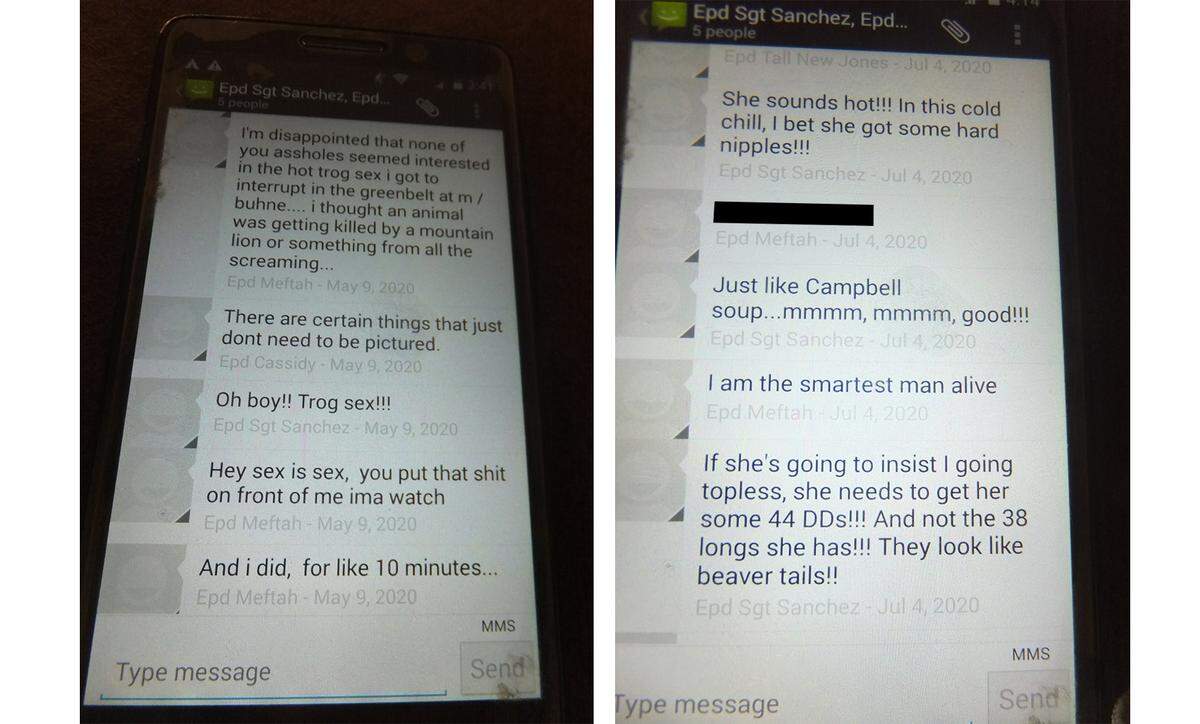
Now, the county public defender is reviewing cases to determine whether court testimony from some Eureka police officers can be believed at all.
Some fear the community is starting over again after years of incremental progress.
Betty Chinn, director of the region’s main hub for homeless services, said the text messages among the Eureka officers “broke my heart” because she thought the department’s relationship with unhoused people and those with mental illness had improved in the years since Moore’s killing.
After the raid in 2006, a grand jury indicted the police chief and lieutenant who authorized the response, saying they lacked judgment in how to work with mentally distraught residents. Even by today’s standard, charging commanders with manslaughter was an unusual rebuke to law enforcement. It was unprecedented in 2006. Though a judge later dismissed the charges, a reckoning for the department was underway.
Now, Chinn wonders just how much progress has been made. At times during an interview, she pounded the conference room table at the service center she runs in downtown Eureka.
“How could anybody in a uniform use that kind of — look at me, I still have goosebumps, just thinking about that language they’re using,” she said.
“They need to clean up house,” Chinn said. “But again, they should not destroy the good cops.”
The uproar and disgust over Reyna-Sanchez’s text messages have not faded. In a new exchange obtained by The Bee, the officers appeared to have accessed jail booking photos to make fun of a homeless woman’s physical appearance and, according to the messages, compared her to a toad.

Reyna-Sanchez and fellow officer, Mark Meftah, remain on paid administrative leave. Records released last week show the city hired an investigator from a Bay Area law office, Sacks, Ricketts & Case LLP, to review the text messages. Todd Simonson, a partner with the firm, has previously represented officers in disciplinary proceedings and contracted in 2019 with Humboldt County for a separate investigation.
Since The Bee story published, Steve Watson, the current police chief, has faced pressure from the community and his employees to investigate the demeaning comments and hold the officers accountable. Many are demanding the officers be fired.
The Humboldt County Human Rights Commission, a citizen oversight group, last week requested monthly updates about the investigation. Watson said disclosure of the text messages was a major setback for officers who have worked to improve the community’s perceptions of the department.
“We’re hurting,” Watson told the commission, pledging accountability and a continuation of the years of work to improve. “We’ve made a lot of progress. I firmly believe the data is there. But this really is a slap in the face.
“I cannot emphasize how seriously we are taking this. I am so eager to get to the bottom, and we fully intend to do that and work tirelessly to get there.”
Despite Watson’s insistence that officers can come directly to him with concerns, some inside his ranks are questioning whether they have a meaningful way to air grievances, multiple current and former officers told The Bee.
Police union leaders have scrambled to publicly strike the right tone that distances officers from the vile comments while also trying to protect officers who might be brought into the review. It was a “foregone conclusion,” Terry Liles, president of the Eureka Police Officers Association, wrote in an email to members, that there would be a broader investigation into “the ‘culture’ of our department.”
Publicly, the union issued a rare rebuke about the “egregious behavior” highlighted in the messages. “They are abhorrent, and do not reflect the character, integrity, or attitudes of the vast majority of Police Department employees. Nor do they reflect the seriousness, maturity, or professional attitude this difficult job demands.”
In the union email provided to The Bee, Liles urged members not to communicate with reporters.
“It may feel good to vent or ask questions in the media,” Liles wrote. “But, that kind of activity serves only to create more negative news cycles, making our current situation worse, and weakens our position within the City as well as the public.”
Outside the department, residents and police officers past and present are questioning how much has changed in 15 years. Fallout could reach far beyond the department’s reputation with homeless advocates.
Humboldt County Public Defender Marek Reavis has instructed his team of a dozen attorneys to review cases involving Reyna-Sanchez and Meftah. He said the text messages that The Bee published could show improper bias and call into question their credibility in court.
“This certainly hinders, even at this point, anything that the district attorney can do with these two officers’ testimony because they will be challenged every time,” Reavis said in an interview.
“Their testimony is muddy,” he added. “Their testimony is not believable.”
The District Attorney’s Office did not return a request seeking comment.
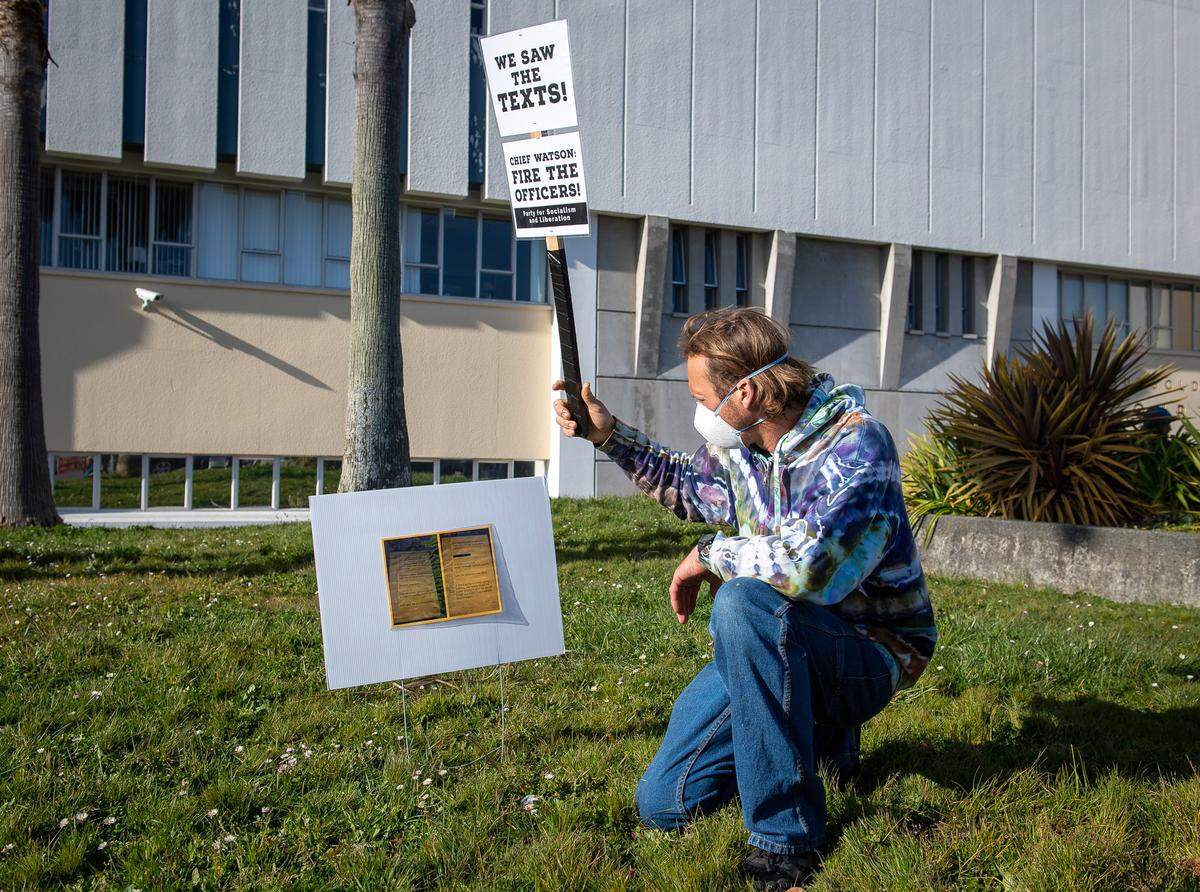
In recent weeks, protesters have gathered outside the Humboldt County courthouse and taped paper signs on a pillar that quote the text messages and make demands. “Chief Watson: Fire the officers!” one said March 26. An online petition spells out even more demands.
Officers like Reyna-Sanchez should not be reinstated, said Yahmo Ahqha, an event organizer.
“That’s not the kind of person we need in our vulnerable communities walking around with a deadly weapon,” Ahqha said. “We need mental health professionals and services.”
Said one officer, who spoke to The Bee on the condition of anonymity for fear of retaliation:
“We tried to say we’re not like everyone else, but (it) looks like we are.”
When a ‘time to heal’ met controversy
Calls for change were swift after officers killed Moore on April 14, 2006. Former Eureka Mayor Virginia Bass called it a “time to heal old wounds and right old wrongs,” the Eureka Times-Standard newspaper reported. The city hired Garr Nielsen, a UC Berkeley graduate who’d been working in the Portland area, to be the healer as the city’s new police chief.
He was quickly hit with a crisis. In 2007, police officers Adam Laird and Justin Winkle pepper sprayed and beat a man outside the Eureka Rescue Mission. The man later died at the nearby jail. A federal jury awarded the man’s family a $4.5 million settlement.
Brian Hall was standing nearby. Hall, who’s now executive director of the Eureka Rescue Mission, said he’s had a positive experience with the police. But the homeless man’s death? “That’s the only time I’ve ever seen anything that made me kind of go, ‘I don’t know,’ you know?’ ” Hall said.
An us-versus-them mentality around policing and a soaring homeless population was straining already tense relationships, said Chinn, the homeless services worker whose work in Eureka has been hailed nationally.
“They don’t like (the) homeless very much,” Chinn said, describing the policing style from that time: Authority came first. Compassion was an afterthought — if it came at all.
“There was no question about the fact that the department had serious issues and that they needed somebody to come in and attempt to make some differences,” former chief Nielsen, 70, said in an interview for this story. “And that’s an uphill battle in any police department.”
One of his first acts as chief was to demote Murl Harpham, a since-retired officer who spent 57 years at the Eureka Police Department. Harpham, Nielsen said, was the leader of an old guard — seen in the community as callous, cruel and dehumanizing.
As a police captain in the 1990s, Harpham helped make a satirical video for the union’s awards banquet. The video, according to news reports at the time, included scenes of an officer running over a newspaper carrier, a cop wearing blackface and Harpham pretending to arrest a Barbie doll for prostitution and then beating it with a nightstick.
Harpham said the video was a riff off of the “Police Academy” movies.
Criticism, Harpham said at the time, amounted to “cop-bashing.”
In an interview for this story, Harpham, 87, defended the department. He described it as “paramilitary” because of all the former servicemen who patrolled the streets — there was a deep history he said should be respected. “We didn’t have any problems.”
On a since-archived blog about his life and policing, Harpham told stories about police work that sometimes were in line with a folksy Andy Griffith-style sentimentality — about his son being jailed, for example. Other times they were, as many have described the recent text messages, “wholly inappropriate.”
In one titled “Don’t Try This Today,” Harpham says he detained a suspected shoplifter in a patrol car. When they got to the station and Harpham opened the car door, the man spat in his face.
Harpham went inside the station, found a urine test bottle and poured some warm water and salt in it. He added drops from a tea bag to the bottle and returned to the car.
“I simulated like I was peeing, even adding a little shaking motion for effect. I turned around exposing the bottle and held it high like I was inspecting my work,” he wrote.
“You know what happened next? I opened the car door, pulled the suspect over in the seat so he was laying on his back and poured the contents into his face. I then whispered in his ear that if he ever spit on me again it would be stuff from another aperture of my body that would find it’s (sic) way to his face.”
Still, Harpham was revered in town. His demotion by Nielsen sent shockwaves.
Next, Nielsen dismantled the small-but-costly police SWAT team that stormed Moore’s apartment. He said it burned through more money than it was worth. The money saved from the SWAT team should instead go toward community-focused problem-solving policing that specifically works with homeless people.
“It was part of cracking that culture of the good old boys who did policing, you know, the old-fashioned way,” Nielsen said.
But dismantling part of a police department and slashing overtime is rarely popular.
Pushback was fierce, and the “insurrection” began, Nielsen said.
Harpham, Reyna-Sanchez and “several others” worked to undermine Nielsen’s progress, the Eureka Times-Standard reported, citing court papers. The officers hired private investigators to follow him, created malicious blogs, encouraged employees to call out sick and took other steps to undermine the “progressive direction of the department.”
In the interview for this story, Nielsen declined to discuss that old guard in detail. But, he said, “I should have been more patient probably for change and not expected change to happen as quickly and radically as I wanted to see it happen.”
“I certainly knew who the problems were. But you’re facing unions, contracts, California state law, employment law, all of those things. And it makes it very, very cumbersome, very difficult to deal with problem police officers,” he said.
The personality clashes led to Nielsen’s undoing.
On June 24, 2011, the city manager walked into Nielsen’s office and fired him. He was forced to strip out of his uniform on the spot and clear out his desk, he said.
“A lot of the people in Eureka are old-time people that have been there for a long time and have connections. There was a lot of, I don’t want to say incestuous, but nepotism type of arrangements, you know, throughout the city, in the county, but that was business as usual in that in that area.
“It was,” he continued, “a four-year struggle, for sure.”
Building bridges to undo ‘spirit of negativity’
The city manager appointed Harpham to be the interim chief during the search for Nielsen’s formal replacement. In the two years Harpham held the post, he left his mark.
In an interview for this story, Harpham said he sympathized with those experiencing homelessness — especially veterans. That’s why he hired a homelessness liaison with the department to help get people off the streets.
“We tried to do what we could,” he said.
In 2013, he acquired a mine-resistant, ambush-protected vehicle, known as an MRAP, from the federal government’s military surplus program. “In my eyes, it’s strictly a protection and rescue type of vehicle,” Harpham told the Times-Standard. “There’s no machine guns, no rocket launchers or anything like that.”
Later that year, the city hired a new chief, Andrew Mills, from San Diego. Mills repaired some of the damage wrought in the community. He promoted de-escalation strategies, started implicit bias training and made diversity and community policing a priority.
He tried to undo a “spirit of negativity.”
“He said, ‘Betty, I want to work with you. I need your experience how to deal with the homeless,’ ” Chinn recalled. “We really worked really well.”
As for the MRAP? There was no policy for how to deploy it and by 2016, nobody in the department knew how to drive it, city records show. Mills decided to get rid of it. The vehicle was “not appropriate for this community.”
“I truly believe that we have helped position the police department to become accepted and respected within this community,” Mills said in an interview with the Times-Standard. “I think we have changed the philosophy from fear-based to working collaboratively with the community and I think that is the biggest element here.
“Officers literally tell me that they want people to fear us when they drive into this community,” Mills continued. “I said, ‘Who do you want to fear you exactly, my mother who’s 84?’ So it was maybe just a little different way of thinking.”
In 2017, Mills left to become the Santa Cruz police chief. He declined The Bee’s request for an interview about his time in Eureka and the drama that has encircled the department.
Mills maintains that progressive policing is the necessary path forward. Atop his personal website is a quote he attributes to Gen. Stanley McChrystal: “If we cannot change the environment to suit us, we must change to suit the environment.”
Righting the ship on policing’s wrongs
Steve Watson took his place and remains the Eureka police chief today. He’s continued many of Mills’ efforts. Despite the progress, a reputation lingered.
Eureka has a stubbornly high turnover rate for police departments. Roughly 80% of officers as of 2017 had less than five years with the department, which often lost officers to the sheriff’s office or bigger police departments in places with lower costs of living.
It means that some officers become more entrenched while others move on.
Meanwhile, community grand juries continued to criticize the police. One issued a damaging report in 2019 that was critical of the department’s enforcement against people experiencing homelessness, nearly half of whom had been homeless for more than three years and 70% of whom had a history of drug or alcohol abuse.
The city disagreed with many of the report’s findings, saying there were existing efforts to address the homelessness crisis. Chief Watson said in an official response to jurors that “together we must find innovative and humane approaches leading to real, lasting solutions.”
The region has its problems, Reavis, the public defender said. He sees them every day.
“I don’t think at this point I would characterize the Eureka Police Department as being in my experience, some sort of rogue outfit that is irredeemable,” he said. “I think Chief Watson has been an excellent, excellent police chief. And I think he’s very sincere in wanting to make things right.”
But some of that old guard Nielsen named in the court papers has lingered. Multiple employees told The Bee that those longtime officers wield their power to this day, dismissing complaints made against fellow cops with whom they are also viewed as close friends.
Reyna-Sanchez’s demeaning and cruel comments about homeless people, those with mental illness, and a fellow female officer weren’t surprising, multiple current and former officers said. After The Bee published the exchanges, tips flooded in about negative experiences involving the sergeant, whose distinctive mustache and decades in the community make him stand out.
Everyone, it seemed, has a Reyna-Sanchez story.
Harpham said he was a “very good officer.”
“He would follow through and make sure everything was taken care of,” Harpham said.
New text message and a widening probe
In one previously unreported text exchange obtained by The Bee from April and May 2020, the squad was discussing a homeless woman who was known to have alcoholism and who was also missing an eye. The officers discuss putting her in sexual situations and later describe her as a “frog,” according to the messages.
“I think she’s more of a toad… frogs are kinda cute,” Reyna-Sanchez wrote.
Someone inserted a picture of a toad into the group chat.
“Yup!! That’s her. And that be a toad!!!” he replied.
Meftah then sent the group a jail booking photo of the woman. “Damn I could build some hilarious memes with her mugshot,” Meftah wrote.
“Use the one with her eye missing,” Reyna-Sanchez responded.
While officers have access to a range of databases, including mugshots, California law prohibits officers from accessing and discussing the databases for non-law-enforcement purposes.
Watson declined an interview request for this story, saying that the investigation needed to run its course and that he looked forward to talking “as soon as I responsibly can.”
“I definitely have questions and want and expect full and complete answers,” he said in a statement. “This is necessary to determine the best path forward — not just for the officers involved but for the department at large and for our whole community.”
Liles, the Eureka Police Officers Association president, declined The Bee’s request for an interview. The union’s attorney, Zachery Lopes, said he couldn’t discuss his communications with officers. But he said they stand by the public statement.
“The POA’s members will work with the city to comply with anything else they want to do to get to the bottom of what’s going on,” Lopes said Tuesday.
Watson, in the human rights commission meeting, said the fact that the text messages were made public, rather than coming about through an internal process, might provide “new opportunities” for change.
Now, he said, there is momentum.
“We’re not going shallow on this,” Watson said. “We want to take a deep look at what happened and what else is potentially going on so we can use this opportunity to look back and have a department where we’ve really taken another huge step forward and fixed any latent issues that still exist.”
This story was originally published April 8, 2021 at 4:46 AM with the headline "California city tried to reform its toxic police department. Then came the vulgar texts."