Sierra snowpack at 59% but ‘next few weeks will be critical’ for California water officials
California water officials on Thursday reported the statewide snowpack is just 59% of average for this time of year as the state continues to experience one of the driest years on record.
It’s the second straight year of low numbers, after the Department of Water Resources recorded a reading of 53% on April 1 a year ago. The back-to-back low measurements could mean the return of summer drought conditions and water-use restrictions for the first time since 2016.
The April 1 survey is typically the most important of the year, when the snowpack is the deepest and has the highest snow-water content. It also marks the end of the wet season for California and is a key indicator for water supply.
The average snow water equivalent measured at 16.5 inches statewide, according to DWR’s April 1 report. The snowpack surveys help DWR officials determine how much snow will melt and runoff into California’s reservoirs. De Guzman said the latest snowmelt runoff forecast was 58% of average statewide. The number marks a second consecutive low point for the surveys. Last year the April 1 survey runoff forecast was at 60% after a relatively dry winter.
The snowpack has been a relative bright spot this winter as California has mostly not had heavy nor consistent storms. But the northern and central Sierra Nevada mountains collected a considerable amount of snow from this year’s winter storms, said Sean de Guzman, DWR’s chief of snow surveys.
Still, the snowpack total was also down from a month ago, when on March 1 it was at 61% of its historical average.
“The few storms that have impacted California have actually been colder storms which have brought a lot more snow than rain compared to a typical year,” de Guzman said. “As the snowpack starts to melt, the big unknowns are how dry are the soils beneath the snowpack? And how much water will absorb into those soils before running off into our rivers and streams?”
He said the next few weeks will be critical to watch to see how much to see how much of that snowmelt will actually enter the state’s reservoirs. The next survey is scheduled for April 29.
“There is no doubt California is in a critically dry year,” Water Resources Director Karla Nemeth said in a statement. “State agencies, water suppliers and Californians are more prepared than ever to adapt to dry conditions and meet the challenges that might be ahead.”
De Guzman and his team conducted California’s fourth manual snow survey of the year Thursday at Phillips Station, the site of a former stage coach stop at an elevation of 6,800 feet near Echo Summit. The snow depth measured 49.5 inches, with an average snow water equivalent of 21 inches; this time last year it was 16.5. De Guzman said that’s 83% of the average for this time of year at that location.
The northern Sierra average snow water equivalent was measured at 18.4 inches, which is 66% of the average for April, according to DWR. The central Sierra had 18.8 inches, 63% of the average.
De Guzman said most of the this winter’s storms came from the north and didn’t drop as much snow on the southern Sierra mountains, which reported an average snow water equivalent of 10.2 inches. That’s only 41% of the average for this time of year.
While the snowpack in the northern and central sierra are decent, they’re still below average, de Guzman said. Also, rainfall statewide has been well below average. He said California has received about 50% of average precipitation for water year 2021, which currently ties for the third-driest year on record.
Reservoir levels, drought conditions in California
“With below-than-average precipitation statewide, California’s reservoirs continue to show the impacts due to dry conditions,” de Guzman told a group of reporters gathered at Phillips Station Thursday. “Statewide, California’s largest reservoirs are only storing about half of their total capacity.”
He said Lake Oroville is currently at 53% of average; Lake Shasta, California’s largest surface water reservoir, is at 65% of average. Folsom Lake is at 37% of its capacity, according to DWR, far below it’s historical average of 57% for this time of year.
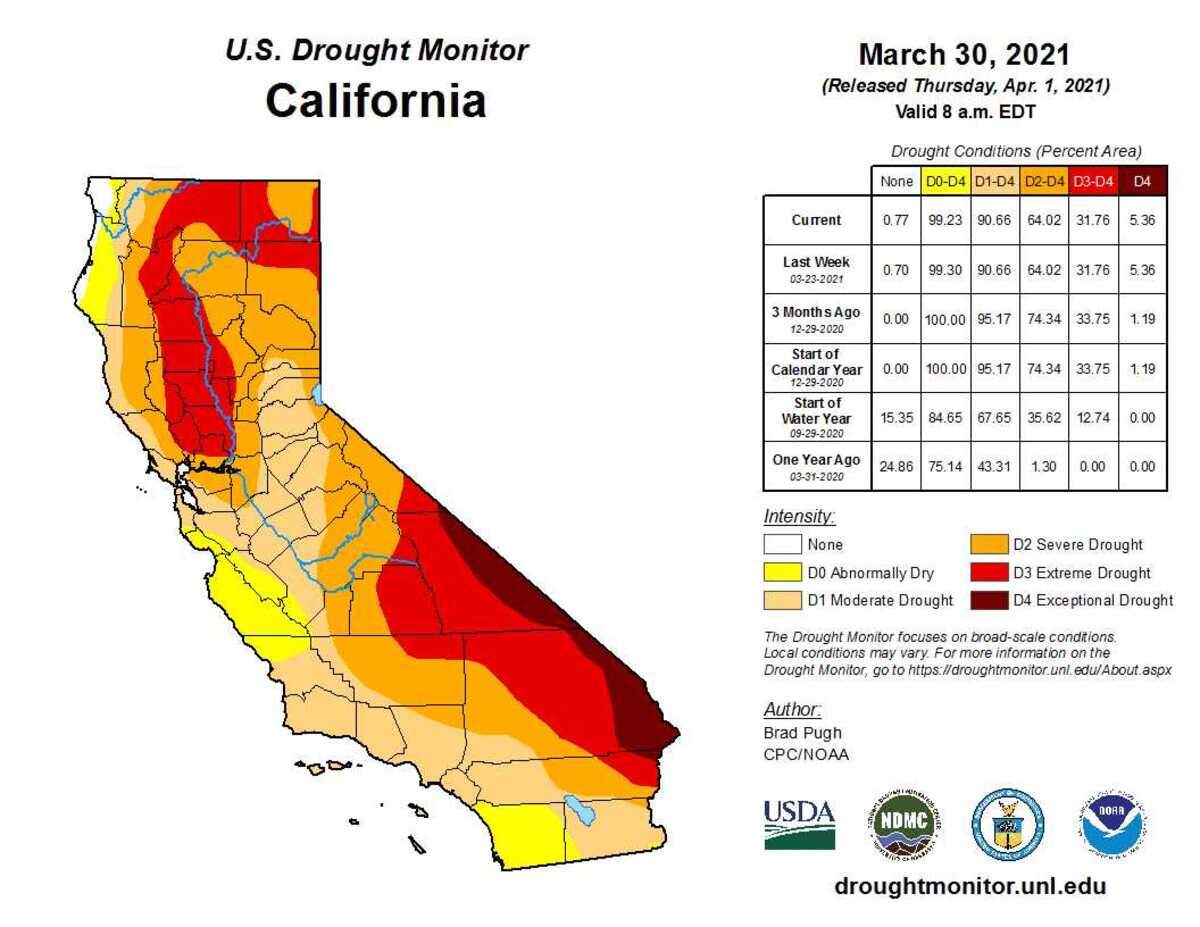
In California, 64% of the state is already in a severe drought, with 5.3% classified as exceptionally dry, according to the U.S. Drought Monitor. Areas of Northern California in “extreme” drought include all of Yolo and the counties along the Central Valley’s western tier. A year ago, less than 2% of the state was in severe drought.
As of Wednesday, according to the U.S. Drought Monitor from NOAA and the University of Nebraska-Lincoln, nearly 98% of the state is under dry conditions or worse. That accounts for about 33 million residents currently under drought conditions.
“Water conservation is always a way of life. Even though we have drought-like conditions, Californians as a whole have actually been conserving a lot more water compared to where we were before 2012, when the previous drought started,” de Guzman said. “A lot of the public has actually continued their efforts, which is a great sign.”
This story was originally published April 1, 2021 at 2:51 PM.