
New housing, civic center planned in Rancho Cordova. Not all residents are happy
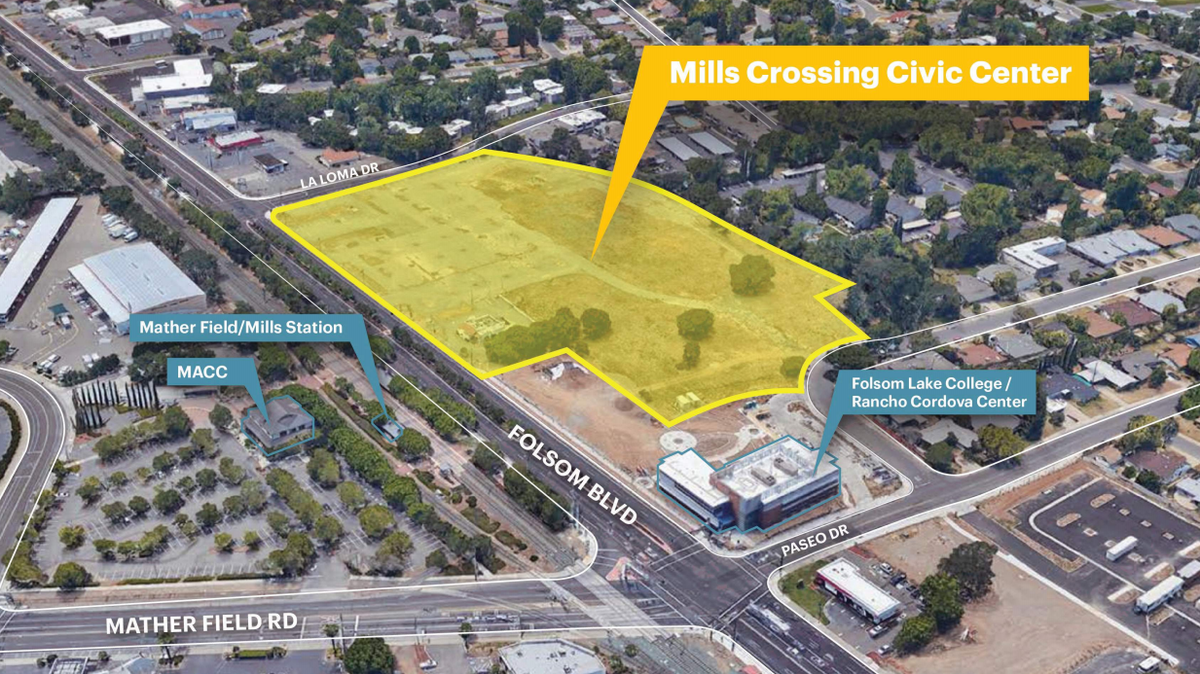
The city of Rancho Cordova is continuing discussions on the development of a community gathering hub, one city officials hope will attract private investment along Folsom Boulevard.
In 2018, the city acquired a 10-acre parcel of land in front of the Mather Field/Mills Station light rail stop and adjacent to the Folsom Lake College Rancho Cordova Center. City officials hope the land can eventually be the site of the Mills Crossing Civic Center, a space that intends to focus on the arts and health and wellness while also providing some housing.
Given the site’s proximity to a Sacramento Regional Transit stop, city leaders have a vision of making it a transit-oriented development by clustering jobs, housing, services and amenities close to public transportation. The project represents the latest efforts of the city to revitalize what officials say is an aging corridor with little private investment.
“We have some fair amount of underperforming retail, we have vacant lots, we have auto-oriented mechanic shops, tire stores and things of that nature that really don’t entice any private investment,” said city manager Cyrus Abhar.
Rancho Cordova was incorporated in 2003 and an early city goal was to revitalize Folsom Boulevard, said Maria Chacon Kniestedt, a spokeswoman for the city.
Soon after incorporation, the city began discussing a planning document that eventually became the Folsom Boulevard specific plan. As part of that process, the recommendation was to work on a long-term strategy to revitalize the Folsom corridor at major transit nodes and create mixed-use developments.
But some residents of the growing suburban city question whether the proposed development to build a community hub will serve the people of Rancho Cordova. At Rancho Cordova City Hall, residents voiced their concerns regarding the city’s plans to build housing on the site during a civic center informational meeting.
Doniell and Matt Cummings said this is one of the largest opportunities in Rancho Cordova for a community space, so they both have concerns about giving part of the city-owned land to a private developer.
Matt Cummings added that the project laid out by the city doesn’t match with the definition of a civic center, a place that brings people together and creates a strong sense of community. Instead, he said the project devotes a large portion of land solely to housing.
“The reality is that a transit-oriented development is not going to change Folsom Boulevard,” Cummings said.
Lupe Trevizo Hernandez, who has lived in Rancho Cordova for over 45 years, said the civic center housing will only attract outsiders who can pay cash and added that locals will not be able to afford it.
Details of Rancho Cordova development
In the latest proposal by the city and its developer, Griffin Swinerton, 5.6 acres would be devoted to community facilities, which includes 80,000 to 100,000 square feet of indoor facilities, a plaza, a community park, a three-story parking garage and an interior street that runs through the center of the property. The other 4.4 acres would be set aside for housing, where officials have proposed 60 to 70 units of for-sale urban townhomes and 50 to 60 units of multi-family apartments.
Some possible uses of the indoor space include a 300-seat black box theater, flexible meeting spaces, retail, artist studios, maker spaces, a learning hub, a community health clinic, a teaching kitchen, a banquet hall and a yoga/exercise studio, according to Chacon Kniestedt.
Several parts of these indoor spaces along with the housing will be several stories high, Chacon Kniestedt added.
Local officials have been adamant that housing is necessary to promote more activity and safety at the site while also making sure the area can serve as a mixed-use community with opportunities for residents to not only visit but also live and work. It’s not envisioned as a standalone strip mall or retail, Chacon Kniestedt said.
Abhar said that if more space is dedicated to community facilities, then some spaces could sit vacant for a big part of a year, which wouldn’t serve the city.
Deputy City Manager Micah Runner said housing plays an important role in creating a 24/7 atmosphere critical for transit-oriented development and to spur further private investment along the Folsom Boulevard corridor.
Still, many residents at Rancho Cordova City Hall had one question on their minds: how much will the housing cost?
Korin Crawford, the executive vice president of Griffin Swinerton, said it’s premature to talk about housing costs. However, he added the City Council supports mixed-income housing. This would only be possible with the rental component and not the for-sale townhomes, which will be sold at the market rate.
The project is one of the largest for a city of close to 80,000 residents in both cost and size. The square footage of the community facilities would be greater than community centers in Elk Grove (32,000), Citrus Heights (29,200) and West Sacramento (21,000).
Chacon Kniestedt said the project could cost between $80 million to $100 million, and the city will invest $35 million to $40 million. Housing isn’t factored into those costs, but officials say the city will not put any of its funding for the project into housing.
Developers are continuing to refine the master plan. The Rancho Cordova City Council was scheduled to discuss the project Monday, but no vote was expected to take place.
Final approvals could take place in early 2022, Chacon Kniestedt said, with a possible groundbreaking in late 2022 or early 2023.