How a new city team is responding to resident calls about Sacramento homeless camps
A resident contacted the city of Sacramento on Wednesday to report a small homeless encampment near Robla Community Park in North Sacramento.
The call was routed to the city’s Department of Community Response, a new city team tasked with responding to noncriminal 911 and 311 calls involving homeless individuals.
After receiving a notification about the call on a laptop, the team of three drove to the site. They found a woman sleeping on a mattress without a tent on the edge of the vacant lot, nestled under trees.
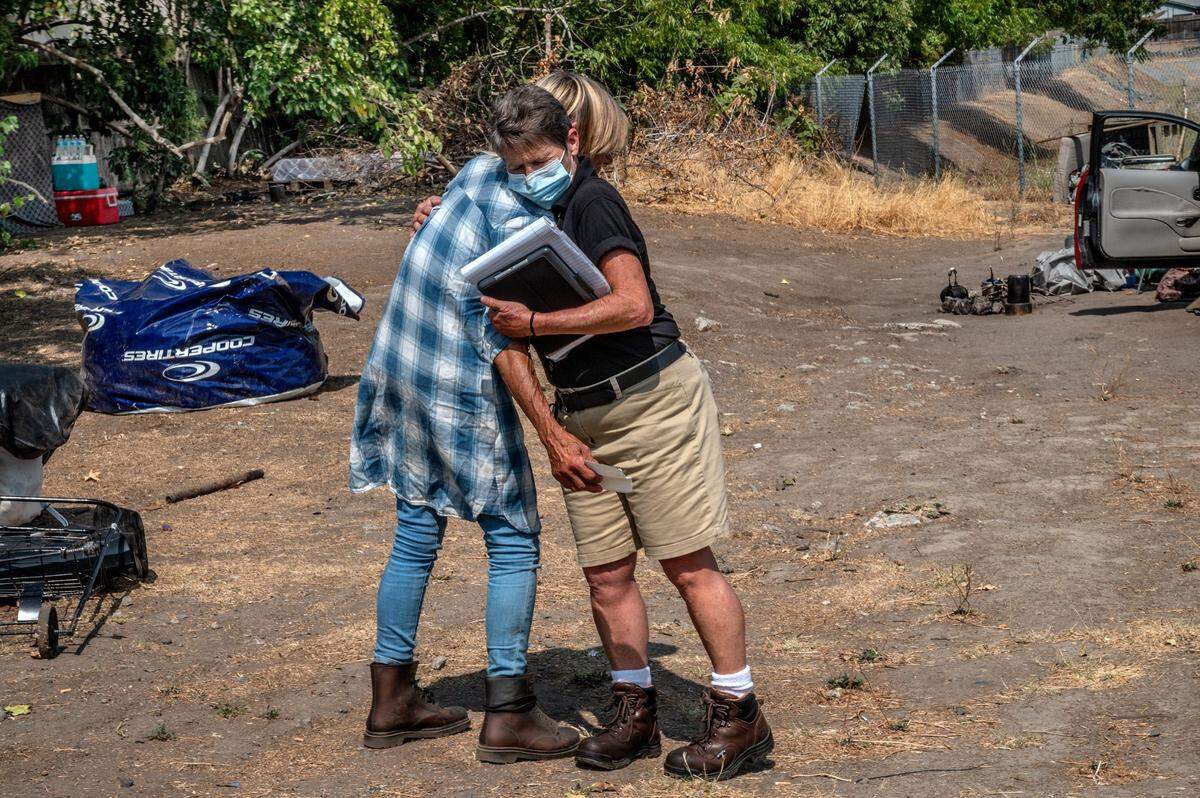
The woman, Cindy Mattison, 67, has been homeless for at least eight years. She told the team she needs a new state identification card, as well as refills of her medication to help her cope with her severe post-traumatic stress disorder. The team wrote down the address for the DMV and the county’s mental health urgent care clinic. They planned to revisit in a couple days, and give her a ride to those locations if she hadn’t made it yet.
“Little parts of me are opening up and I feel better,” Mattison said after the team left. “They’re making me feel better, which is hard to do.”
In July 2020, in the wake of the Minneapolis police killing of George Floyd, the Sacramento City Council voted to shift some noncriminal calls away from police. At the time, Mayor Darrell Steinberg, who proposed the idea, said the change would occur within two years. About a year later, that shift started.
“In a sense, DCR has this golden opportunity,” said Bridgette Dean, director of the department. “I absolutely believe this city can be and will be the model city for this nation to show an alternative model.”
The department is small — comprised of five city employees, Dean said. None of them are police officers. Some are social workers, one is a veteran with an interest in the homeless crisis and some are formerly homeless themselves. Dean is also formerly homeless. The team also has about 10 people from organization Hope Cooperative, contracted with the city.
The team started responding to calls this summer. In August, the team received about 1,640 calls and responded to about 1,000. That’s a relatively small percentage of overall 911 calls — about 3%. The police department received about 50,000 calls in August, not counting those transferred to regional fire agencies, according to police data.
But when the department hires more staff, it plans to take on many more calls. Eventually, Dean wants the department to have 85 employees, mostly city staff and some contractors, who could respond to about 70,000 calls per year. That would be about 5,800 calls per month, up from 1,000 the team responded to in August.
As the department grows, it also plans to expand its hours, Dean said. Currently, staff work Monday through Friday 8 a.m. to 5 p.m. Three new staffers are starting in the coming weeks.
Calls for homeless camps, help
The calls either come in from the city’s 311 system, or come in as 911 calls, and dispatchers transfer them to DCR if they do not involve a crime.
Many of the calls handled by the new department consist of residents wanting someone to check on homeless individuals camping near their homes, Dean said. When the team arrives, the first thing they do is assess basic needs. The team might provide campers water and food, get them medication refills, connect them with services, reunite them with family members and get them into motels and shelters. They always go back to check on people.
The shelters, motels and Safe Grounds, which are the city’s sanctioned tent encampments, were all full on Wednesday, as they often are. As a result, the team was unable to offer those options to people, said Nathan Cox, an employee with the department.
Sometimes there are beds available, though. The team was recently able to secure a shelter bed in the River District for a man who was staying outside a gas station with nothing except the clothes on his back after his belongings were stolen, Cox said.
The city is planning to open 20 new sites for shelters, tiny homes and Safe Grounds, which should help the team have more beds to place people. Two of the sites are set to open this year, both in North Sacramento.
Mixed success on calls
Sometimes, in responding to a call, there is not much the team can do.
On Wednesday, a person called to report a man in a trailer on the side of the road in a residential area – with a dog and trash – in an area where kids were walking by. The team approached the man, a veteran, talking to him through the window, but he did not want any services. Someone had already come by to get the trash. They left after a couple of minutes.
“Some citizens don’t like it,” Dean said, referring to the new department. “They think enforcement should be key, but it’s not illegal to be homeless.”
Due to the Martin v. Boise federal court ruling, governments cannot cite people for camping on public property unless a shelter bed is available and transportation is offered. In addition, during the coronavirus, the U.S. Centers for Disease Control has issued guidance saying if individual housing is not available, homeless people should be able to stay where they are to avoid breaking connections with service providers and spreading the coronavirus.
Since the team is not always able to respond to calls immediately, they are not always able to locate the person who was the subject of the call. That happened Wednesday, when somebody reported a veteran experiencing a mental health crisis in a trailer in a North Sacramento industrial area.
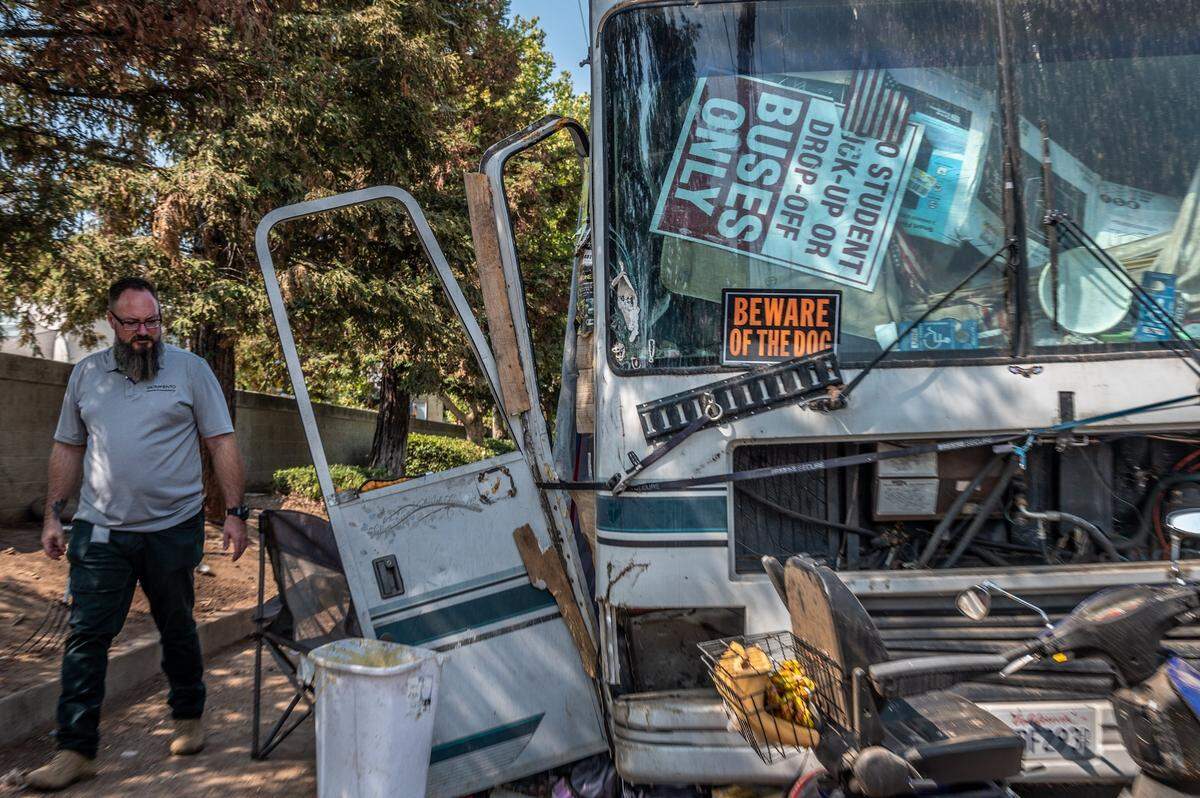
When they team got there, they could not find the man. But they did find two women, Nicole Olson and Sharon Catron, living in RVs. Olson has mental health needs, so the team contacted El Hogar Community Services, who were going out the following day to meet her.
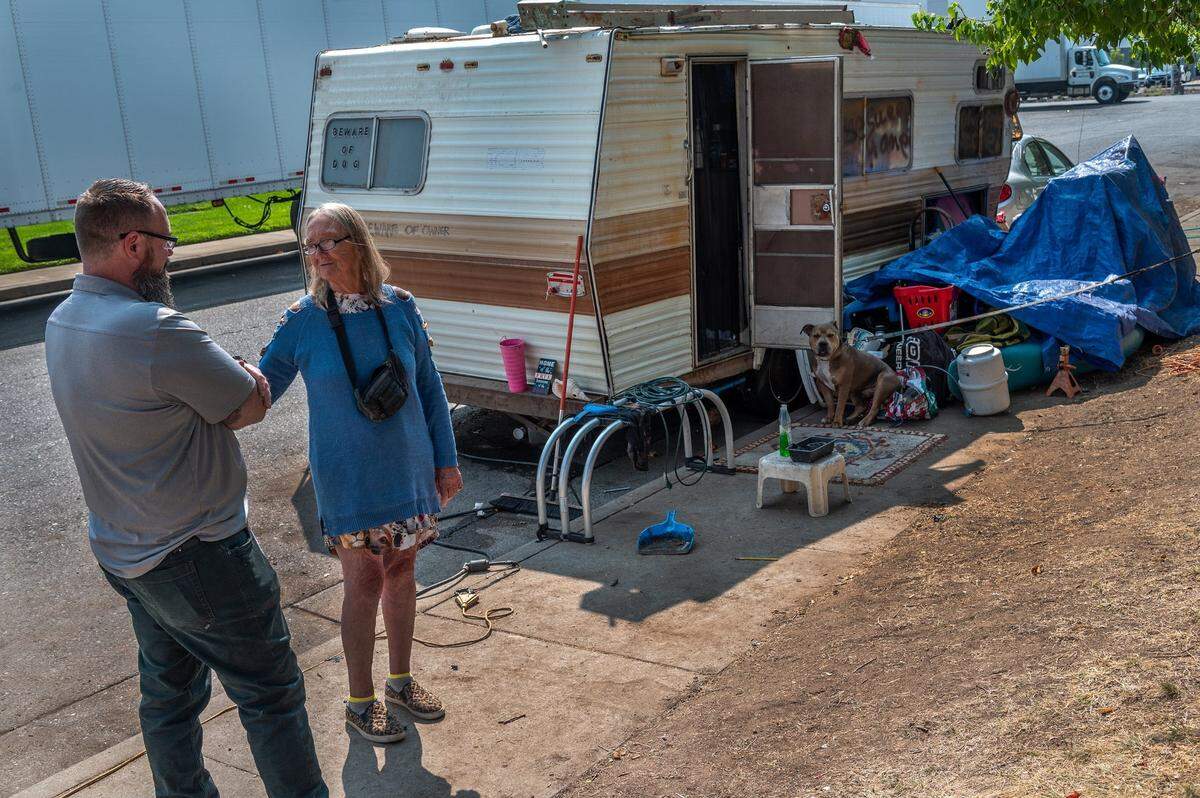
“It feels reassuring,” Olson, 41, said. “It gives me hope that there is hope. Things take time, I know. There’s gonna be room for us somewhere.”
The team is also trying to find space for Olson and Catron to move their RVs to one of the city’s two Safe Ground parking lots, which have bathrooms and security, but are typically full.
If the two women can get into a safe parking lot, they would feel safer than where they are, Catron said.
“It’s scary out here at night,” Catron, 62, said. “I hear all kinds of people.”
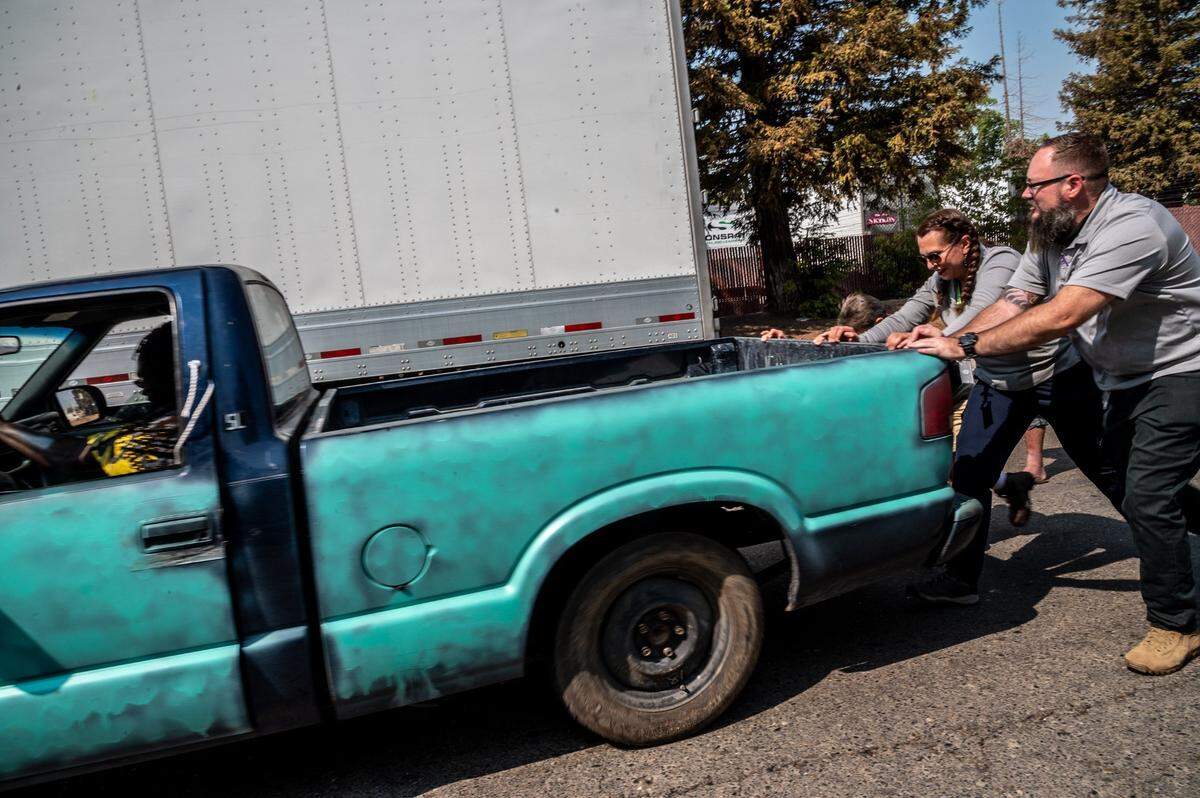
Sometimes, the team happens to be at the right place at the right time to offer help. On Thursday, the team was under the I-80 freeway signing people up to go into the city’s new shelter under the W-X freeway, when a car drove onto the sidewalk and struck a man who was in a tent. The man was transported to the hospital with non-life threatening injuries, police said. The driver was homeless herself, and was distraught after accidentally hitting her friend. The team worked to get medical care for her injured ankle and will work to get her into a shelter, said Susannah Bruno of Hope Cooperative, a member of the department.
Tracey Knickerbocker, another member of the team through Hope Cooperative, was homeless on the Sacramento riverfront from 2000 to 2010. That experience made her want to help others in the same situation.
“A lot of folks like us came and saw me and never gave up on me,” Knickerbocker said. “Every time they’d see me, they’d make little holes in my heart.”