A Native American statue will replace Junipero Serra in Sacramento. Who will it honor?
State lawmakers and local tribal leaders shared details Monday on the plan to replace the toppled statue of missionary Junípero Serra in Sacramento with a monument dedicated to Native American tribes upon whose land California’s state Capitol grounds were built.
The new monument will feature William Franklin, a Miwok leader whom Assemblyman James C. Ramos called a “fierce protector and preservationist” of cultural dances and other ceremonies, and who also helped build three Northern California roundhouses.
“This monument that will be constructed and put forward here on the state Capitol will start to pave the way for the voices of all California Indian people to be heard in the state Legislature and in the educational arena,” Ramos said at a groundbreaking ceremony Monday morning, which included a 7-foot-tall cardboard cutout depicting Franklin’s likeness.
Ramos, D-Highland and the first California Native American elected to the state Legislature, penned Assembly Bill 338 in 2021, authorizing construction of the Native American monument to replace the Serra statue that protesters ripped down on July 4, 2020. Gov. Gavin Newsom signed AB 338 into law last year.
The new monument will honor Northern California tribes, including six on whose ancestral lands the Capitol currently stands: Wilton Rancheria, Buena Vista Rancheria of Me-Wuk Indians, Chicken Ranch Rancheria of Me-Wuk Indians, Ione Band of Miwok Indians, Shingle Springs Band of Miwok Indians and the Tuolumne Band of Me-Wuk Indians, all of which co-sponsored AB 338.
Serra, a Franciscan priest who helped establish California’s 21 Spanish missions, founding the state’s first in 1769, was one of the state’s earliest colonizers. A polarizing figure, many modern historians say Serra’s arrival led to Native American enslavement and cultural erasure.
Pope Francis canonized Serra as a saint in 2015.
“I’m a descendant of someone who experienced these horrific missions,” said Rhonda Morningstar Pope, chairperson of Buena Vista Rancheria. “It was Jesus Oliver, and he was my great-great-grandfather ... his village was destroyed as a result of these mission periods that took place.”
Protesters pulled down the Serra statue, which had stood since 1965 in a grove of trees on the north side of Capitol Park, amid a wave of summer 2020 racial justice protests following the police killing of George Floyd in Minneapolis.
William Franklin served on the California Native American Heritage Commission “to fight for the land we stand on today, and our cultural (and) burial rights, to bring back the songs and dances,” said Matt Franklin, William’s grandson.
As a child, William Franklin — an orphan — “would run around to the roundhouses and peek through, because back then they didn’t let the little kids in the roundhouse,” Matt Franklin said. “So he said he learned his dances by peeking in at that time.”
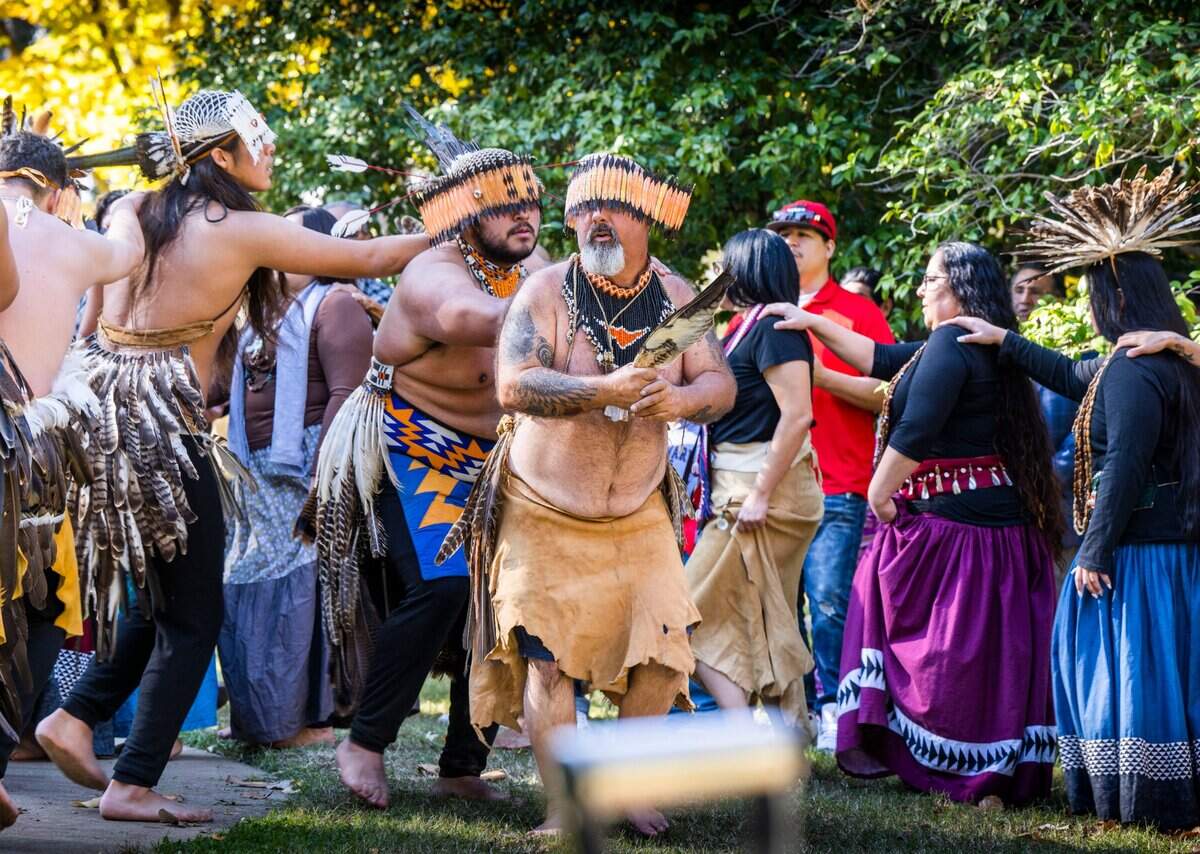
Dancers with the Shingle Springs Band of the Miwok Indians, Wilton Rancheria and the Tuolumne Band of Me-Wuk Indians followed state and tribal leaders’ remarks with a presentation of some of those dances.
Ramos, who is a member of the San Manuel tribe in San Bernardino County, said the monument will help educate on the “destructive biases and ignorance about California (Native American) history and our culture,” while also illustrating “the resiliency of our people.”
The statue will be designed by Sacramento sculptor Ronnie Frostad.
“There’s a lot of issues that we’re still tackling,” Ramos said, pointing to the continued use of derogatory slurs for Native American women in California place names. “Yet, I also wish we could have other California Native Americans serving, sooner, with me.”
This story was originally published November 14, 2022 at 3:30 PM.