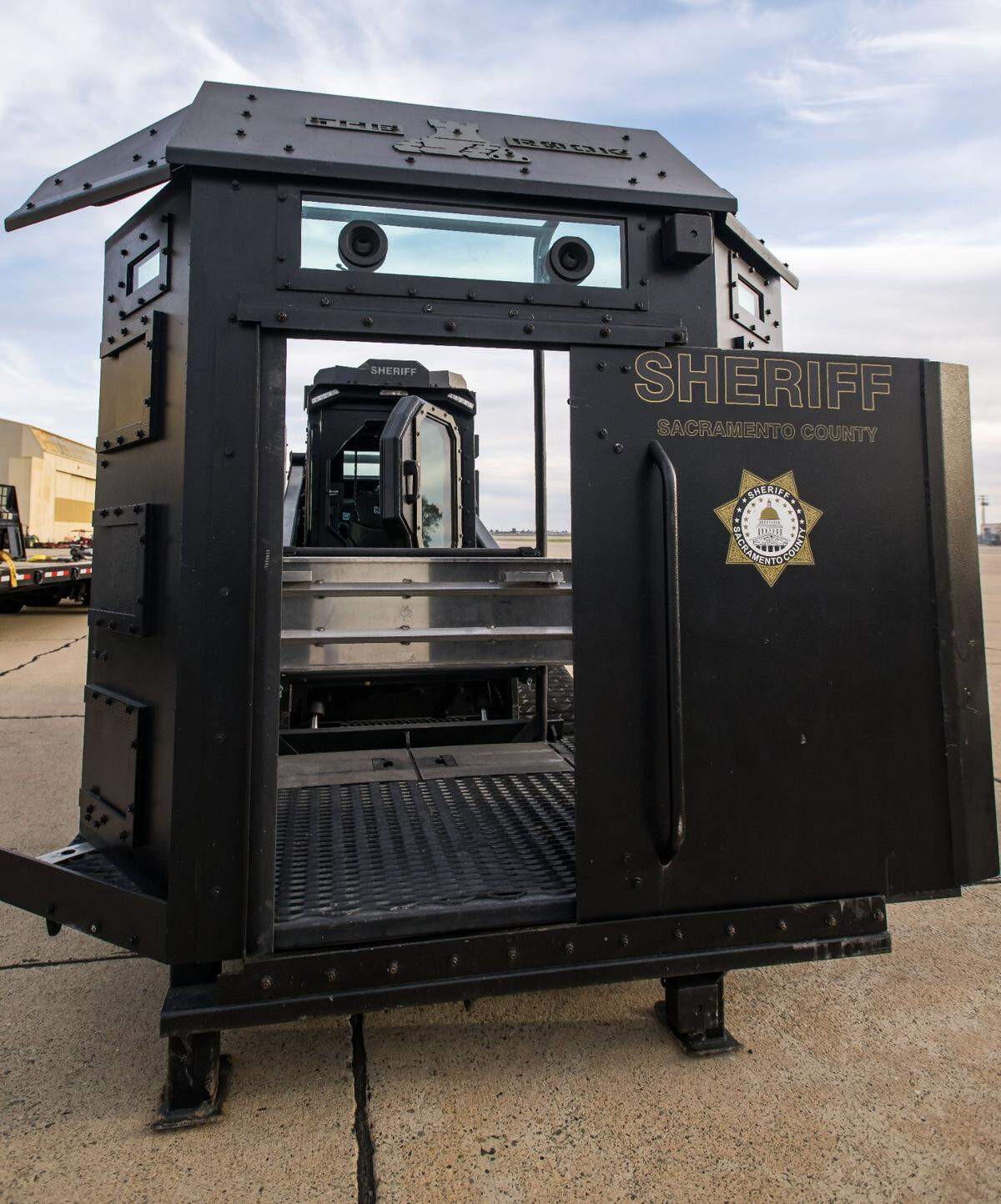
Inside the Rook: Sacramento Sheriff Jim Cooper calls armored vehicle an ‘invaluable tool’
Sacramento County Sheriff Jim Cooper calls the Rook, the armored vehicle at the center of a resurfaced debate over militarization of local police, an essential tool to rescue residents or officers under fire.
The Sheriff’s Office, which has had its Rook for four years, demonstrated the capabilities of the armored vehicle for The Sacramento Bee. Cooper stood on the elevated platform — raised to a second-story level — to describe how it’s used to help people out of dangerous situations.
“This is a really a rescue vehicle. You can take this right up to window and evacuate them,” Cooper said. “It’s really meant as a defensive tool; not an offensive tool.”
And that’s what happened about two years ago at a Rancho Cordova apartment complex. The sheriff’s SWAT team evacuated a mother, a father and five children from a second-story window.
Deputy Ken Becker, a member of the SWAT team, said there was an attempted murder suspect with a gun — refusing to come out — on the first floor of the apartment building. The SWAT team rescued the family through a rear window of their apartment.
“Knocked on a window, and they all came out to us. And we evac’d them,” Becker said. “And then we did two other apartments on the adjacent side.”
At a Jan. 31 meeting, the Sacramento City Council voted 7-2 to authorize its Police Department to purchase a Rook despite numerous objections from residents and community activists who challenged elected officials to stop further militarization of police. California Assembly Bill 481, approved in 2021, requires law enforcement agencies to seek community feedback on the acquisition, funding and use of military equipment.
The Sacramento Police Department obtained a federal grant — not city funding — to buy the Rook for $439,894 from a Florida-based company called Ring Power, which calls the Rook an Armored Critical Incident Vehicle.
The Police Department has asked the Sheriff’s Office for assistance with its Rook 13 times since 2019. In three of those incidents, the sheriff’s Rook did not arrive in time to be used. The Police Department will not receive its new armored vehicle until at least November, so it’s likely police will ask for the sheriff’s Rook again before then.
How often is the sheriff’s Rook used?
The Sheriff’s Office has used its Rook on an average of about 10 to 12 times each year, usually about once a month. Cooper said it’s well worth the cost for having this “invaluable tool” if they can use it to prevent someone from being killed.
“We have a job to do, and I wanna make sure these guys go home safe at night,” Cooper said about his SWAT team. “I wanna make sure that the folks that live in that neighborhood are kept safe.”
Cooper said the Rook has no weapons mounted on it; the only guns on it are the ones the SWAT members carry with them. Without an armored vehicle, deputies would have to approach with nothing but an opened vehicles door to use as cover. He said those vehicles aren’t bulletproof, and gunfire from a high-powered rifle would go through that like “a hot knife through butter.”
“Obviously, it’s meant to protect officers. To make sure we don’t lose any officers,” Cooper said. “And if they’re fired upon, they’re gonna fire back.”
Deputy Chris Johnson, a SWAT team member who drives the Rook, has taken gunfire while operating the armored vehicle. He said he heard some small, faint pops shortly over the Rook’s roaring engine. Then, he quickly realized those were gunshots hitting the Rook.
He stayed in his driver’s seat, hoping the front windshield glass would hold up. He said he also was hoping the shooter would stop firing after realizing the bullets were not piercing the Rook.
“It’s uncomfortable,” Johnson said about taking gunfire while driving the Rook. “It’s never comfortable to be shot at. I mean, I have faith in the armor on the Rook. But you’re looking through glass, and that’s not a common thing to be looking through glass at somebody who’s shooting at you.”
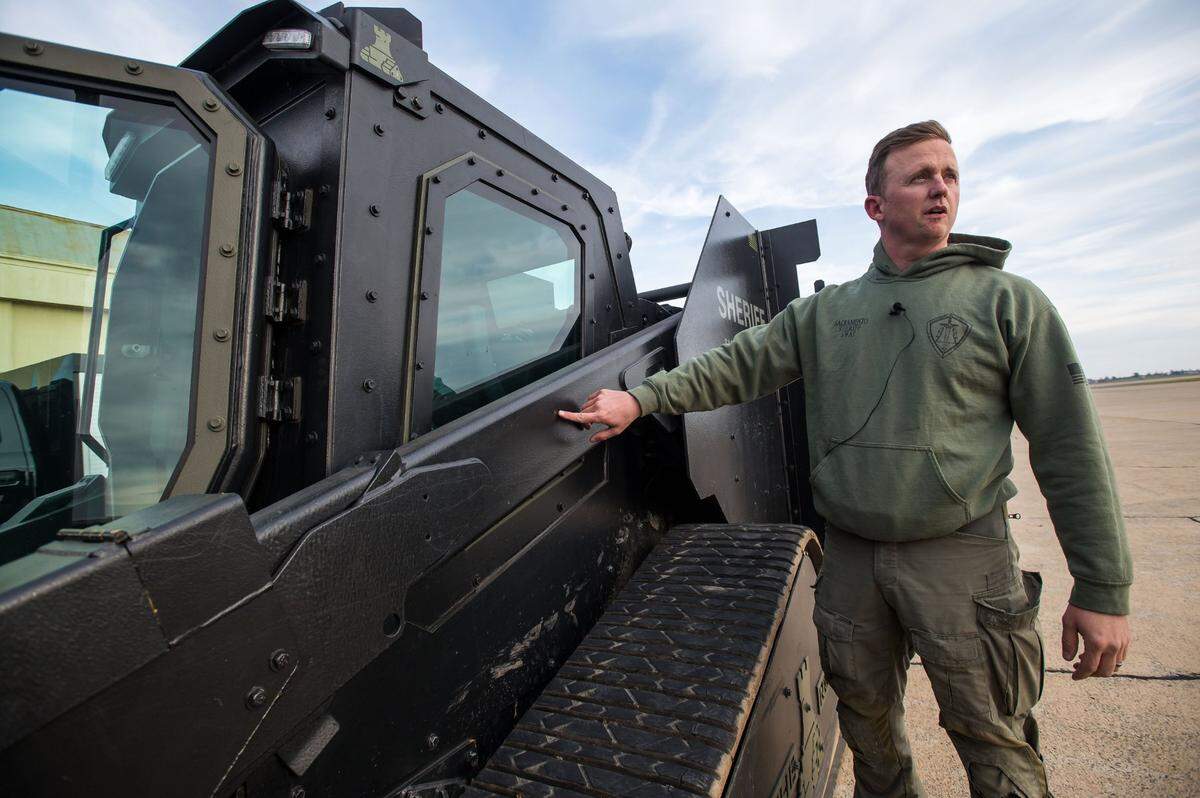
Used to get closer to speak to barricaded suspect
Becker said the Rook is usually taken to an incident scene when there is a significant threat of firearms being used against deputies or the SWAT team. He said they’ll at least drive it to the scene on a flatbed trailer and have it ready if needed to approach a suspect or rescue residents who could be in the line of gunfire.
The sheriff’s SWAT team can get the Rook out to an incident — depending on the distance to the scene — from about 15 minutes to an hour. There have been times the deputies hauling the Rook were told to turn back as they were en route.
“As a normal tactical event proceeds, they’re gonna continue doing those PA announcements, trying to get the subject to surrender,” Becker said. “Sometimes it works out where the subject does surrender prior to us showing up with this.”
There are a few members of the sheriff’s SWAT team who are trained to drive the Rook. Becker said Ring Power — the company sold the Rook to the Sheriff’s Office in February 2019 and will deliver the Sacramento police Rook as early as November — provided the sheriff’s SWAT team an instructional class on the vehicle and all its capabilities. The team also has quarterly training on the Rook.
Becker said they have used the Rook to get closer to a barricaded suspect to provide cover as they try to negotiate for a safe surrender. They can throw a phone into the home or building from the protected platform or speak directly to the barricaded suspect using a microphone on the Rook.
“We’ve gotten close enough to where the subject inside is yelling out at us. And we can turn the motor off, but leave the battery going,” Becker said. “So we can actually have a conversation with them through the intercom system. And then we’re just relaying that back to the negotiations team, trying to help that come to a peaceful resolution.”