
Residents share worries, frustrations during Sacramento PD’s meeting on military equipment
“You are representing what?”
“Sacramento Police Department.”
“The things that you’re describing are what?”
“Military equipment.”
“But you are Sacramento, what?”
“Police.”
“So what do you got to do with military?”
So went the first questions posed to Sacramento Police Department officers at the first of two community meetings about the department’s military use policy, which a Sept. 2021 state law required the department to hold, on Thursday night at a community center in the Hagginwood section of North Sacramento.
A second meeting was held Saturday in midtown, and residents have been encouraged by the department to give its feedback through an anonymous survey that will stay open until Aug. 25. The survey is available in five languages at bit.ly/sacpd-military-feedback-2023.
Armored vehicle concerns residents
Over the course of the three-hour meeting Thursday, residents spoke of their outrage over the $361,700 the department wants to spend on military equipment in the upcoming year – adding to its more than $4.5 million of existing military equipment, including 322 M16 rifles, two $250,000 Northrop Grumman-developed robots and several armored vehicles, disclosed in Tuesday report draft also required by the state law — combined with frustration that the Community Police Review Commission that hosted the meeting had no direct power to shape policy, only make recommendations that the city council could choose to ignore.
No city council members or other Sacramento-area elected officials were present at Thursday’s meeting. City Police Review Commissioners Zachary Wayne Johnson, Keyan Bliss, Jason Sample and Graciela Castillo-Krings were present, along with Shaun Naidu, who works for Assembly Speaker Robert Rivas, D-Hollister, as a policy advisor on criminal justice to provide an overview of state law regarding police use of military equipment.
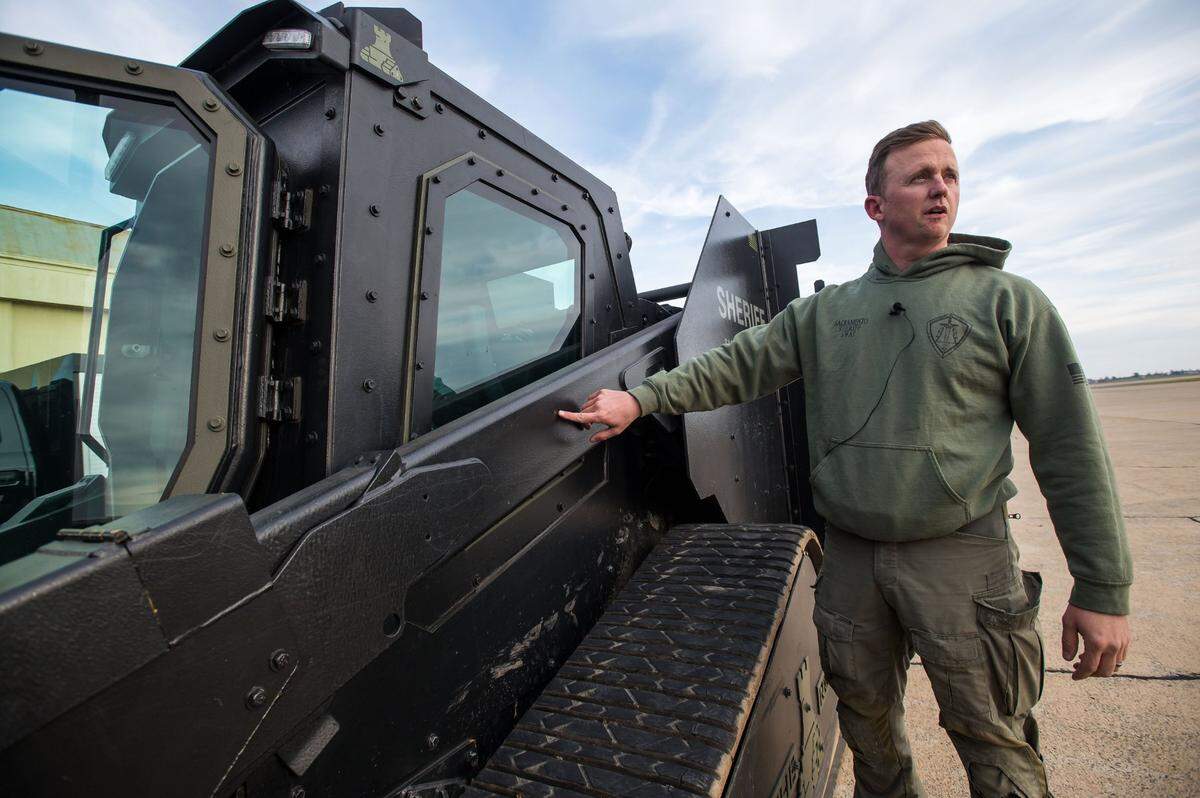
Fresh on several attendees’ minds was the Sacramento City Council’s 7-2 vote approving the department’s purchase of a $440,000 armored vehicle called the Rook in February.
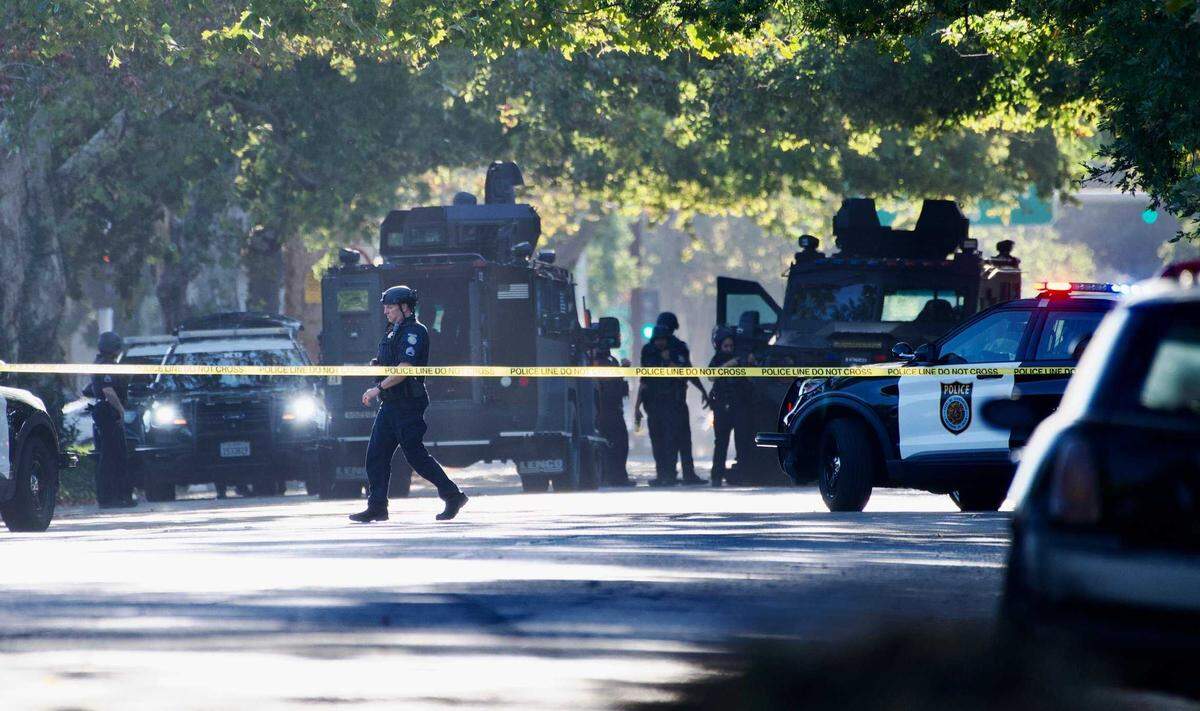
Police officers who led the presentation emphasized that no weapons would be mounted on the vehicle, though officers within it may carry firearms, and that it would be used only to rescue civilians and officers under fire. The vehicle has a grapple claw that can remove fortified doors and immobilize vehicles, according to a city report.
At Thursday’s meeting, attendees renewed concerns that police militarization was continuing to create a divide between the community and police instead of contributing to their safety.
Natomas High School teacher Raymond Walker pointed out that police should do more to be proactive instead of intimidating subjects during crisis responses, such as a barricaded suspect inside a home. Walker said that intimidation, including the use of fortified military-style vehicles, affects everyone in the neighborhood.
“If (police) could show that it was gonna make the community better and cut down the crime and have everyone safe, we would understand that,” Walker said. “But it just seems like it’s out to knock us down, so we are always on defense, you know?”
Retired truck driver Andre Banks asked why funding was being allocated to military equipment instead of community investment.
“If you know you need a lane of military equipment to do your job out here, why don’t you get in the lane early, use that money toward something before you have to use military equipment and you won’t have to procure so much military equipment?” he said.
‘A lot of anger and a lot of emotion’
Many at the meeting voiced frustrations that an initial agenda involving an hour of breakout discussion groups, which a professional Sacramento State facilitator repeatedly stressed was intended to “capture all of” the community’s “input,” might do exactly that: bottle the anger and energy without any idea of how it would lead to change.
When the facilitator asked an attendee to save comments directed at the officers for the breakout groups, the tension boiled over. One attendee interrupted to ask the facilitator whether they were from the neighborhood.
“I’m not, I’m a neutral facilitator,” the facilitator replied. “I understand that right now it’s difficult. There’s a lot of questions. There’s a lot of information that is being provided. ... There’s a lot of anger and a lot of emotion.”
“Everything you said is very patronizing,” one attended said in response. “This is not a question of voices being heard. We were basically blatantly told by every single person who organized this event that no matter what we say in this room, it will not change anything.”
Commissioners Castillo-Krings and Bliss, mostly quiet for the first hour, had to take control of the room to keep the meeting going.
“Nobody here is wrong that we don’t have the power to make the policy change in this room. It’s ultimately left to the city council, who in the past consistently has ignored us,” Bliss said. “That said, power never concedes anything without a demand, and the fact that this entire room is packed right now with people who are rightfully concerned and even upset speaks volumes to how much pressure we can actually wield and put on city council when this policy comes up in public meetings.”
Commission ‘making incremental steps’
Castillo-Krings emphasized that the commission had already delivered 130 recommendations to the council, including 13 regarding the use of military equipment. After the meeting, she shared that the Police Department has fulfilled some specific asks of the commission. The department included demographic information of people they used military equipment on in this year’s report, for example.
The commission’s work is to hold the police accountable without “just bashing PD and bashing the city,” Castillo-Krings said. The commission’s approach when it comes to working with the department is to “trust, but verify.”
Although the commission has been around since 2016, Thursday’s meeting was only the second public forum they have hosted. The meetings are ongoing experiments in how to effectively be a bridge between policymakers and “the community at large,” Castillo-Krings said.
“We’re in the process of trying to figure out how we actually can all work together because some of the recommendations that we wanna move forward should be possible,” she said. “At the end of the day, I don’t want them to show up and say, here we go again. You’re not doing anything. I want us to move forward. ... I feel like we’re making incremental steps.”
Castillo-Krings said comments about the disconnect between the community and police stuck with her and speaks to what’s required for long-term change.
“At the end of the day, we can change policy all day, but if the underlying culture isn’t being changed, that’s what’s ultimately gonna (determine) its effectiveness,” she said.
“We want to say our heroes take care of us, care about us,” one attendee said to the officers as the meeting reached its end. “This doesn’t tell us that, it tells us that I need three inches of steel between you and me.”
This story was originally published July 29, 2023 at 11:00 AM.