Local

What will Sacramento’s new American River bridge look like? See the city’s renderings

Sacramento officials are poised to decide on one of four configurations for a new bridge across the American River that would connect the River District and downtown with South Natomas.

The project, which could cost nearly $300 million, is in the early planning stages, and all the renderings of the Truxel Bridge include space for vehicles to pass from Truxel Road on the north side of the river to Sequoia Pacific Boulevard on the south.

Some residents have pressed the City Council to reconsider Regional Transit’s original plan for a bridge that accommodated only public transit, cyclists and pedestrians. That plan would leave drivers to continue using the car-oriented infrastructure already in place. The Active Transportation Commission, an advisory board, voted at its January meeting to urge the council to at least consider a car-free option. In addition to being safer, a bridge without cars would be cheaper to build and maintain, commissioners argued.

The Department of Public Works is not recommending the cheapest of its proposed four options. “Alternative 2,” the narrowest bridge at a cost of $179 million, would place cars and light rail in the same lanes. It would also cost $39 million less than the next-cheapest option, the Department of Public Works estimated.

The option preferred by the city department, Alternative 3B, would cost an estimated $227 million and feature a two-lane roadway with two tracks for light rail trains and a dedicated area for a set of bike lanes and a 10-foot pedestrian thoroughfare.

The Truxel proposals will go before City Council for a vote before they move forward. The Truxel Bridge project manager, Fedolia “Sparky” Harris, explained to the Active Transportation Commission that when a report on the bridge was prepared 12 years ago, the no-cars option was rejected.

Because of that policy decision from 2013 as well as other planning documents, Harris said, the department could only consider building the bridge with cars. Members of the commission countered that the city should change its position in 2025.

In the meantime, the Department of Public Works released its current renderings of the future bridge in response to a Public Records Act Request. Harris said that the bridge is at best a decade away from construction.

Here’s what the bridge renderings look like:

Alternative 1: The $295 million bridge

This option for a Truxel Bridge places light rail in the center, pedestrians and cyclists on the outside edges and car lanes between them. This is what the Department of Public Works called “alternative 1.” It is not the recommended design. The department estimates this option would cost $295 million.
This option for a Truxel Bridge places light rail in the center, pedestrians and cyclists on the outside edges and car lanes between them. This is what the Department of Public Works called “alternative 1.” It is not the recommended design. The department estimates this option would cost $295 million. City of Sacramento

Alternative 2: The $179 million bridge

This option for a Truxel Bridge places light rail and personal vehicles in the same lanes, which could slow public transit dramatically. Pedestrians and cyclists would share a path, protected by a barrier. This is what the Department of Public Works called “alternative 2.” It is not the recommended design. The department estimates this option would cost $179 million.
This option for a Truxel Bridge places light rail and personal vehicles in the same lanes, which could slow public transit dramatically. Pedestrians and cyclists would share a path, protected by a barrier. This is what the Department of Public Works called “alternative 2.” It is not the recommended design. The department estimates this option would cost $179 million. City of Sacramento

Alternative 3A: The $218 million bridge

This option for a Truxel Bridge places light rail between pedestrians and vehicles. Cyclists have dedicated lanes. Personal vehicles also have their own lanes. This is what the Department of Public Works called “alternative 3A.” It is not the recommended design. The department estimates this would cost $218 million.
This option for a Truxel Bridge places light rail between pedestrians and vehicles. Cyclists have dedicated lanes. Personal vehicles also have their own lanes. This is what the Department of Public Works called “alternative 3A.” It is not the recommended design. The department estimates this would cost $218 million. City of Sacramento

Alternative 3B: The favored bridge, at $227 million
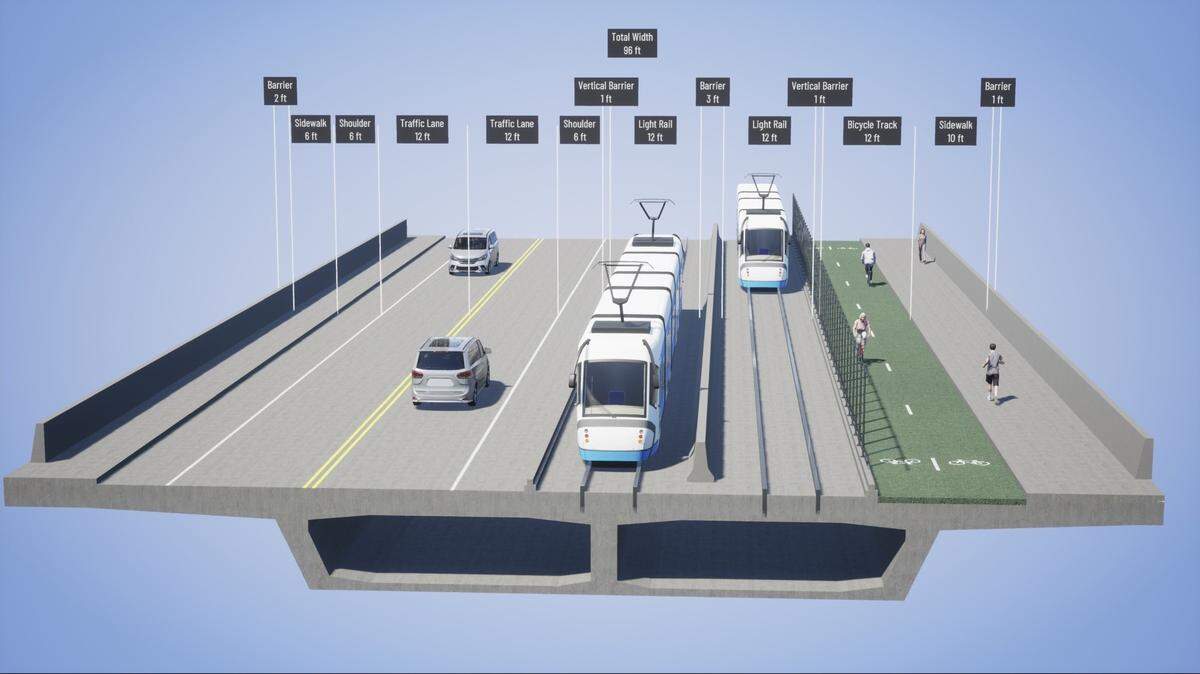
This option for a Truxel Bridge places light rail between pedestrians and vehicles. Cyclists have dedicated lanes. This is what the Department of Public Works called “alternative 3B.” It is very similar to 3A, and it is the design that city staff recommend the City Council approve. The department estimates this option would cost $227 million.
This option for a Truxel Bridge places light rail between pedestrians and vehicles. Cyclists have dedicated lanes. This is what the Department of Public Works called “alternative 3B.” It is very similar to 3A, and it is the design that city staff recommend the City Council approve. The department estimates this option would cost $227 million. City of Sacramento

This story was originally published February 3, 2025 at 10:25 AM.
Ariane Lange
The Sacramento Bee
Ariane Lange is an investigative reporter at The Sacramento Bee. She was a USC Center for Health Journalism 2023 California Health Equity Fellow. Previously, she worked at BuzzFeed News, where she covered gender-based violence and sexual harassment.
Get one year of unlimited digital access for $159.99
#ReadLocal

Only 44¢ per day

SUBSCRIBE NOW