
Health inspectors closed 100-plus Sacramento County restaurants since 2023. Why?
Sonia Andrusiak has worked in restaurant inspections for more than 20 years, spending the first few years of her career in Yolo County before moving to Sacramento County.
Now she is a supervisor at Sacramento County’s Environmental Management Department, overseeing health officials in the field who inspect thousands of food facilities across the county every year.
“I’ve seen a lot of things, like a rodent that looks like a cat running through the place … or cockroaches falling in front of me,” Andrusiak said. “Nothing surprises me anymore.”
Over the past two and a half years, The Sacramento Bee has published weekly reports on the county’s restaurant inspections, detailing the violations that have led some of top restaurants in the Sacramento area to be shut down.
The Bee recently compiled a list of 103 food-serving facilities in Sacramento County that received red placards between September 2023 and April, analyzing the reasons the businesses closed and how long they took to reopen.
Here’s what we found out:
Who makes sure restaurants are safe in Sacramento County?
The county Environmental Management Department is in charge of ensuring that area businesses and residents comply with regulations that protect public health, encompassing everything from hazardous waste disposal to food safety inspections.
The agency splits a wide set of responsibilities across two divisions.
The Environmental Compliance division handles programs for waste, water and hazardous materials storage, while the Environmental Health division handles food safety, regulates piercing and tattooing, manages noise complaints and more.
Under the large Environmental Health umbrella is the Retail Food Protection program, the county’s stronghold for enforcing and educating about California’s food safety standards in every retail food facility across the county.
The facilities subject to safety inspections under this program range from full-service restaurants to clothing retailers that sell a handful of prepackaged snacks.
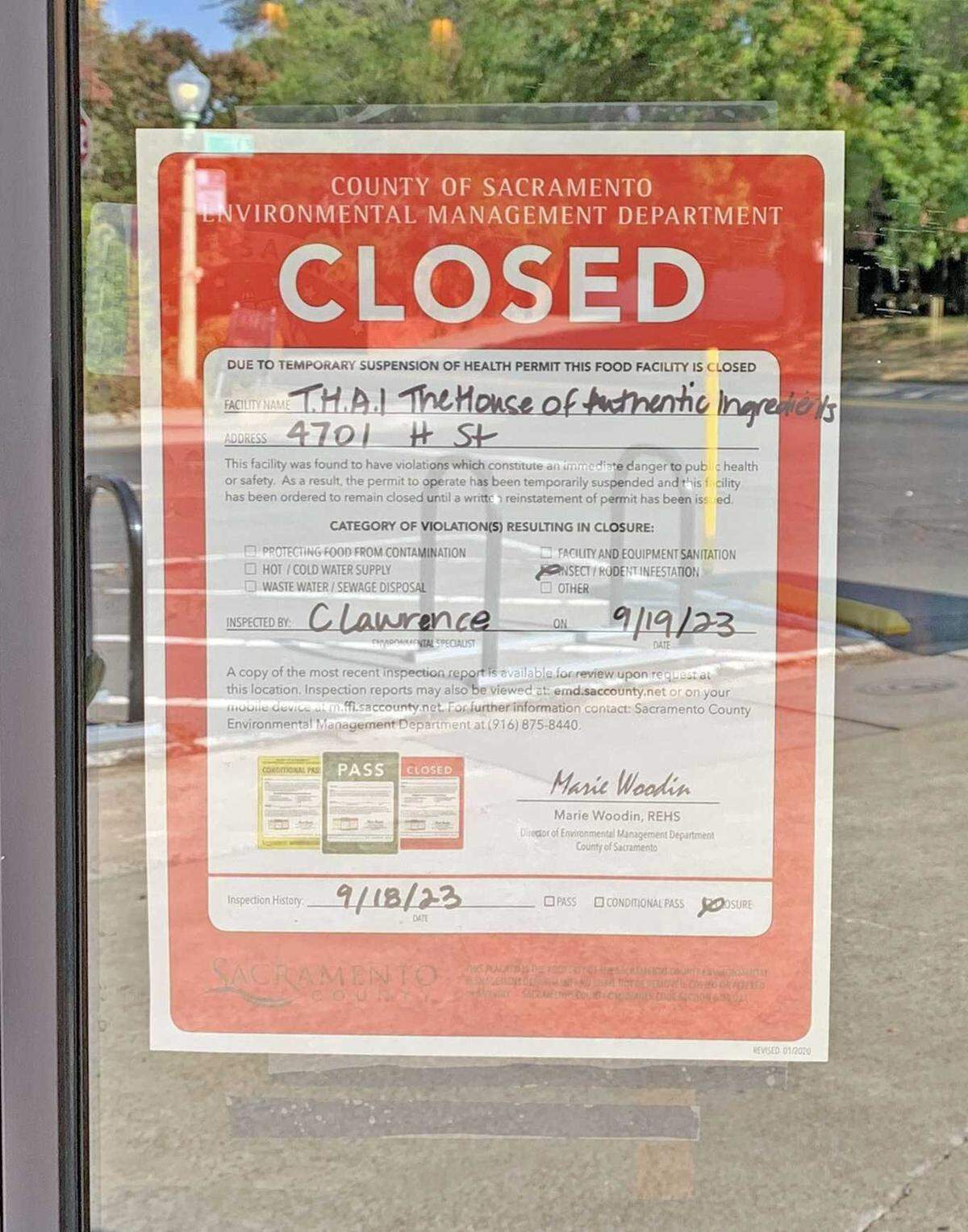
If county health officials determine a facility has violated the California Retail Food Code in a way that immediately endangers the public, the restaurant or other retail food facility could be shut down by the county, indicated by a bright red placard reading “CLOSED” posted in the facility.
How do Sacramento County health inspections work?
Roughly 14,000 inspections are conducted in Sacramento County each year, county spokesperson Ken Casparis previously told The Bee. Among these inspections, only 1% — about 140 — lead to a facility closure, he said.
According to Andrusiak, food service facilities don’t get advance notice of an inspection to ensure that inspectors get a view of the facility’s typical conditions.
At each food-serving facility, inspectors make dozens of observations — exploring every crevice to determine if there are violations of the California food safety code.
These observations include checking the temperature of all food items being used or stored, checking surfaces for mold, slime or food residue, searching for evidence of vermin infestation and identifying broken and unusable equipment.

What happens when restaurants have food safety violations?
The Sacramento County Retail Food Inspection Guide outlines the expectations restaurateurs must meet in terms of food safety and cleanliness, condensing California’s food safety code into 62 digestible sections.
Within each section, specific instances are defined as “minor” or “major” violations.
According to the Sacramento County food guide, minor violations do not put the public at risk of foodborne illnesses — or restaurants at risk of closure — but major violations do.
For example, storing moldy food can be a minor violation. However, when that moldy food is used in cooking or food preparation, it becomes a major violation.
Facilities receive a passing grade if they have no more than one major violation during a routine inspection, resulting in a green placard posted near the facility’s entrance.
If inspectors find major violations, they must be immediately corrected in order for the facility to receive a full pass, according to the county food guide.
A “conditional pass,” indicated by a yellow placard, is issued when two or more major violations are observed and immediately corrected, the county food guide explains.
Eateries that receive a yellow placard are subject to be re-inspected within roughly 72 hours. Major violations must remain corrected for a green placard to be issued, according to the county.
If major violations can’t be corrected, the county may shut down the restaurant until inspectors can verify code compliance.
According to Andrusiak, the Environmental Management Department requires inspectors to consult multiple supervisors to determine what warrants a closure.
Facilities that receive red placards must request re-inspection once issues are addressed in order to get permission to operate again, the county’s website says.
In the case of restaurant closures related to vermin infestations, some pest control companies offer emergency services to help facilities pass re-inspection quickly.
“It’s a full-scale attack,” Andrusiak said. “That’s their livelihood, and we want to see them open as well.”

Which Sacramento-area city had the most restaurant closures?
The closures involved restaurants and other food service facilities in 20 Sacramento County cities and unincorporated areas:
Antelope
Arden Arcade
Carmichael
Citrus Heights
Elk Grove
Elverta
Fair Oaks
Folsom
Foothill Farms
Galt
Lemon Hill
North Highlands
Old Foothill Farms
Rancho Cordova
Rancho Murieta
Rio Linda
Rosemont
Sacramento
Unincorporated south Sacramento
Vineyard
Nearly half of the restaurants closed due to health code violations — 48 — were in Sacramento, while 16 of the eateries were in Arden Arcade. Eight were in unincorporated South Sacramento.
Five facilities were in Elk Grove and four were in Citrus Heights.
Carmichael and Folsom had three closed restaurants each and North Highlands, Vineyard and Rancho Murieta each had two. The other areas each had one.
The types of facilities closed due to food safety violations range from traditional full-service restaurants to small markets.
Two hotels — Holiday Inn Express & Suites in Elk Grove and Hilton Garden Inn in Sacramento — had their food service areas shut down.
In addition, two local schools had their cafeterias temporarily closed: McCaffrey Middle School in Galt and Elverta Elementary School in Elverta.
Which restaurants had the most health-related closures?
Of the 103 facilities that received red placards between September 2023 and April, most closed only once — reopening after a successful secondary inspection, The Bee reported.
During that period, there were 31 failed re-inspections, and some restaurants failed to pass muster multiple times before reopening.
Restaurant closures lasted an average three days, with some eateries reopening the same day they closed.
Afghan Pita Market and Restaurant in Arden Arcade took 32 days to pass re-inspection after being shut down in September.
One local restaurant held the record for the highest number of closures due to food safety issues.
T.H.A.I. The House of Authentic Ingredients in East Sacramento failed inspections six times in September 2023 for cockroach-related violations, The Sacramento Bee reported at the time.
Carniceria Mi Mercadito in the Parkway neighborhood closed five times after receiving red placards, and the aforementioned Afghan Pita Market and Restaurant closed four times.
Why does Sacramento County shut down restaurants?
According to Sacramento County’s food inspection guide, these major violations have the potential to close a restaurant:
No hand-washing facilities available.
No ware-washing equipment or facilities available.
All refrigeration equipment inoperable.
Infestations of cockroaches, rodents or flies.
Lack of drinking water in the facility.
Lack of sufficiently hot water for washing hands and kitchen wares.
Contaminated or “unapproved” water source.
Overflow of sewage or wastewater into the restaurant.
Clogged floor sinks impacting the use of equipment.
Lack of bathroom facilities.
Most shutdowns were caused by only one major offense, but 13 reports cited multiple severe violations as reasons for closure.
Nearly two-thirds of the food facility closures The Bee analyzed were caused at least partially by cockroach activity.
Roaches played a role in 93 of the 141 logged closures, with inspectors reporting both live and dead insects.
According to Andrusiak, the mere presence of cockroaches isn’t enough to trigger a closure.
The insects must come with an “imminent health threat,” she said.
Dead roaches are not considered an imminent health threat, she said, because they are not able to move around and contaminate the kitchen.
Inspectors consider a variety of factors to determine whether the facility has a potential cockroach infestation, Andrusiak said.
If inspectors find only one live cockroach after a thorough search of the facility — and confirm that the restaurant has an adequate pest control and monitoring method — they may be able to avoid closing an eatery, according to Andrusiak.
The second-most common reason for Sacramento County inspectors to close restaurants was rodents. This includes the presence of a live or dead rodent, as well as evidence of a rodent infestation, such as gnaw marks and droppings.
About 16.3% of all local restaurant closures — 23 in all — involved rodents.
A lack of hot water accounted for 14 closures, while a severe sewage clog or backup led to 11 shutdowns.
Excessive flies on or around food led to six facility closures, and a lack of refrigeration was linked to two red placards.
Unusable bathroom facilities and having no sanitizer for ware washing were cited in one restaurant closure report each.
How hard is it for restaurants to stay clean?
In April, former Natomas Donuts owner Thana Rong Ny issued an apology to customers after the Sacramento doughnut shop failed two inspections due to a rodent infestation and was shut down.
Ny said he fired the manager who allowed the eatery’s cleaning situation to get to a hazardous point for “negligence,” and implemented stringent pest control and cleaning procedures going forward.
Sacramento County honors facilities that successfully maintain top form annually with the Award Of Excellence in Food Safety. In 2024, the health department awarded 604 facilities for their efforts.
In order to be eligible for the award, full-service restaurants must have no more than three minor violations in each of their last three unscheduled inspections. In all cases, having even one major violation is enough to take an eatery out of the running.
Yume Gelato in East Sacramento was a 2024 award recipient and continued its clean streak during its most recent inspection in February.
Mike Janwar, one of the gelato shop’s owners, previously told The Bee that the food safety award recognizes the “considerable efforts” he and his staff put in to keeping the facility spic and span.
“Working in a clean and organized environment makes me happy and hopefully that translates to the gelato that we make and serve,” Janwar wrote in a March email to The Bee.
How can I check if my favorite restaurant is a safe place to eat?
If you’re worried about whether your usual haunts are hiding grime and filth, Andrusiak said you should check the county’s public online database of inspection reports.
The Environmental Management Department’s database features records of all retail food facility inspection reports filed since May 1, 2023.
You can search for a food facility by name or address, which will pull up a record of all of the facility’s inspection reports available online. You can also filter all of the county’s inspection reports by date.
In both cases, you’ll be able to tell whether it was a routine or follow-up inspection.
All the juicy — and disgusting — details of each inspection can be found in a PDF embedded under each restaurant’s entry. The report includes which sections of the county’s food guide were violated and why, as well as which placard the restaurant received.
To get a quick view of real-time restaurant closures, click the tab at the top of the database home page labeled “Restaurant Closures.” This page briefly explains the closure process and has a list of actively closed restaurants and the reasons they were shut down.
.jpg)