Historic homes gain new life in Sacramento — and tax relief — under state law
Jenessa Gjeltema bought an 1895 home in midtown Sacramento in 2024, but she was short on funds to address the repairs it needed. While age presented some of the home’s problems, it also unlocked a solution.
Gjeltema turned to a program enacted under a California state law, the Mills Act that could give her home a reduction in property tax in exchange for a contractual commitment to do work to preserve the property.
“It doesn’t necessarily take away the costs entirely but it can offset some of it to kind of help out with people who do want to do the right thing for their house,” Gjeltema said.
Gjeltema’s contract was certified Oct. 14, coming around a time that the city has been looking to ramp up its Mills Act program.
Of the approximately 60 properties that have enrolled in the Mills Act program since the city began accepting applications for it in 2018, roughly half the applications have come since the beginning of last year, according to Sean deCourcy, the city’s preservation director.
“It’s a really cool program that’s kind of under the radar that I wish more people knew about,” deCourcy said.
Bringing the Mills Act to Sacramento
The Mills Act dates to 1972 and was the work of former California state Assemblymember and Senator James Mills, according to an article in The Coronado Times.
When Mills died in 2021 at 93, the Associated Press wrote that Mills had drafted the law to prevent the demolition of historic buildings by reducing their property taxes if owners would preserve the buildings. Mills’ obituary noted that he’d been “credited with saving thousands of historic landmarks.”
“Dad believed that government existed to serve the people,” his daughter Beatrice Germain told the Associated Press.
For many years, the only property receiving a Mills Act property tax reduction in Sacramento was the former Senator Hotel at 1121 L St., which got the distinction in 1978, around the time the hotel became an office building.

City code needed to be updated to allow more properties in Sacramento to take advantage of the Mills Act, deCourcy explained. Not long after deCourcy was hired in the late 2010s, then-City Councilman Steve Hansen directed deCourcy to enact a Mills Act program locally.
Mills Act contracts for about nine properties were certified in 2019, including the former Bank of America building, where coworking space The Urban Hive is now located. That building was one of three successful Mills Act applications that year from Bay Miry, a developer, who has continued to make use of the program.
In 2020, Jonathan Arambel, a lobbyist, applied for a Mills Act reduction for a house at 1029 F St. in Alkali Flat that he and his wife bought partly so they could walk to work and to indulge Arambel’s love of history.
Arambel said his home dates to 1853 and is the second-oldest house in Sacramento. Famous former residents of the house include former California Gov. J. Neely Johnson and former California State Supreme Court Chief Justice David S. Terry, arguably most known for killing a U.S. senator, David C. Broderick in a duel.
On one hand, the Mills Act provides Arambel and his wife with some savings, with the Sacramento County Assessor’s website listing the home’s assessed value at $368,000 compared to a purchase price of $985,000. This suggests tax savings of around $6,000 annually.
That’s not to say, however, that the house lacks other expenses beyond what a typical homeowner might pay, Arambel noted.
“Generally, when you’re in a historic home there is just that historic home tax — whether it’s trying to find people to work on your home, whether it’s just trying to maintain your home, whether it’s trying to heat or cool your home,” Arambel said. “So any sort of savings definitely goes a long way.”
To be clear, the Mills Act can generate big savings. An examination of 20 properties in Sacramento with known sales prices that got Mills Act reductions through the end of 2024 showed they had a cumulative assessed value of $9.6 million compared to a total sales price of $23.1 million. Under Proposition 13, which helps set property tax in California, this would seemingly equal around $140,000 annually in lost property tax revenue.
Sacramento City Councilmember Phil Pluckebaum said the amount of property tax revenue lost with the Mills Act is “certainly not going to solve our budget conversations.” Pluckebaum also said there was value in preserving historic properties.
“When you own a historic property, you’re really doing a public service,” Pluckebaum said. “It really is a labor of love in most instances where folks don’t get nearly adequately recognized or compensated.”
Why Mills Act applications have been increasing in Sacramento
In the early years after deCourcy helped the city codify the Mills Act locally, most of the property owners who signed up for it had old houses, with several Victorians enrolled in the program.
Early on, the program was capped at just 12 applications a year locally. It could be tricky to apply for, too. Former Sacramento Kings owner Gregg Lukenbill, who lives in a 1912 house in East Sacramento but doesn’t have a Mills Act reduction, said he’d heard the application process could be cumbersome.
Gjeltema didn’t find the Mills Act application process overwhelming, though she acknowledged that some people might struggle with it, since the application requires listing out prospective projects.
“I think if you’re not well-versed in what historical houses need or the maintenance issues of that particular property or if you’re just not very well versed in construction… I think it could be a little bit daunting to kind of come up with those projects,” Gjeltema said.
As use of the Mills Act has started to increase more in the past two years in Sacramento, a new group has been coming in.
“A lot of the increase is being driven by these major commercial properties,” deCourcy said.
Since the beginning of 2024, there’ve been Mills Act contracts certified for projects like the former Marshall School at 2718 G St., which is owned by KBLH Investments, LLC, where Miry’s wife Katherine Bardis-Miry is the registered agent.
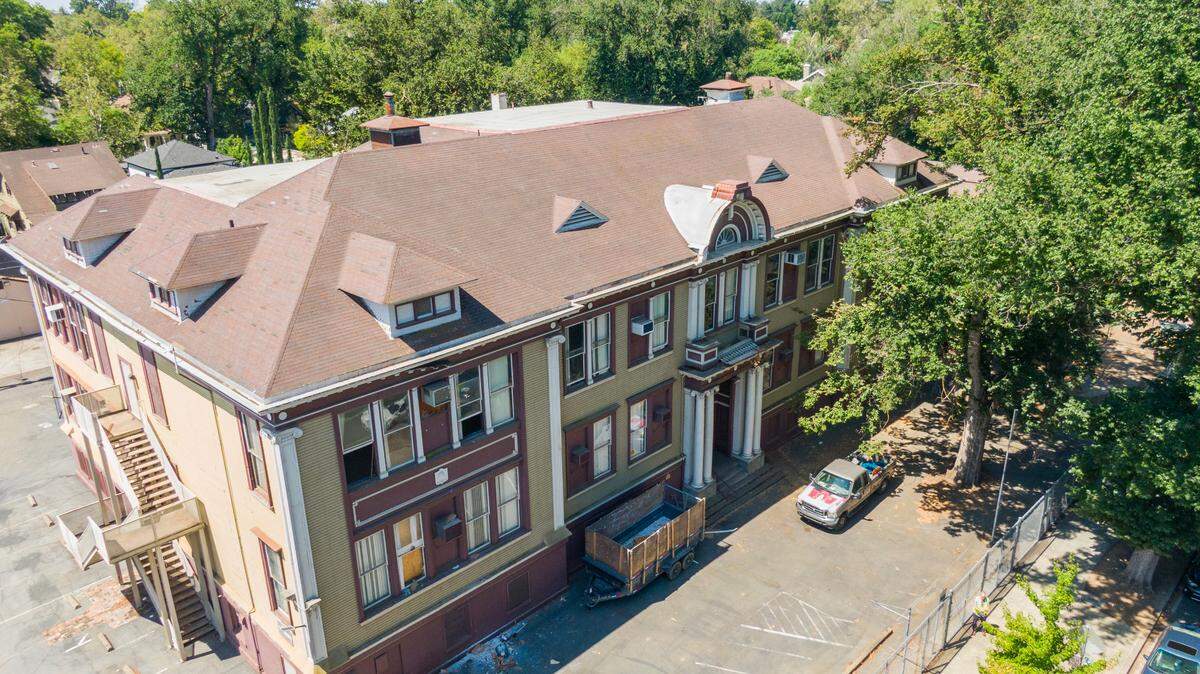
Miry, who was unavailable for interview for this story, said in a statement that the Mills Act could “be a valuable tool to aid in successful historic rehabilitation and preservation.” He has continued to use the program in recent months, with his Mills Act reduction for Ronald Reagan’s gubernatorial residence at 1341 45th St. being certified on Oct. 29.
Miry has also touted the Mills Act to people like Deron Benvenuti, a Heller Pacific vice president who received reductions in October for three downtown properties, namely the former A.C. Westerguard Auto Repair, Elliott and Thompson Diggs buildings.
“He spoke very highly of the program and it just seemed like low-hanging fruit,” said Benvenuti, whose company also has the MARRS building in midtown and is interested in getting it Mills Act certification at some point.
The city’s cap on annual Mills Act applications has been increased to 50, deCourcy said, with officials having realized they could be turning people away under the old cap of a dozen. He’s hopeful about where things could be going with the Mills Act.
“Hopefully, we’ll be able to hire someone to administer the program,” deCourcy said.
This story was originally published November 22, 2025 at 5:00 AM.