Car crash death toll climbs as Sacramento pivots to a quicker safety strategy
Sacramento announced a “Vision Zero Transportation Safety Initiative” Wednesday and said the city would shift more focus to rapid street safety improvements amid an ongoing crisis of fatal crashes.
Speaking at a news conference Wednesday, City Traffic Engineer Megan Carter said that the new Vision Zero initiative would center the work of the previously announced quick-build “Transportation Safety Team.” The City Council approved the $4.6 million quick-build team in March. The supervising engineer for the six-person team, Carter said, would likely start in January; two new traffic investigators will start over the next two months. The original target start date was July 1.
Most crash deaths are preventable with changes to infrastructure and policy. With that in mind, the city made a Vision Zero pledge in 2017 to eliminate all traffic fatalities and serious injuries by 2027. Since then, data released by the Sacramento Police Department show that more than 350 people have died after collisions on city streets. At least 29 people have been killed this year. The new initiative will focus on proactive, low-cost improvements that do not rely on years of planning and approvals and unreliable competitive grants.
Even without the quick-build team in place, Carter said the Department of Public Works had still moved forward with 17 quick-build projects to make roads safer in the past year.
“Sacramento is taking bold action to eliminate traffic fatalities and serious injuries through the launch of the Vision Zero Transportation Safety Initiative and establishment of a Transportation Safety Team,” Carter said. “This initiative represents a transformative step in how the city addresses transportation safety, prioritizing rapid response with low-cost treatments, data and community engagement.”
The news conference took place next to a quick-build project completed earlier this month at Sutterville Road and Mead Avenue. At that Land Park intersection, Alena Wong, now a freshman in college, was nearly killed at the age of 12 after a driver struck her while she rode her bike to class at California Middle School.
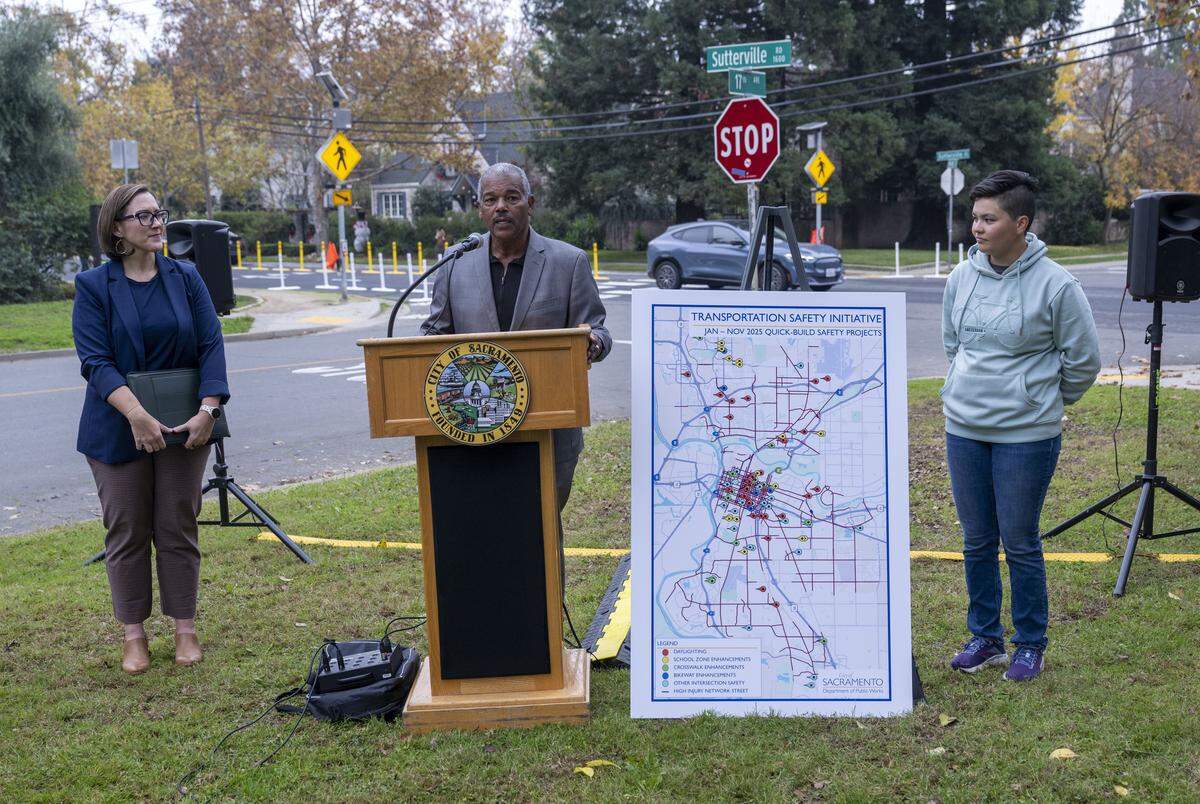
“Elements of the street design allowed for the greater likelihood of a crash,” Carter said Wednesday. Sutterville is a two-lane street with a 35 mph speed limit, and it’s wide enough for parking and bike lanes, which makes drivers feel comfortable going faster. Even the legal speed limit has a relatively high chance of lethality in the event of a pedestrian crash: The AAA Foundation for Traffic Safety found that when a driver strikes a pedestrian at 32 mph, the average risk that the pedestrian will die is 25%.
On Nov. 10, city workers finished making changes to Sutterville and Mead to narrow the space for cars and to increase driver caution as they approach the crosswalk. Public Works installed relatively cheap, semi-temporary posts at the intersection to coax them to slow down and pay attention as they approach the crosswalk. The posts that create “bulb-outs” essentially extend the curb farther into the street on each side. Now, drivers are slowing down more for right turns because the angle is tighter, and they cannot pass vehicles stopped at the intersection — whether to turn left or to yield to pedestrians — without running down a bunch of plastic posts and possibly damaging their vehicle. Yellow posts in the middle of the road draw drivers’ attention to the intersection.
Wong spoke at the news conference as her parents and younger siblings watched. “This is only the beginning,” she said.
The improvements came after years of advocacy by Wong and her parents as well as coverage of their story in The Sacramento Bee last year. At the event Wednesday, their councilmember, Rick Jennings, thanked them for their work. Wong pointed out that her family is relatively affluent and had the knowledge and resources to push for change; she urged the city to make sure that improvements were made in other neighborhoods where safety improvements are needed even more urgently.
“Our council member is in charge of a lot of more privileged areas,” Wong said, gesturing to Jennings. “There are lots of more dangerous roads where people don’t have the time to advocate for things like my family was working towards for the past six years. So it’s gonna take a long time, but I think we’re on the way there, and we’re gonna have to change a lot about the city.”
Wong said she fears that family and friends who remain in Sacramento could die in a crash. Sacramento has had the worst traffic death rate of any large city in California.
Behind such statistics are grieving families. One of the victims this month was Bee Lao, a 46-year-old father whose widow started a GoFundMe as she struggles to pay for a funeral and to support their five young kids. Lao’s children now face their first Christmas without him.
How many die in Sacramento crashes?
In 2025, vehicle collisions have killed Najah Islam, 30; Jonathon T. Slaugh, 62; Adrienne Keyana Johnson, 33; Cornelius Jesse, 59; Vuong Van Nguyen, 47; Zachery Ryan Taylor, 20; Natalia Regina Sanchez, 50; William Andrew Akens, 26; Ernesto Torres, 58; Zhen Cheng Kuang, 76; Thongthai Xanaxay, 55; Kaleb Josiah Green, 22; Huynh Huu Duc Nguyen, 30; Robert Michael Pineschi Jr., 39; Kimberly Lynn Pickett, 60; Parris Shauntel Windham, 41; Michael Driskell, 78; three young men from the same family — Mohammad Shaoib Durrani, 22, Hashmatullah Durrani, 24, and Omar Durrani, 25; Ricky Ray Reyes, 19; Jeremy M. Robinson, 46; James Lee Little, 64; Alicia Andrea Barnes, 65; Nedra Lee Franklin, 67; Gerald Hall, 60; Lao; Kyle Scott Silvers, 33; and Randy Allen Perez, 41. Of the dead, 22 were pedestrians or cyclists, and the remaining seven were motorists.
In 2024, The Sacramento Bee reported on 32 traffic deaths, 20 of which were pedestrians or cyclists, and two of which were riding scooters. Data obtained by The Bee from the Sacramento Police Department show that a 33rd person — a 72-year-old driver named Victor Mencarini — died Dec. 29, 2024, from injuries sustained in a crash eight months earlier. Mencarini brings the traffic death toll to at least 62 in two years.
Patterns have emerged in just under 23 months of Sacramento traffic deaths, with fatal collisions clustered on certain roads. Two men — Jesse in 2025 and James Lind, 54, in 2024 — died at the same intersection on Fruitridge. Six people in total have died on Fruitridge since January 2024: Jesse, Pickett and Perez this year, and David Rink, 51, Lind and Jose Valladolid Ramirez, 36, last year.
Four fatal crashes have occurred on Stockton Boulevard since January 2024, killing Sanchez and Driskell this year, and Edward J. Lopez, 61, and Duane Ashby, 35, last year.
Four fatal crashes have occurred on Marysville Boulevard since January 2024, killing Lao, Taylor, Jordan Nicolas Rodriguez, 38, and Alfred Ramirez, 23. Three fatal crashes have killed five people on the stretch of Roseville Road within city limits since January 2024; another crash just outside city limits on Roseville killed Wendy Connell, 54, as she biked to a dental appointment in January.
Two grandfathers also died in separate crashes at the same intersection in Natomas Park last year: Sau Voong, 84, and Muhammad Saddique, 64. Voong was on a bike ride, and Saddique was walking. The city restriped the crosswalks at this intersection after Saddique’s death.
Carter said Wednesday that the goal of the Transportation Safety Initiative was to proactively identify areas that could benefit from low-cost interventions, ideally before a severe or deadly crash occurred. Even survivable crashes have long-term ramifications. Wong said she saw the quick-build at the site of her crash for the first time while driving to an orthodontist appointment Monday.
She had to go to the orthodontist because of ongoing dental problems caused by the crash six years ago.
This story was originally published November 26, 2025 at 1:25 PM.