
Storms once sunk Sacramento under 10 feet of water. ‘An inland sea’
The rain began to fall on Dec. 9, 1861.
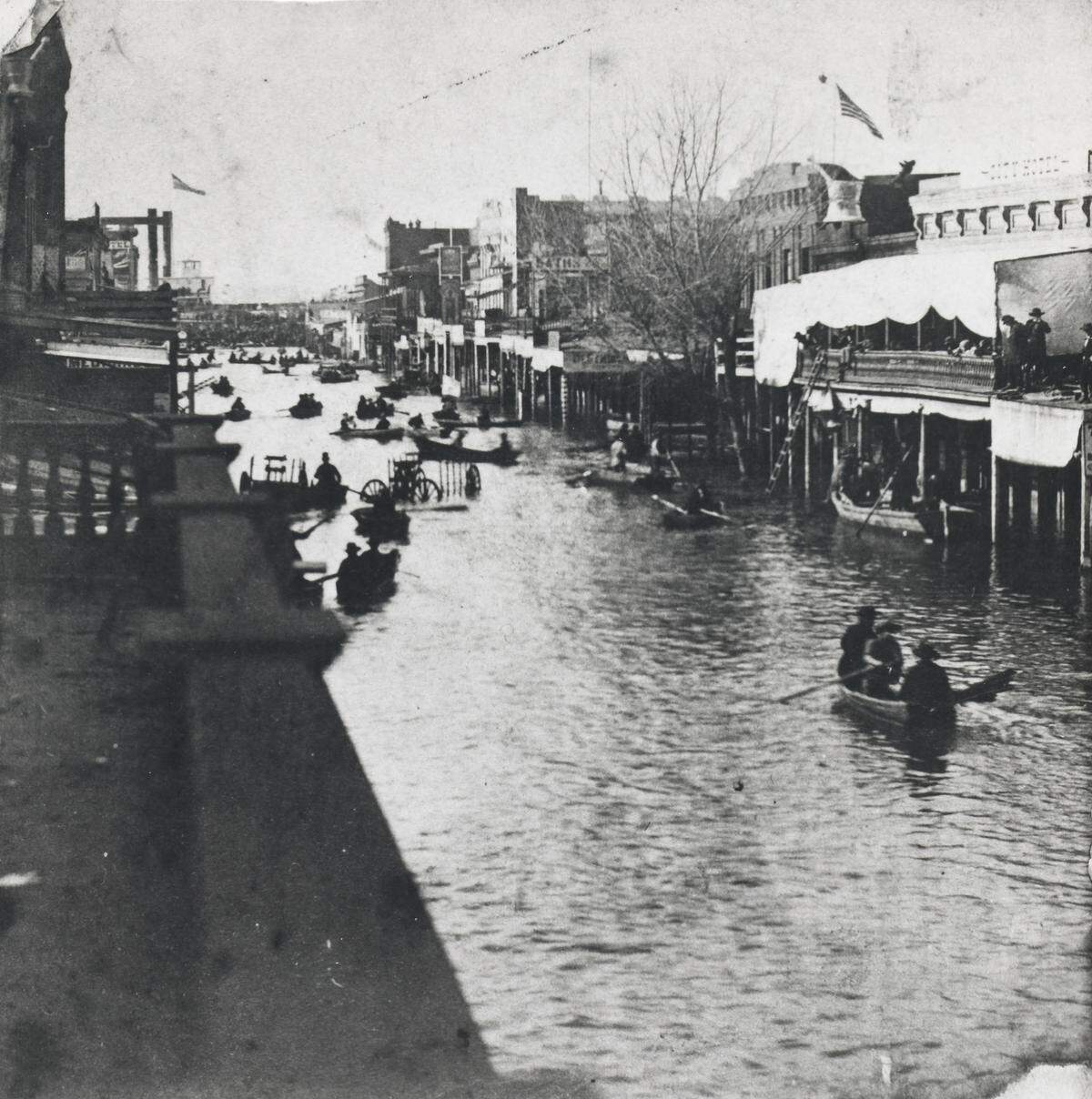
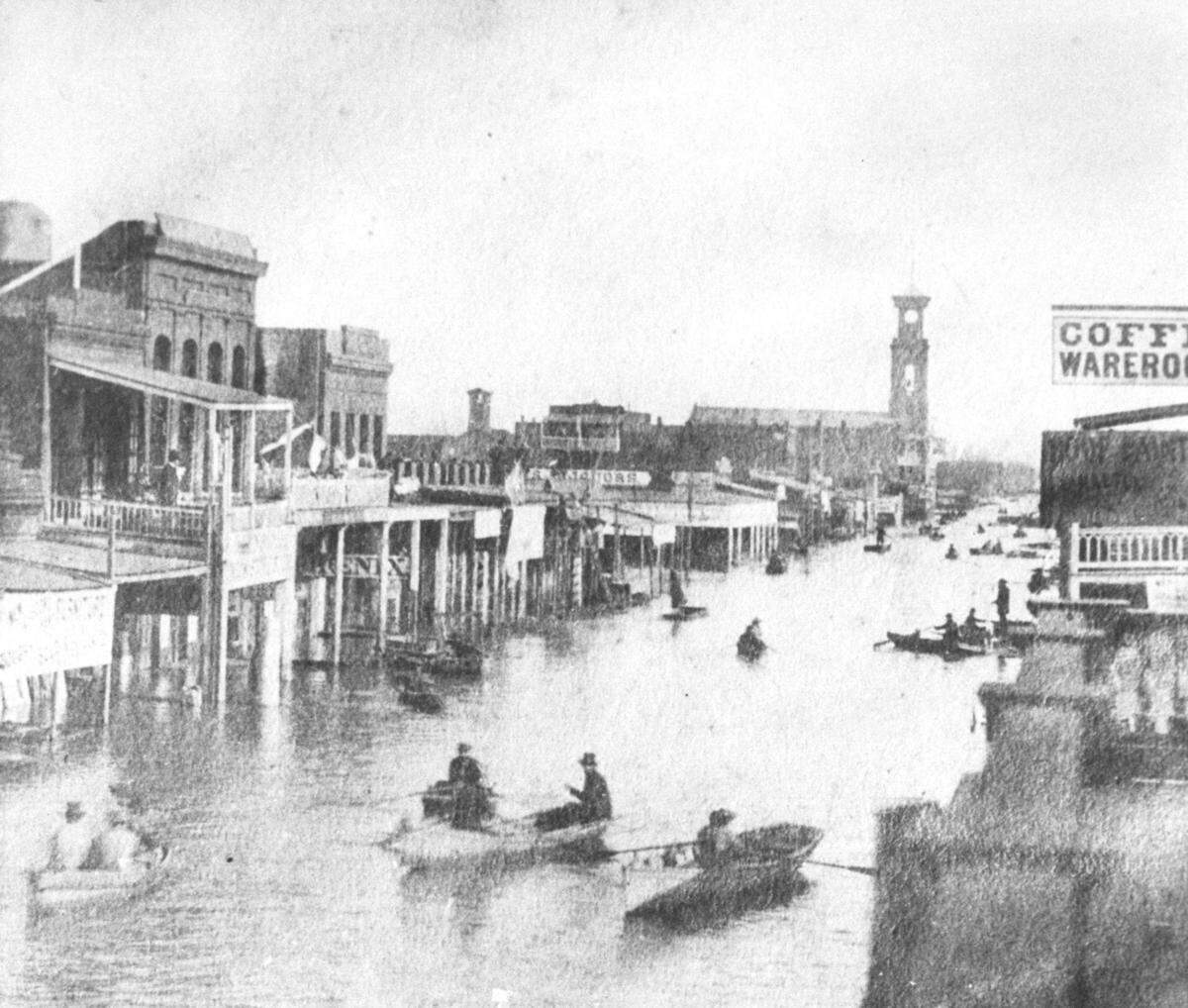
It didn’t relent until hundreds of miles of the Central Valley turned into an inland sea, leaving the city of Sacramento submerged beneath 10 feet of water.
The disaster became known as the Great Flood — 2025 is the 164th anniversary of the deluge.
“Rivers overflowed, levees were breached and vast areas were submerged under water,” the U.S. Geological Survey said.
By the time the crisis ended in January 1862, the flood had claimed an estimated 4,000 lives, the National Oceanic and Atmospheric Administration said.
An estimated 200,000 cattle in California drowned, “destroying possibly a fourth of the state’s taxable wealth,” the Monterey County Historical Society said.
The state legislature relocated from Sacramento to San Francisco for six months, and then-California Gov. Leland Stanford had to travel to his inauguration in a rowboat, according to geology-focused audio program EarthDate.
The floods did an estimated $50 million to $100 million in damage, equivalent to about $3.2 billion in 2025, NOAA said.
Here’s what to know:
What caused the Great Flood in Northern California?
Starting on Dec. 9, 1861, Northern California experienced more than 40 days straight of rain.
Sacramento recorded about 37 inches of rain over two months, while San Francisco received 34 inches, NOAA said.
Sacramento received almost 4 inches of rain in a single day during the deluge, according to “California Washed Away,” a 2007 research paper by Jan Null and Joelle Hulbert available on ResearchGate.
The storm was fueled by meteorologists now call an atmospheric river, EarthDate said, defined by NOAA as an area in the atmosphere that carries water vapor outside the tropics, EarthDate said.
The total rainfall that caused the Great Flood was the equivalent of 10 Mississippi Rivers of moisture, the Sacramento History Museum said in a video about the flood.
The storms dumped 10 to 15 feet of snow in the Sierra Nevada in December, but the warmer rain of the January storms caused an early snowmelt, turning rivers into “raging torrents,” Scientific American reported.
Overburdened river levees broke near Sacramento on Dec. 9 and Jan. 10, causing even more flooding problems, EarthDate reported.
How much damage did the Great Flood cause?
In time, the flood waters receded and Sacramento dried out with the rest of Northern California.
However, the Great Flood left behind millions of dollars in damage and thousands of lost lives.
“The destructive force of the floods was awesome: houses, otherwise intact and complete with their contents, were carried away in the rapids; horses, cattle, and barns were swept downstream for miles,” Scientific American said.
One in eight homes in California were destroyed, according to EarthDate.
The National Oceanic and Atmospheric Administration pegged the cost of the flood damage at about $3.2 billion in 2025 dollars.
Sacramento streets and buildings were raised in the 1860s and 1870s to avoid further flooding, the Sacramento History Museum said.
The museum offers tours of the underground spaces left behind.
How did storm impact Sacramento?
The incessant rain overwhelmed early efforts to protect Sacramento from floods.
“The flood water rose so rapidly that it imprisoned many people in their homes, unable to be rescued,” according to the Sacramento History Museum video.
“People in two-story buildings quickly moved belongings upstairs and many individuals waited on their roof to be rescued by boats passing by,” the museum said.
By early January, the city was submerged beneath 10 feet of muddy, debris-laden water, Scientific American said.
Stanford, who had been elected in 1861, had to travel from his mansion at 8th and N streets in Sacramento to the California State Capitol by rowboat to be sworn in on Jan. 10, Scientific American said.
“Following the expedited ceremony, with floodwaters rising at a rate of one foot per hour, Stanford rowed back to his mansion, where he was forced to steer his boat to a second-story window in order to enter his home,” the magazine reported.
The state legislature fled to San Francisco on Jan. 22 and didn’t return for six months, Earthdate said.
William Brewer, a chemistry professor who served on the staff of the first California state geologist, visited Sacramento in March 1862 and wrote to his brother about the conditions he found there, Scientific American said.
“Such a desolate scene I hope to never see again,” Brewer wrote. “Most of the city is still under water, and has been there for three months. A part is out of the water, that is, the streets are above water, but every low place is full — cellars and yards are full, houses and walls wet, everything uncomfortable. No description that I can write will give you any adequate conception of the discomfort and wretchedness this must give rise to.”
“Not a road leading from the city is passable, business is at a dead standstill, everything looks forlorn and wretched,” Brewer wrote. “I don’t think the city will ever rise from the shock, I don’t see how it can.”
Central Valley farms flooded, cattle drowned
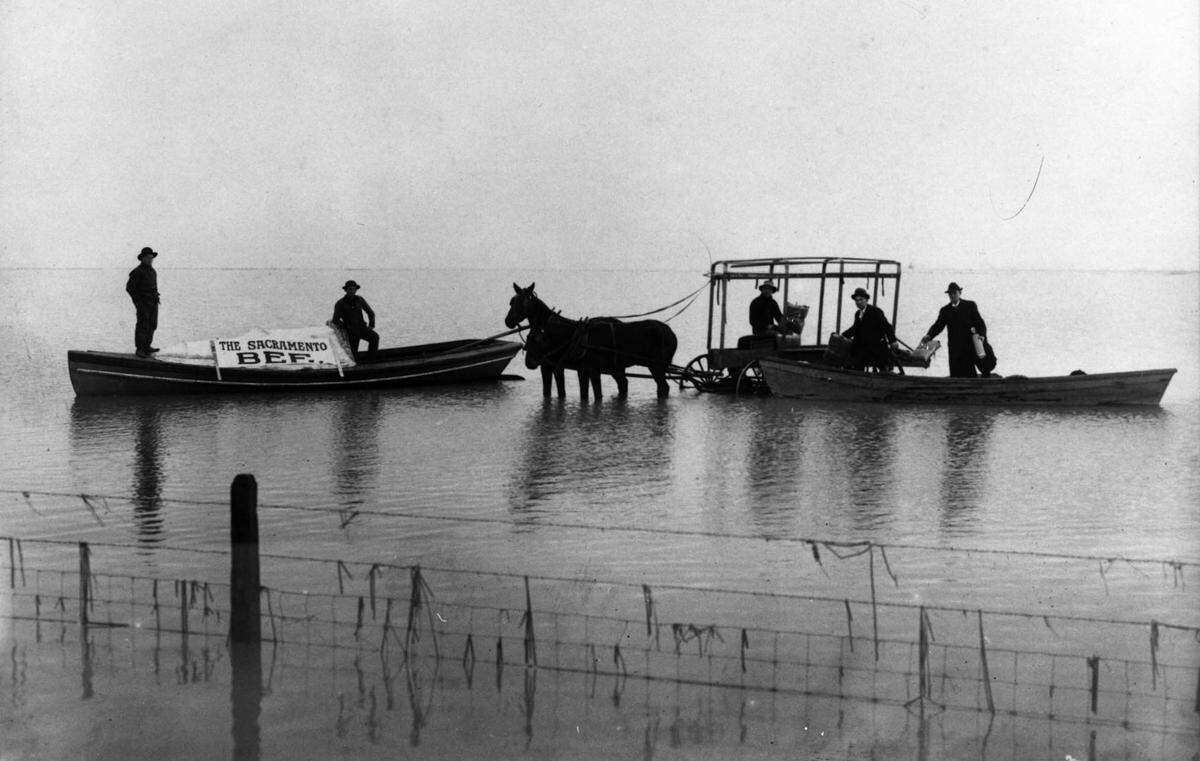
As a result of the Great Flood, the entire Central Valley became an inland sea, extending 300 miles long by 12 to 60 miles wide, EarthDate said.
“Thousands of farms are entirely under water — cattle starving and drowning,” Brewer wrote in January, according to “California Washed Away.”
A quarter of the state’s estimated 800,000 cattle drowned, “marking the beginning of the end of the cattle-based ranchero society in California,” Scientific American said.
An estimated 100,000 sheep and 500,000 lambs also died, Earthdate reported.
The town of Napa was inundated by 4 feet of water, while the San Ramon Valley was “one sheet of water from hill to hill as far as the eye could see,” the magazine said.
Near Fresno, the rain caused the Kern River to carve a new channel, according to a 2013 study on statewide flood risks by Flood Safe California.
“The Kings River washed away the entire town of Scottsburg, which was re-established on higher ground,” the study said. Flooding also damaged sawmills in the Fresno area.
Modesto, however, was spared as the city wasn’t founded until 1870, historians said.
Could California see another severe winter storm?
“A severe California winter storm could realistically flood thousands of square miles of urban and agricultural land, result in thousands of landslides, disrupt lifelines throughout the state for days or weeks, and cost on the order of $725 billion,” the U.S. Geological Survey said.
Working with other agencies, the geological survey created a weather model dubbed the ARKStorm Scenario — named for the atmospheric river phenomenon.
The model found that such storms are “projected to become more frequent and intense as a result of climate change.”
Such a storm would be an “economic catastrophe” for California, the ARKStorm Scenario model found.
“Extensive flooding is deemed realistic in the California Central Valley, San Francisco Bayshore, San Diego, Los Angeles and Orange Counties, several coastal communities, and various riverine communities around the state,” the U.S. Geological Survey said.
Such a storm is “plausible, perhaps inevitable,” the agency said.
This story was originally published December 9, 2025 at 6:00 AM.